

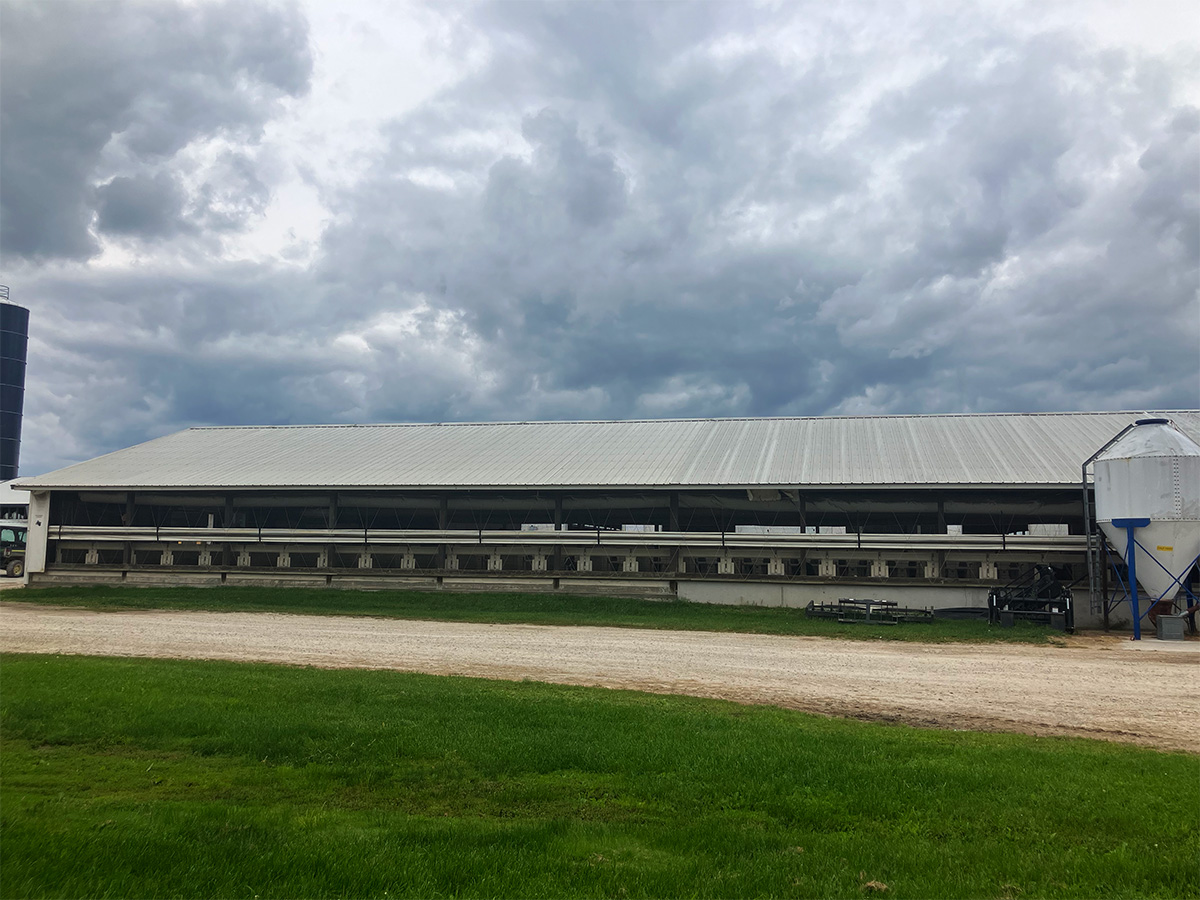
The Door County Environmental Council and several county residents took to social media and the Aug. 26 county board meeting to register their opposition to Gilbert Farms, Ltd.’s recent application to expand its Sevastopol dairy farm.
Members of the Door County Environmental Council and other concerned residents posted copies of the farm’s Wisconsin Pollutant Discharge Elimination System permit application on several local social media sites. The posts urged other residents to submit comments in opposition by the end of the required 30-day comment period required by the Department of Natural Resources. The DNR is the governing body for the application in Wisconsin, and the comment period ended on Aug. 22.
Gilbert Farms is seeking the WPDES permit in order to expand its dairy operations and become a Concentrated Animal Feeding Operation, or CAFO. Several members of the Gilbert family own the farm and it has been in operation for over 40 years.
The permit application raised concerns among some residents that the presence of another CAFO–there are two others in Door County currently–would endanger ground and surface water due to the soluble bedrock, called karst, and shallow topsoil in the area.
A public hearing regarding the permit will be held sometime in September or October, according to Brittiny Mueller, the DNR wastewater specialist responsible for the process.
Six residents opposing the expansion either submitted written testimony or spoke during the public comment section of the agenda at the county board meeting.
Gilbert Farms did not respond to initial requests for comment. The Door County Soil and Water Conservation Department has been responsible for regulation and enforcement of standards for the Gilberts for the last several decades.
Becoming a CAFO is not an easy way to make a bigger profit for the family-run operation, as there are “significant costs” to the additional regulation, according to Timothy Dahl, a conservationist with the department. As an example, well monitoring for CAFOs costs upward of $30,000 per year, he said.
CAFO basics
In Wisconsin, a CAFO is an agricultural facility that has 1,000 animal units or more, as defined by the DNR. Animals in CAFOs are kept and raised in confinement.
An “animal unit” does not refer to an individual animal, rather it refers to the weight of animal flesh. For dairy and beef cattle, 1,000 pounds is equal to one animal unit.
For example, a 1,400 pound milking cow is considered 1.4 animal units and a 500 pound heifer would be .5 units. If a farm’s animals total more than 1,000 pounds of weight, it is required to get a WPDES permit or reduce their animal population.
In Door County, the two CAFOs currently operating are S & S Jerseyland Dairy, which has 9,596 animal units, and Brey Cycle Farm, which has 1,788 animal units. There are also 35 active dairy farms, according to Greg Coulthurst, the county conservationist for the Soil and Water Conservation Department. In addition, Kewaunee County has five permitted CAFOs that are land-spreading in Door County.
There have been 185 nutrient management plans for Door County submitted in 2025 to the department, he added. That means there are that many cropland parcels in Door County that are being used for land spreading manure.
Gilbert Farms has a current dairy herd size of 1,443 animal units, which is equal to 688 milking and dry cows, 500 heifers and 275 calves. Their planned herd size by 2026 is for 2,430 animal units, which is equal to 1,150 milking and dry cows, 900 heifers and 400 calves, according to information provided by the farm on their WPDES permit application. The expansion means an increase of 68 percent.
Gilbert Farms’ 1,443 animal units is more than the amount allowed for a non-CAFO farm, and it means they were technically in noncompliance before they submitted the permit application, according to Mueller. The response from the DNR to a farm being in noncompliance regarding animal units is for the farm to either cull their herd or submit a WPDES permit request.
Since the Gilberts have submitted the application, they are currently in compliance, she said.
Once a farm’s WPDES permit and CAFO status is approved, the permit is good for five years. A farm cannot continue to expand their herd more than 20 percent of what they are licensed for or another 1,000 animal units (whichever is less), without having to go through a re-permitting process, Mueller said.
(The Gilberts’ permit application is no longer available on the DNR website, but will be re-posted publicly in advance of the hearing, according to Mueller at the DNR. Portions of the document are included in the Aug. 26 county board meeting packet.)
CAFO requirements by the DNR are stringent, Dahl said. They include:
- WPDES permit applications must be submitted 12 months before an operation becomes a CAFO. (this requirement is where the Gilberts Farm was noncompliant)
- A “zero” discharge standard for runoff to navigable waters must be maintained from areas where animals are housed, and manure and feed are stored.
- Plans for manure and process wastewater storage/handling systems and facilities must be reviewed and approved by the DNR.
- The farm must have a response plan in place for manure and non-manure spills and must properly dispose of deceased animals.
- All farms, including CAFOs, must have a nutrient management plan in place. NMPs detail manure and process wastewater application on cropped fields. This practice is called land- or field-spreading.
- Land-spreading must occur at setbacks from drinking water wells, sinkholes and fractured bedrock. Additional restrictions imposed by the Silurian Bedrock Performance Standards, apply to manure and process wastewater spread on shallow soils over fractured bedrock. Door County operates under these standards.
- Operators may not spread liquid manure on frozen or snow–covered ground unless it’s injected or tilled into soil right away, or there is an emergency outside the operation’s control.
- Operators may not spread solid manure on frozen or snow covered ground during February and March unless tilled into soil right away. Farmers must store solid manure during these months.
- A six month storage capacity for liquid manure is required with some exceptions.
Concerns
Six county residents entered public comments opposing another CAFO in Door County during the regular county board meeting on Aug. 26. Their concerns included: potential degradation of surface and groundwater quality, perceived discrepancies regarding amount of manure and wastewater that will be produced, lack of clarity regarding how much land Gilbert Farms has available for spreading, incidents of non-compliance and that the public hearing will be Zoom only, rather than in-person with a Zoom option.
Annette and John Vincent live about three miles from Gilberts Farm. They submitted a letter to the board and Annette also gave oral comment at the board meeting. Door County’s karst geology and shallow topsoil makes it an inappropriate place for any CAFO to be, according to her statements.
She cited the odor of land-spreading, toxic algal blooms caused by nitrates and unsafe drinking water as issues, indicating that if Door County’s water were compromised, it would have a severely negative impact on tourism, besides its impact on public health.
“Why are the governing bodies of Door County and the DNR letting one industry’s needs to override the concerns of hundreds of others who depend upon tourism for their livelihood?” Annette said.
Robert Sijgers, Door County resident and a director on the board of the Door County Environmental Council, submitted a letter and questioned perceived discrepancies in amounts of liquid waste generated by the farm.
Rod Miller, a Sturgeon Bay resident who lives one mile south of Gilbert Farms, spoke in person, and also questioned the permit documents that “contain troubling inconsistencies and clear risks for our community,” he said.
There is a lack of clarity as to how many land-spreadable acres the farm actually owns versus rents and that the community is “left unsure how much land is truly secure for long term manure application,” he said.
All of the opponents of the Gilbert Farms CAFO expressed a desire for the DNR public hearing to be conducted in-person, rather than only via Zoom. Since the Covid pandemic began in 2020, the DNR has conducted all of its public hearings via Zoom.
“We think it’s imperative that this hearing be in person with a Zoom option so that people impacted by this expansion will have the opportunity to look the decision-makers in the eye, ask their questions, and be part of the process,” Miller said.
The language in Wisconsin Administrative Code does not require in-person hearings, Mueller said.
During public comment at the board meeting, Forestville resident Christine Reid suggested the county board offer the use of its public meeting room for the hearing.
Door County Corporation Counsel Sean Donohue addressed the board, responding to the public comments, at the request of County Administrator Ken Pabich.
“CAFO permits are regulated almost exclusively by the Department of Natural Resources in the state,” Donohue said. “I want the board to keep that in mind that if there are concerns, voices or opinions they should be expressed with the DNR … the permitting of a case, there is little that we at the county can do other than voice our opinion to the DNR.”
However, before the state legislature adopted Silurian standards in 2018 for areas with karst geology, three counties – Brown, Manitowoc and Kewaunee – passed their own ordinances restricting or outright prohibiting winter manure spreading and manure spreading on porous bedrock and thin soils.
Permitting process and oversight
The DNR process for a Wisconsin Pollutant Discharge Elimination System permit begins with the farm submitting a permit application, followed by preparation of a draft permit and supporting documents. Public notice of the permit is given for 30 days, where the public is invited to comment. If five or more individuals request a public hearing, then one is scheduled and the permit application is re-posted before the hearing date.
Mueller will be the DNR representative conducting the Gilbert permit hearing, and the purpose is to collect comments and questions. No responses are allowed from the DNR at the hearing, she said, but she will take the comments back to the agency, where they will be recorded and responded to.
The DNR is responsible for making sure the farm is able to maintain the adequate amount of manure storage days and has enough land secured for land-spreading, she said.
The DNR has no authority over issues like odor, animal welfare, traffic, noise, etc. Those issues should be taken to the state legislature and local representatives, Mueller added.
The Door County Soil and Water Conservation Department has a long history with the Gilberts, according to conservationist Dahl, and has been the regulatory body responsible for enforcing compliance and standards. If the farm becomes a CAFO, oversight and enforcement will become the DNR’s responsibility, Dahl said.
As a result of working with the Gilberts for so long, he added, the department knows their situation well.
“They’ve been operating just below the CAFO threshold for years,” Dahl said. “Their barns are getting old. They need new barns and have to add milk production to afford to build new barns.”
Neighboring issues and Silurian standards
In 2021, a federal study was conducted, driven by citizen advocacy groups like Clean Water Wisconsin, to irrevocably confirm manure-contaminated wells were causing illness, and to quantify the public health burden. The study did just that, and found a direct link between manure content in Kewaunee’s ground water and gastrointestinal illnesses in the human beings drinking that water. This was not news to residents, who had been dealing with well water contaminated by bacteria like E.coli for years.
Cows outnumber people 5-to-1 in Kewaunee County and there are more dairy cattle there than in any county in the state, as reported by Knock in 2024. Door County has 20,826 cattle and calves, according to the 2022 USDA Census of Agriculture which is performed every five years and was released in 2024. Kewaunee County has 105,220 cattle and calves, according to the survey.
Kewaunee County may have five times the amount of cows that Door County has, but they share the same fractured karst bedrock and shallow soils. And while there are 19 CAFOs in Kewaunee versus Door County’s two, some Kewaunee farms haul manure north of the county line and land spread on Door County fields.
Wisconsin code NR 151 regulates land-spreading of manure. On July 1, 2018 the state adopted additional regulation for areas like Kewaunee and Door counties with karst bedrock and thin soils, as a result of the Kewaunee issues. These “Silurian Standards” were also adopted as ordinances by both counties shortly thereafter.
The adoption and enforcement of these regulations is a “limiting factor” to how much manure can be applied to land in Door County, Dahl said.
There is no way Door County will ever be able to support a lot of CAFOs, because there is simply not enough land to allow it, he added.
But according to those opposing Gilbert Farm’s CAFO expansion, even one is too many.
“Door County…is not an appropriate location for any kind of CAFO,” Annette Vincent said.