

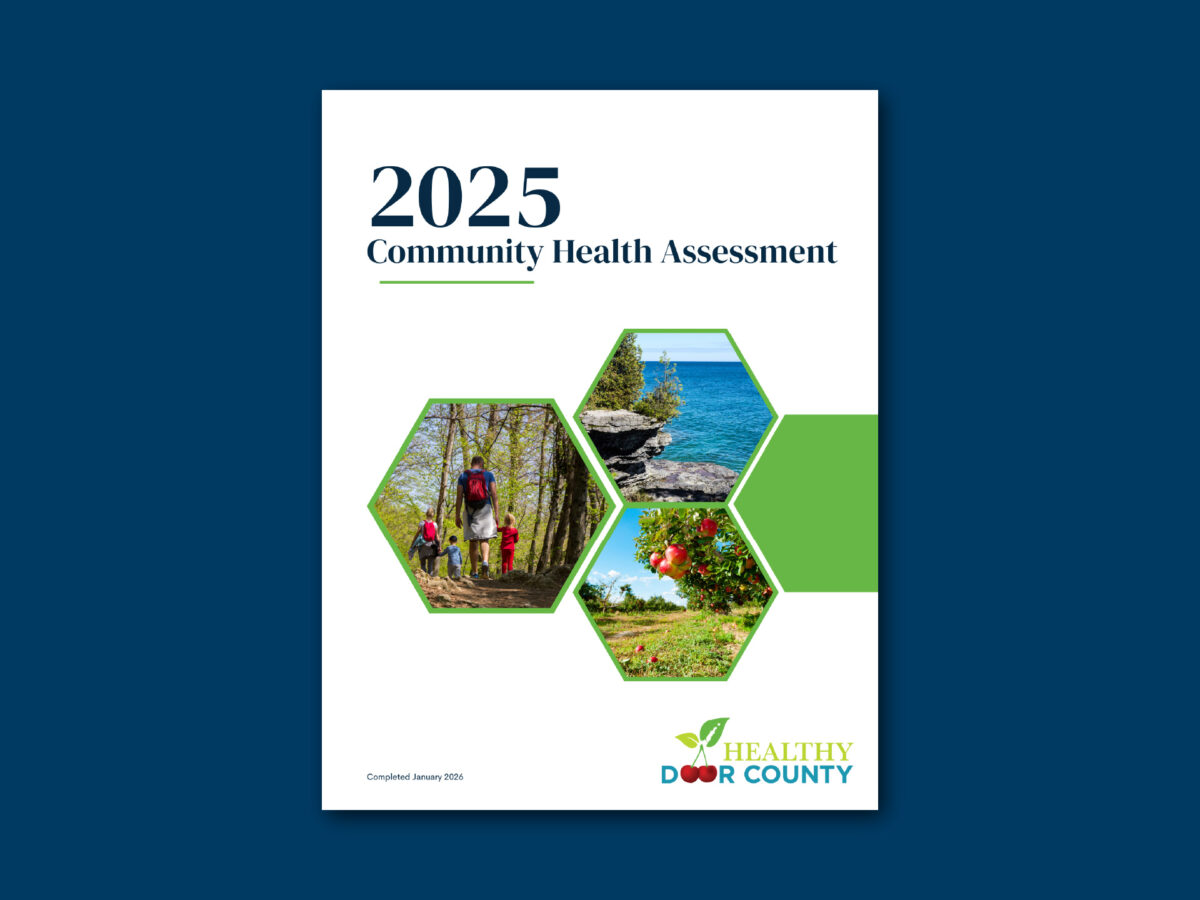
The Door County Community Health Assessment report, released in early February, identified housing affordability, livable wages, social isolation, and Door County’s aging population as priority areas for residents. More than 900 people responded to the 2025 CHA, administered by the local public health department and Door County Medical Center, along with other community partners.
In Wisconsin, public health departments are required by the state to conduct an assessment every five years, and nonprofit hospitals are required by the IRS to conduct one every three years. Both are also required to use the assessment information and create an action plan to address community health needs.
The assessment uses three different data collection methods–a public survey, focus group discussions and a stakeholder questionnaire. The public survey portion garnered 973 responses, a nearly four-fold increase from 2023, when 242 people filled out the survey, Public Health Strategist Shauna Blackledge said.
Public health and DCMC collaborated on the most recent CHA, as the timing cycles aligned. Working together with the hospital and other community partners––United Way of Door County, the Door County Economic Development Corporation and the UW-Madison extension office–for the 2025 assessment led to one of the most comprehensive collections of data yet, according to Blackledge.
Besides the public survey, five community focus groups were held, and a stakeholder questionnaire was returned by 22 community leaders. The focus group discussions, called “community conversations,” represented four distinct populations, including families with young children, young adults, rural residents and Hispanic residents.
Social isolation is a primary concern
Social isolation and loneliness emerged as the top concern after safe and affordable housing in the community conversations part of the assessment. It also was an issue in the top five of those identified by survey respondents. Thirty-one percent of Door County adults said they experience loneliness regularly, according to assessment data.
Cynthia Germain said social connection is “foundational.” Germain is the president of Do Good Door County, an agency dedicated to improving the aging experience here.
Feelings of loneliness and isolation can lead to poor health outcomes for the person experiencing them, she said, but there is also an impact on the community overall, in the form of absence.
“If I’m socially isolated, I’m not giving what I have to the community,” Germain said. “And the community is not getting what I have to give either.”
Cathy Gos is a 68-year-old widow who lives alone in an apartment in Sturgeon Bay. Connection means spending time with others in her age group, usually in person, a few times a month, she said, but it is something she struggles with for various reasons.
Gos has a disability that makes riding in many vehicles uncomfortable, so she mostly relies on herself for transportation. She has attended ADRC bingo a few times, but said she felt like she did not belong. She attends a local church. Gos has adult children living nearby, but she does not see them very often, she said. She spends most of her days alone in her apartment, occasionally visiting an elderly neighbor or friend across town.
Winter makes isolation worse, Gos said. When the weather cooperates, she is able to get out for walks and that helps. Gas and auto maintenance can be costly on her fixed income, she said.
Young adults and parents are another group that said they want more social connection during community conversations. One parent described their need to be more than “mom” and said: “I feel like for my mental health and some of the challenges I’m seeing, (they) really revolve around having some socialization time for myself.”
Human beings need social connection for their mental well-being, Do Good’s Germain said, but mental health problems can prevent some individuals from making the needed social connections.
“I know I have some depression, and part of it may be my fault because I’m not more social,” Gos said. Accessing resources like therapy is difficult and costs money, she added, and she is already barely “breaking even” on Social Security and a small pension.
The housing connection
2025 CHA data showed 45.7 percent of respondents ranked housing as a concern. It was the number one priority identified, according to Public Health Strategist Blackledge. Housing was one of the highest-ranking priorities in the 2023 CHA as well.
Door County has high housing costs and wages in industries like retail and hospitality remain modest, according to the assessment report. Thirty-six percent of survey respondents also reported “jobs with livable wages and benefits” as an area that needed improvement. Thirty-nine percent reported a household income lower than $60,000.
The Door County Economic Development Corporation reported that the average worker in Door County earned about $44,000 annually in 2024, compared to the national average of about $71,000.
The average rent in Door County in 2025 was $1,489, and the Wisconsin average was $1,583. According to Zillow, the average home price in Door County was $418,951, compared to $331,195 in the state in 2025.
DCEDC partnered with DCMC and the public health department on the assessment. It is also the lead on housing and workforce initiatives that come out of the CHA. Partners meet quarterly to discuss and advance priorities, Devin Vandertie, DCEDC’s director of business development said.
Business growth, wage stagnation, and affordable housing are intertwined with community health, she said. Economic development has evolved to address workforce needs, according to Vandertie.
“Economic development used to be about attracting businesses,” she said. “But now it’s about making sure we have the workforce infrastructure to support them, and housing is a huge part of that.”
Affordable housing and childcare are the most significant barriers to hiring and retaining employees, according to a 2024 employer survey by DCEDC.
More people in Door County are reaching retirement age, which compounds issues of housing affordability. Retirees, like Gos, are often on fixed incomes. She is careful with the money she has, she said, and her rent and utilities take over half her income.
Several respondents indicated their incomes were not keeping pace with costs of living: “The housing is not affordable. Every time we get a raise, our rent goes up and takes whatever extra we are earning. It is difficult to save money. If we didn’t have a paycheck, we would quickly be without a place to live,” according to one community conversation participant.
“The cost of living, food, utilities, rent is dangerously close to my income,” said another.
The connection between affordability concerns and isolation is pretty clear, according to Blackledge. Mental well-being, social participation, and mobility are all affected by fixed incomes, housing costs and financial strain.
Additionally, housing stability affects everyone, not just those looking for a home, Vandertie said.
“Just because you don’t have kids doesn’t mean you aren’t impacted by child care,” Vandertie said. “Housing works the same way. If we can’t secure nurses or other essential workers because they can’t find housing, that affects quality of life for the whole community.”
Participants suggest solutions
Assessment participants provided insight on what might help ameliorate social isolation.
More accessible, affordable transportation is one area that can be improved, according to some respondents. Though Door County does have a public transportation network, for some residents who depend on it and have no vehicle of their own, costs can add up.
During community conversations, some residents living north of Sister Bay lamented the options for reliable public transportation in that area of the county: “Aside from the bus in Sister Bay, there is no reasonable option for any sort of public transportation. There are very few Uber or Lyft drivers here, and because of this, it is very hard to depend on them. You might be able to get a ride to your location, but not able to get a ride home.”
“I think having a no-membership place, available nights and weekends, with activities for those 55 plus, no alcohol served, maybe sell healthy food items, would be appreciated in the area,” suggested Gos in Sturgeon Bay.
Both older adults and young people expressed a desire for more activities that are not centered around bars or alcohol. Alcohol-free social spaces with affordable or free programming would be ideal, according to Gos.
“There are no evening activities to participate in without having to spend a bunch of money,” she said. “And it seems like the majority of events are serving alcohol. It’s not that anyone is against alcohol, but it often results in rowdies who ruin the night for others.”
One young adult said: “Other than a bar, it’s hard to find something that’s open after five,” and several other young adults who took part in focus groups made similar statements.
Even when housing is not a challenge, often social isolation is, DCEDC’s Vandertie said. If an employer hires for a well-paying job like an engineer, for example, and they are able to find housing, they may still struggle socially, she said.
“We hear from employers who can get someone here for a year or two, but if they don’t build social connections, it’s hard to get them to stay,” Vandertie said.
Plans and goals implemented
Public Health, DCMC, DCEDC and other partner organizations will develop a leadership team to create the 2026-2030 Community Health Improvement Plan, or CHIP, based on information collected in the assessment.
The 2023-2025 CHIP identified access to housing and social isolation as top priorities and listed several goals to help with those issues.
One of those goals was to improve mental health through social support networks. While a Door County chapter of National Alliance on Mental Illness, or NAMI, was a component of those goals, it has yet to be established, according to Blackledge at Public Health.
Door County’s ratio of mental health professionals to residents has been historically very low–one provider for every 710 residents, compared to the state ratio of 1:350, but the data has not caught up with reality, Blackledge said.
DCMC expanded its behavioral health department, hiring 12 mental health professionals in the last year. Most of them, along with county Health and Human Services Department staff, are co-occurring therapists who can treat mental health and substance use disorders together. Once these providers are factored into the data, the ratio is almost cut in half, Blackledge said.
Another outcome of prioritizing mental health and social connection is Credible Mind, a free, anonymous online mental health platform. Hundreds of resources and access to accurate information regarding mental health are available. There is also a community resources section on the platform, Blackledge said, which connects to local providers and therapy groups.
Credible Mind does not directly “solve” social isolation for people, Blackledge said, “but it gives a landing place for what people could be looking for to find social connection in the mental health space.”
Simply having more mental health and substance use resources and providers does not automatically mean more people are getting the help they need. The CHA identified a significant gap between awareness of services and residents’ comfort using them.
Eighty percent of survey respondents were aware of mental health services, and 59 percent of total respondents would not be comfortable using them. Seventy-two percent of survey respondents were aware of substance use services, and 49 percent of total respondents would not be comfortable using them.
Some of that is due to a small community, where “everyone knows everyone,” and mental illness and substance use still carry stigma, Blackledge said.
The Alcohol and Other Drug Abuse Coalition, United Way and the Door County YMCA have been collaborating to create more alcohol-free spaces, Blackledge said. Stephanie Short, a Community Impact Coordinator with United Way, is leading the coalition to normalize sobriety, Blackledge added.
Short has been asking bars and restaurants to offer more non-alcoholic options, according to Blackledge, and the idea is gaining traction. Door County festivals this season had more non-alcoholic choices than ever, she said.
The AODA Coalition has already hosted yoga in the park, bowling outings, a Christmas-light viewing bus, a summer picnic and other programming that appeals to younger adults who don’t drink.
In regards to housing, the Attainable Housing Committee, made up of realtors, nonprofits like Habitat for Humanity, employers and planners, meets every other month, according to Vandertie at DCEDC. The organization is the lead for that committee, she added, and its purpose is to share updates and coordinate action.
A DCEDC staff member checks in with local landlords every month to update its rental inventory, Vandertie said. Even with new units being added regularly, rental vacancy rates in Door County remain extremely low. The inventory is a resource for local employers looking for housing for new hires, she added.
Next steps
Now that data is collected and reported, CHA partners will work together to create the next CHIP, Vandertie and Blackledge said.
Do Good Door County is working on some ideas to expand transportation for older adults, organization president Germain said. Do Good is also working with DCEDC on a mentorship matching program called M Squared.
“It’s meant to take those older adults who have skills, experiences and education and to filter them back into the community,” Germain said.
As far as housing, DCEDC recently issued a Request for Proposal from companies to initiate another county-wide housing study–the last one was in 2019 and used data from 2017.
Vandertie anticipates the study will show the county needs more single-family houses, she said, and more municipal and developer partnerships to surmount infrastructure costs.
Housing solutions need creativity, Vandertie added, and also legislative change. DCEDC is keeping an eye on some changes that may incentivize employers to provide housing, she said.
Beyond data collection, the assessment works as a tool to improve things like housing and social connection that are foundational to a community’s overall health, according to CHA partners.
“I love highlighting this as a core function of public health. It is state-mandated and grant-funded that we do this,” said Public Health’s Blackledge. “I love this part of my job where I get to coordinate efforts to find out what the problems are and how people experience the problems…We want to be that vehicle and coordinator for change in the community and make sure people know that’s part of what we’re here for. It’s not just shots.”
Correction: While social isolation was the top issue that arose in community conversations, assessment facilitators gave more weight to the survey portion based on participation. The themes that emerged from that determination, in order, were: housing, livable wages, child care, aging population and social isolation. An earlier version of this story incorrectly identified social isolation as the second-highest concern after housing in the assessment overall. A portion of the story has been revised to correct that error.