

The Door County Board of Supervisors addressed a variety of action items on its March 24 agenda, demonstrating just how wide-ranging county business can be. The March meeting was the last meeting of the board in advance of the April 7 election. With six new members elected on Tuesday, almost 30 percent of the board will be new faces.
Decisions ran the gamut from public safety and emergency declarations to staff salaries and environmental protection.
Weather emergency
Blizzard Elsa ran her course from March 14 to 15. She was clearly an emergency for most of Door County. The peninsula and island were covered in 30 to 33 inches of snow, hit by wind gusts in excess of 45 miles per hour, and piled on by snow drifts up to 8 feet in some places.
In order to get outside resources and funding from state and federal agencies for help with the cleanup efforts, the county had to officially declare Elsa an emergency. Board chair David Englebert and County Administrator Ken Pabich did so on March 17, and the board unanimously approved the declaration at their regular board meeting on March 24.
Emergency Services Director Jeb Saelens described residents in skid steers clearing the way for ambulances, and county highway department staff just wanting the snow and wind to end so they could keep roads clear.
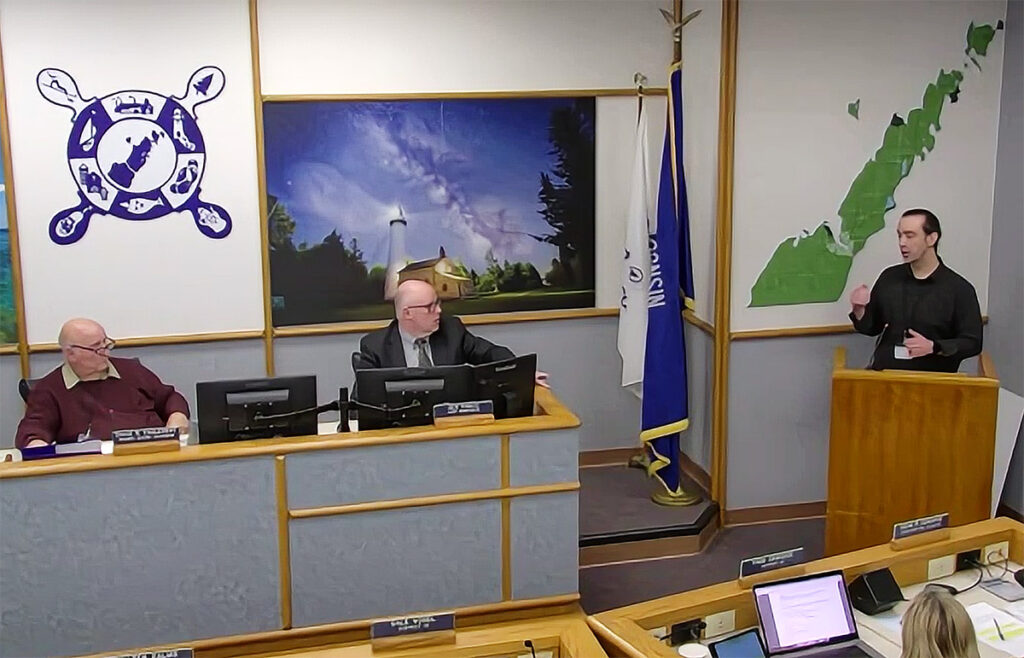
The county highway department is its own entity, according to Highway Commissioner Thad Ash. It operates like a regular business, he said, and has contracts with the Wisconsin Department of Transportation, Door County government and most of the towns and villages on the peninsula.
The department bills for its work like a contractor, based on who owns the road–state, county or municipality. But for county highways, there’s no outside reimbursement from WISDOT or the municipalities, so when Blizzard Elsa required longer hours and more cleanup, that cost fell on the county.
Many highway department employees worked 90 hours during Elsa and its aftermath, according to Pabich. On March 24, the day of the county board meeting, cleanup was ongoing, he added.
The county will be responsible for a “chunk” of the costs, Saelens said, but they are working with municipalities and state and federal guidelines to leverage as much funding as possible for an unprecedented weather event. The emergency declaration is the fundamental mechanism to do just that.
Operational expenses, staff salaries
The board determined salaries for the sheriff and clerk of courts in advance of the candidate filing date for the election in November, as required by the state.
“It was a fairly lengthy and long discussion in our admin meeting,” Supervisor Todd Thayse said.
The committee used data from 15 other comparable counties, including wages and how they are established, to determine Door County’s compensation structure, according to County Administrator Ken Pabich.
The board approved the salary changes, with percent raises each year, as follows: (These numbers do not include benefits.)
- For the Door County Sheriff, the starting salary in 2026 is $110,379, $119,766 in 2027, $122,761 in 2028, $125,830 in 2029, and $128,975 in 2030. The sheriff’s salary would increase about 17 percent in the four-year period.
- The Clerk of Circuit Court will have a starting salary of $79,301 in 2026, $87,859 in 2027, $89,616 in 2028, $90,513 in 2029, and $91,418 in 2030. The clerk’s salary would increase by about 15 percent in four years.
For comparison’s sake, two counties that are similar in demographics are Manitowoc and Bayfield. In Manitowoc County, the Sheriff’s salary for 2026 is $107,358 and the Clerk of Circuit Court’s is $83,033. In Bayfield County, the Sheriff’s salary for 2026 is $89,444 and the Clerk of Circuit Court’s is $74,155.
Wisconsin counties approach setting salaries in a variety of ways, from fixed schedules–like Door County–to formulas based on internal pay scales.s.
Proclamation made
The visitor and tourism economy is “one of the most consistent and reliable economic engines” in Door County, Jon Jarosh said. Jarosh is the chief communications officer and interim CEO for Destination Door County and gave a brief report highlighting the economic impact of tourism to county board supervisors on March 24.
The board subsequently approved a resolution to designate May 3-9 as “Tourism and Travel Week.”
Last April, the board created specific rules for adopting county-wide proclamations like the Tourism and Travel Week one. The rule states: “to be considered by the Door County Board of Supervisors, a proclamation must be sponsored by the County Board Chairperson and directly impact the County’s programs, services, or budget. A proposed proclamation shall specify how it directly impacts the County’s programs, services, or budget.”
Travel and tourism certainly impacts county programs, services and budget, according to the information provided by Jarosh. In 2024, visitors spent $523.2 million in direct dollars, and had a total economic impact of $651.2 million across the local economy. Direct dollars refers to money visitors spent on lodging, food and beverages, transportation and attractions.
Money generated by a business purchasing goods and services–for example, a restaurant ordering ingredients–has an indirect impact on the local economy and supply chain. Additional economic impact occurs when employees spend income locally, income they earned as a result of visitor activity–a bartender buying groceries, for example. This indirect and induced impact on the local economy accounts for $128 million of the total economic impact.
Almost half of visitor spending in Door County was on lodging in 2024, according to the economic impact report produced by Tourism Economics for DDC. Food and beverage spending accounted for about 20 percent of the visitor economy that same year.
The Door County Community Investment Fund, through the Door County Community Foundation, was established three years ago to reinvest room tax dollars into local communities. The fund has awarded almost $3.5 million to 66 local projects since 2023.
The grant program is a mechanism to use room tax dollars to support projects that impact both local residents and tourists. The county board received its fifth grant from the fund in March, toward public safety barriers, for a total of $342,885 towards county projects in the last three years.
Public safety
A unique partnership between Door County Emergency Management and DDC resulted in the county receiving a $100,000 Community Investment Fund grant for safety barriers, according to Jeb Saelens, Door County Emergency Management director.
Emergency Management has purchased 108 mobile vehicle barriers with the grant funds, Saelens said. The barriers are designed to protect people and property against intentional or accidental vehicle ramming situations, he said, and can be used for festivals, farmers markets and other outdoor public gatherings.
The barriers will be available as soon as Memorial Day, according to Saelens, and all of the barriers may be deployed to bigger festivals, or spread around as needed.
“We want to get these out to as many places as we can and just protect the widest amount of people. It’s all going to be very situationally dependent,” he said. “How can we do the most good for the largest part of the county?”
Environmental protection
European Frog-Bit, Spiny Waterflea and Starry Stonewort have a number of things in common besides their catchy names. They are water-dwelling creatures that are invasive to Door County, have the capacity to reproduce asexually–therefore, more quickly than other organisms—and are the subjects of two separate resolutions approved unanimously by the county board.
A total of $33,988 in grant funding from the Wisconsin Department of Natural Resources was accepted by the board on behalf of the county’s Soil and Water Conservation Department, to help control these invasive species.
European Frog-Bit is “basically a little tiny lily pad,” County Conservationist Greg Coulthurst told the board. Discovered in Door County about five or six years ago, Coulthurst said department staff has been removing 200-500 pounds of the aquatic plant from county waters every year since then. Two new sites for Frog-Bit were found last year, he added, and “it’s important we stay on top of this.”
The primary method of removal is by hand, he said, and staff collects and composts the plant. Without mitigation efforts, Frog-Bit will take over an ecosystem because it floats on the water’s surface, blocking sunlight so the native plants below die. It also reproduces asexually, which means it reproduces and expands very rapidly, Coulthurst said.
The DNR is providing a $10,000 grant to control Frog-Bit in the county. No new budget funds are being requested, and there is no requirement for matching funds.
Spiny Waterflea and Starry Stonewort are also aquatic invasive species targeted with a DNR grant. The Spiny Waterflea is a zooplankton, and eats smaller zooplankton. Predator fish avoid eating the creature because of its long barbed spine. No Spiny Waterfleas have been found in inland lakes yet and “we want to keep them out,” Coulthurst said.
Starry Stonewort is an algae that forms very large mats on the bottom of lakes, reducing native aquatic plant diversity and preventing fish movement and spawning activity. When the mats grow to the surface of the lake, they can impact recreational boating and other activities, according to information from the Door County Invasive Species Team website.
DCIST works with the Soil and Water Conservation Department to identify, prevent the spread of, and reduce harm caused by invasive species. Most of the funding is provided by grants like the ones approved during the March board meeting.
The grant targeting Spiny Waterflea and Starry Stonewort is for $23,988. The total project cost is $32,214. The difference will be made up by Soil and Water’s existing budget and donations, Coulthurst said.
Seeking state funding
The largest expenditure in county and municipal budgets in Door County is transportation, and it makes up about 18 percent of overall county spending.
This is true for most rural counties and municipalities in Wisconsin. Shared revenue from the state is one way the county receives financial aid for costs related to roads, public safety and more.
According to a resolution supported by several other Wisconsin counties, it is not enough, and “despite modest increases from the state over the years, transportation aids to local governments remain insufficient to keep pace with inflation and rising construction costs, leaving many communities funded below 2000 levels, in real dollars.”
The resolution passed the Door County board unanimously, calling on state lawmakers to enact comprehensive and sustainable transportation funding to county governments and municipalities.
A state legislative solution to transportation funding has been “a hot topic for a long time and decisions haven’t been made,” according to District 2 Supervisor and Board Vice-Chair Todd Thayse.
The Wisconsin Counties Association identified transportation infrastructure as a primary issue in its 2025-2026 Legislative Agenda and will be continuing to lobby for that and other state legislation to help counties.
Parks and open spaces
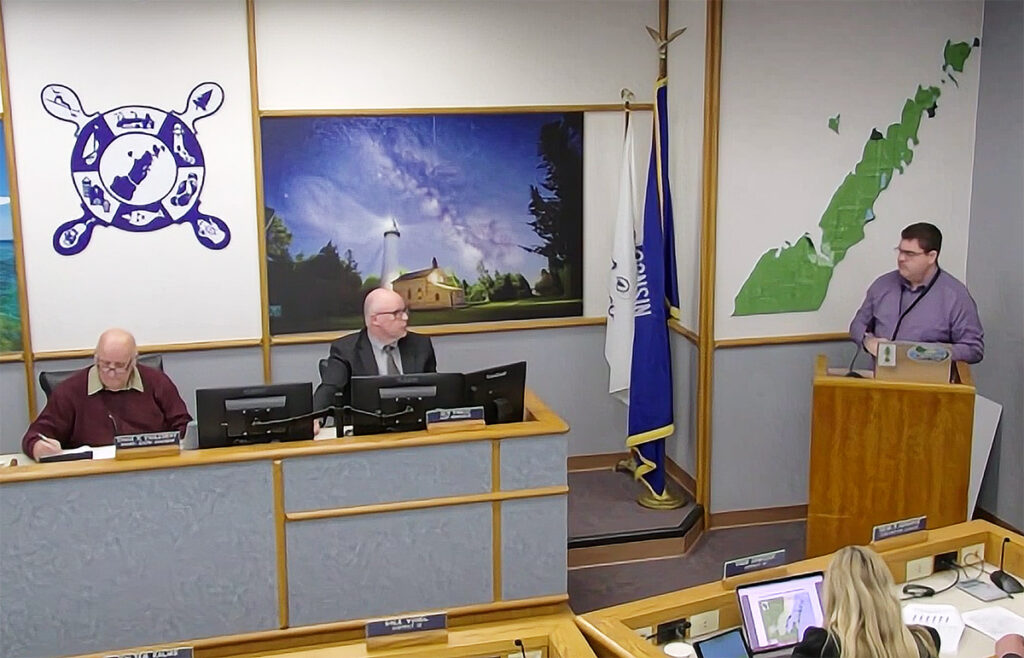
Door County has five state parks, more than any other county in the state, and has 21 county parks, giving it one of the highest concentrations of protected public land in Wisconsin. Managing those spaces requires funding. During its March meeting, the county board approved a 2026-2030 Door County Parks and Open Spaces Plan that will help facilitate some of that funding through grants, according to Facilities and Parks Director Wayne Spritka.
“This plan does not change how we operate and manage our parks,” Spritka said. Rather, the plan now includes “our five year hopes and dreams of things we want to accomplish…they’re in the plan and it’s easier to write grants for them now,” he added.
Land conservation, public engagement, and accessibility are all highlighted in the draft. When those issues are addressed by a plan, Spritka said, it will improve the county’s score when applying for grants from non-local funding sources like the Wisconsin Department of Natural Resources, the U.S. Fish and Wildlife Service and the U.S. Department of Agriculture and Rural Development.
State mandates
According to Chapter 980, Wisconsin statute mandates counties to provide appropriate housing for sexually violent persons, or individuals convicted of a sexually violent crime on supervised release.
In 2021, the county fulfilled the mandate by constructing two double-occupancy homes and installed two concrete pads with utility infrastructure for future potential residence needs.
The county was ordered by Circuit Court Judge Jennifer Moeller to provide an appropriately accessible residence for an individual with disabilities on supervised release in September of last year.
The county received one bid for the construction, from Perret Homes, in the amount of $136,000 for the home and an additional $12,000 for an accessibility ramp and $7,100 for upgraded skirting materials. The county Highway and Facilities Committee approved the bid and added $7,000 for plumbing and electrical and possible conditions placed by the City of Sturgeon Bay’s Aesthetic Design Review Board.
Chapter 980 housing is located next to the Justice Center in Sturgeon Bay. The board voted unanimously to transfer a total of $162,100 from its housing reserve account and the general contingency account for the project.