

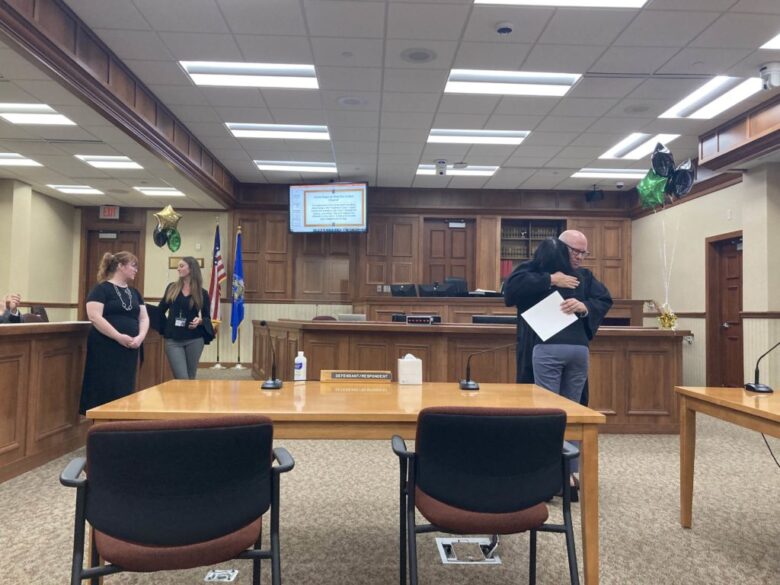
A year ago, Door County’s Treatment Court Steering Committee decided to press pause on accepting new program participants until the county was able to hire more staff. Program funding was also removed from Door County’s 2026 budget.
The 11 remaining Treatment Court participants were allowed to finish the program, and the last one graduated in March.
At the committee’s June meeting, members learned the program would start accepting participants again in July because it has enough staff to operate again. The Door County Health and Human Services Department has a state matching Treatment Alternatives and Diversion grant available to fund it, according to Deputy Director Kevin Brennan.
The county will contribute $66,000 of local money to match the grant requirements, and will receive $200,000.00 in TAD funding. The matching funds were put back into the 2026 county budget, according to HHS Director Joe Krebsbach.
Last June, there were five vacancies in the HHS behavioral health division, including for a behavioral health clinical supervisor and AODA coordinator, both supervisory positions. The department’s deputy director position was also vacant.
Since then, the deputy director position has been filled, and the other two lead positions were combined into one, which is also staffed.
Three counselor positions have remained vacant, but one substance abuse counselor is starting in July. HHS is still recruiting for a court services case manager and a contracted substance abuse counselor, according to current Behavioral Health Clinical Supervisor Kristin Deprey.
Substance use landscape
Brennan started as HHS deputy director in August 2025. “The vacancies in leadership were traumatic (for the department),” he said, and when he and Deprey came on board, things stabilized.
HHS behavioral health staff is committed to building the county’s substance use program now that positions are being filled, he said. Focus remains on specialized substance use disorder treatment like group therapy, peer support, sober living and using technology to improve access to care, according to Brennan.
Group therapy started this week, he added, and the county is looking for a partner to restart its sober living programming. A recovery app that tracks sobriety, provides daily inspiration and has 24/7 access to peer support is also available now for county SUD clients, he said.
There are 16 people on the HHS waitlist for SUD-specific counseling and the department is working on getting more counselors certified for SUD treatment, Brennan said.
The top three substances listed by people seeking HHS resources for SUD are alcohol, marijuana and methamphetamines.
“Opioids are a close fourth,” Brennan said, and the need for services remains. Treatment Court is a big piece of the county’s programming, and there are several residents who meet the criteria for it, “once we open the door,” he added.
County program impacts; one woman’s story
Elizabeth Huettl never participated in Treatment Court herself, but she said its influence shaped her recovery through the county’s sober living house and changed how her probation officer approached people with substance use disorder. She also witnessed a friend graduate from Treatment Court successfully and maintain their sobriety.
Huettl’s substance use spiraled out of control when she started using methamphetamines nearly a decade ago, she said. She served almost seven years in prison as a result, and when she was released in December of 2024, she had nowhere to go.
A woman she met in recovery got Huettl admitted to the county’s sober living home for women, which opened in November of 2024. She moved out of the home and into privately run NEW Door Sober Living in Sturgeon Bay after just a few months. That situation fell apart quickly, she said, and resulted in Huettl and another resident being told to leave.
She was homeless for about a week, she said, but was able to get admitted back into the county’s sober living home, where she remained for the next six months.
Her second experience at the county’s house was better, Huettl said. “They had it more together, there was better communication, it was more structured than it was the first time around. They kind of were just winging it at first, but they finally figured it out, and it was a great experience.”
The county’s sober living home closed in May.
Much of the home’s structure used Treatment Court protocols, she explained, which she knew about from a friend who was a participant in that program and lived at the house with her.
The program practices have stuck with her, she said. “I still feel like I should be filling out my Rule of 40 some days.” Treatment Court participants are expected to perform 40 hours of productive activity every week, whether it is community service, work, recovery meetings or education.
Even though not all residents in the sober living house were part of Treatment Court, they were all required to fulfill the Rule of 40, Huettl said. They also were expected to submit to regular urine analysis, another requirement shared with Treatment Court participants.
Between those standards and a nightly curfew, she said the structure has carried over into her life after successfully graduating from sober living last summer.
Huettl thinks probation officers and other criminal justice system employees gain more understanding of SUD and learn methods that help when they receive Treatment Court training.
All team members receive Wisconsin standardized training on best practices, evidence-based substance use, mental health and trauma treatment, medically-assisted treatment and psychiatric medications, complementary services, behavior modification, community supervision, procedural fairness, drug and alcohol testing, and legal and constitutional standards.
“She treats me like one of the treatment court participants,” she said, referring to her own parole agent, who has served on the Treatment Court board. “She makes sure that I’m still in therapy and everything like that.”
Huettl also described positive interactions with county jail staff when she served some of her time there eight years ago. She was four and a half months pregnant with her youngest child when admitted, and jail staff exhibited “extreme care” for her throughout the pregnancy, birth and postpartum period, she said.
Huettl said she knows there are more women who would benefit from a county sober living house and expressed disappointment when she heard it closed.
“It’s so needed here,” she said.
Between sober living and HHS’s Comprehensive Community Services program, Huettl said she feels the county’s resources helped her and continue to help her in recovery. CCS provides counseling and other therapies for her and her children.
“I’ve been doing great for the last six months,” Huettl said. “If it weren’t for that house, I would have been completely lost.”