

Locked Out: Door County’s affordable housing shortage
Door County Knock is reporting an in-depth series on Door County’s affordable housing shortage, addressing questions such as why the county lacks affordable housing, how market trends have contributed to its decreased availability and what roadblocks exist to building more. Click here to read more.
If there are questions you’d like the answers to or people you’d recommend we talk with as part of our reporting, please email us at [email protected].
Michael (name changed to protect his privacy) wakes up as the sun rises, on the nights he manages to sleep. He used to drive to a grocery store to buy breakfast, but since his vehicle broke down in mid-July, he walks to a nearby gas station instead. He might get milk and cereal, maybe some bananas.
The public library opens at 9 a.m., and he goes there to read the newspapers, maybe work on a puzzle. He will return to the gas station again for lunch and then head back to the library. He might walk around town if there are not a lot of people around. Michael does not feel comfortable around crowds.
Before his vehicle woes, Michael tells me he would spend his days in “natural places” in Door County. Parks, trailheads, boat launches, places he could watch the birds and enjoy peace and quiet. No one to look askance at or wrinkle their nose at him. Now he is stuck in the downtown area of a small town, where he is subject to many gazes, many wrinkled noses.
The showers at Sawyer boat launch have not had hot water for months, Michael tells me. There are not a lot of options for personal hygiene needs when one lives in their car. He does not know what he is going to do when the weather turns cold, he says.
I met Michael in late June, and have talked to him a handful of times since then. A mutual acquaintance introduced us when I was looking for sources for a story about local homelessness. Michael has spent a couple nights in hotel rooms and had a few stints in jail.
Otherwise, his vehicle has been his primary residence for over a decade.
Michael prefaces his story by telling me he does not have a substance use disorder and does not do drugs or drink anymore. He lost his apartment when he went to jail for about six months after an incident at a bar more than 10 years ago. He was drinking that night and said he had not had enough to black out, but black out he did.
There was an altercation of some kind, the police were called. He is not clear on the details, but he woke up in the hospital, and then went to jail, where he spent about six months.
While he was serving time, his Social Security disability checks did not get sent – when someone in Wisconsin is incarcerated for more than 30 days their SSDI benefits are suspended.
His rent did not get paid, so he lost his apartment. He’s been living in his vehicle ever since.
PIT crew
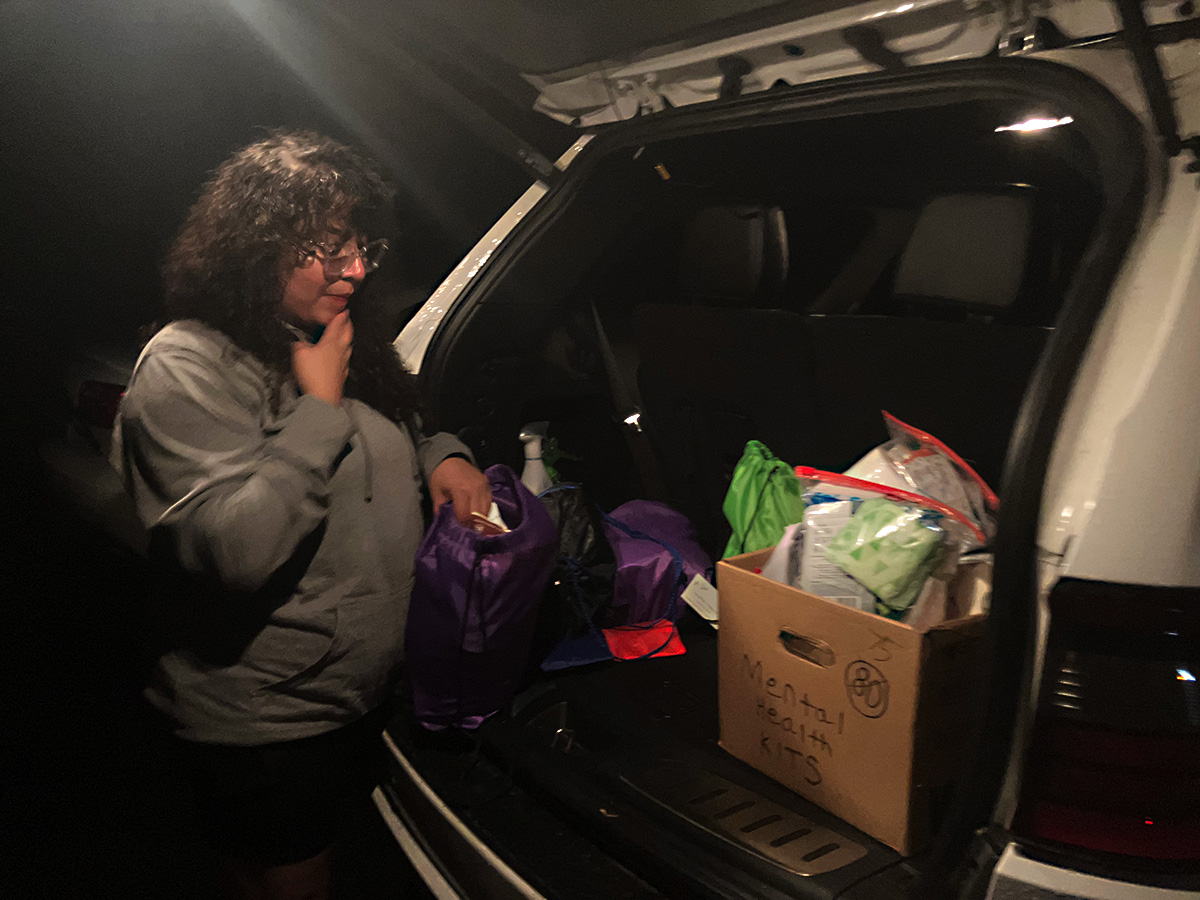
The third time I met with Michael was in the wee morning hours of July 24. I was one of four volunteers – myself, my husband, another journalist and an older gentleman who is a seasonal Door County resident – and Itzchel Garza, the supportive housing outreach coordinator for Lakeshore Community Action Program. Itzchel was our team leader.
We were counting people experiencing homelessness in Door County as part of the Point-in-Time count. Twice a year, in January and July, the federally coordinated event provides data meant to shape funding, resource allocation and policy decisions surrounding homelessness.
Lakeshore CAP organizes the PIT count for Manitowoc, Sheboygan, Kewaunee and Door counties and is meant to capture information about the local homeless populations. Data is reported to Congress and the U.S. Department of Housing and Urban Development.
Anyone staying in shelters, transitional housing, living on the street, in their vehicles or places not meant for human habitation is counted.
Rural homelessness looks different than it does in big cities, I have learned from my time reporting on it. It is not as visible. In small towns and rural communities there are rarely people literally sleeping on the street as there are in more urban areas. There are tents, but you would be hard-pressed to find them without an inside source.
Itzchel acknowledged that the PIT is surely an undercount of the unhoused, especially in rural areas. At least it is a starting point though, she said.
Itzchel and volunteers counted four people experiencing homelessness in Door County during the summer PIT count. There are certainly more, according to Itzchel, but it is hard to find them. Residents who know their community well are the best sources for guidance on how to find and reach people experiencing homelessness.
She is particularly worried about a woman she met during the PIT count who is unhoused and has a stitched wound she needs medical care for, Itzchel said. Homelessness is so much more than shelter or a place to sleep, she added. It is a complex issue encompassing housing, affordable healthcare, mental health and more.
Lakeshore CAP and HELP of Door County are planning an outreach event for folks experiencing housing instability on October 8.
“A common comment we heard was ‘there’s no help here,’” Itzchel wrote in an email to various groups about the event.
Itzchel wants to bring people together to pool knowledge and resources, she said. She knows there are organizations and community members in Door County who want to help, and it is a matter of coordination and communication to get that help where it is needed.
“We know it is real here. I’ve met the real people now,” Itzchel told me.
July 23, 2025, 11:00 p.m.
My husband and I meet our PIT crew in the parking lot of JAK’s Place, a mental health resource center in Sturgeon Bay. Itzchel is self-assured and friendly. She tells us she is excited to have four volunteers for the first shift and two more for the second shift. This is the first time there have been any volunteers signed up for the Door County count.
She makes introductions and gives instructions as she unloads the “hygiene bags” we will hand out. The bags are filled with donated items that someone experiencing homelessness might find useful: nail clippers, soap, shampoo, snacks, water bottles, an emergency blanket. Lists of resources and contact information are also in the bags. Any unhoused people we find will receive a bag and be asked some survey questions if they are willing.
The CAP count takes place from 11 p.m. to 2 a.m., and then again at 4 a.m to 6 a.m. There are four different routes in Door County. The one we volunteer for is in the City of Sturgeon Bay and the other ones are in southern Door County and parts north of Sturgeon Bay.
The route we follow has about 20 stops, and we add some along the way, as those of us who are familiar with the area think of places someone sleeping in their car or a tent might stay. About two hours into our route, we run into a Sturgeon Bay police officer on patrol at the fairgrounds. He gives us a few tips and talks about the half dozen or so unhoused people he knows from patrol.
I am struck by his familiarity with them and he seems compassionate. He echoes what I have now heard many times from health and human services and housing workers in Door County – there is not anywhere for them to go.
There is no emergency shelter in Door County. The closest ones are in Green Bay. A few local churches have gift cards for food and fuel, or a few nights in a hotel. HELP of Door County has some safe houses available for victims of domestic violence also. For the majority, resources are limited.
We drive in the dark, headlights washing over wooded areas and gravel roads at Potawatomi State Park, an Ahnapee trail head, the Sawyer boat launch. We stop at the edge of hotel and Walmart parking lots and peer into cars under a floodlit halo. It is both peaceful and a little eerie.
Itzchel tells us to look for cars that have visible belongings in them, stacks of mail, bedding, clothing, prescription bottles or toiletries.
If someone is living in their car, it’s going to look like it, she says.
July 24, 2025, 2:00 a.m.
It is a long night and we only end up finding two people on our shift, Micheal and another person staying in their vehicle. Itzchel met the woman earlier in the day during her outreach work and told us she is fleeing domestic violence and has been unhoused for a year.
“Domestic violence is one of the leading drivers of homelessness across the country. Survivors often face a devastating choice: remain in an abusive situation or leave with nowhere to go,” according to an article Itzchel wrote that was published in the Peninsula Pulse on July 3 in an attempt to recruit volunteers for the PIT.
The woman told Itzchel she did not know about Lakeshore CAP or the resources they offer.
“That’s heartbreaking to me,” Itzchel told us. CAP has been trying to expand their reach into Door and Kewaunee the last few years, she said.
A lot of people equate homelessness with mental health problems or substance use disorder or both. Itzchel tells us that is sometimes the case but in her work, it is more often a “snowball kind of thing.” One missed rent payment, one illness, a layoff can drive someone into being unhoused.
Housing affordability is a huge, huge issue, she says, and she has been shocked at some of the housing costs she has heard about in Door County.
At the end of the count I feel both wired and tired. I fall into a comfortable bed, the air conditioning turned up high and then into a restless sleep. Another phrase Itzchel used in her article is on repeat in my head, that homelessness is most often “rooted in trauma.”
‘Like you’re nothing’
People experiencing homelessness are frequently lumped together with criminals in the public imagination. When leaders vow to “clean up the streets,” and make their communities “safe,” the unhoused are included in what is to be cleaned up, what is dangerous.
This attitude extends to the highest offices.
On Monday, Aug. 11, President Donald Trump gave a press conference to explain the recent National Guard presence he ordered in Washington, D.C. “Our capital city has been overtaken by violent gangs and bloodthirsty criminals, roving mobs of wild youth, drugged out maniacs, and homeless people,” he said.
Characterizing unhoused people as dangerous, immoral, lazy or deficient contributes to their dehumanization. It makes it easier for those of us not in that situation to turn away, shrug our shoulders, wrinkle our noses. I have been guilty of this myself.
Michael tells me about a sign on the public library he frequents. It displays the rules of conduct for all Door County libraries. One in particular upsets him, he says and it reads: “Individuals whose bodily hygiene is sufficiently offensive to constitute a nuisance to other persons shall be required to leave the building.”
It is very difficult to keep one’s clothes clean and bathe regularly, according to Michael. He wishes there were some basic hygiene services available for people in similar circumstances.
”People look at you like you’re nothing,” he says.
When the PIT crew visits Michael, he declines a bag of supplies, but takes a list of resources from Itzchel. Michael has told me he does not want any handouts. He tells me that he “paid back double” for hotel and food vouchers he was given a few years ago.
Michael is guarded about his history. He tells me he is from Door County and was self-employed, doing handyman jobs before his arrest. He alludes to having a learning disability.
When he talks about his incarceration and experience with the criminal justice system, he is confused about the legal details and sequence of events.
He has been having some health problems; dizziness, shortness of breath, and tiring easily. He is afraid it is his heart. Michael does not want to see a doctor and is wary of “office people” and does not want to be a part of any system. To access the resources available means he has to sign over money and personal information, details about his life he does not want to share, he says.
He does not want to be catered to, talked down to or misunderstood.
I think about the inevitable trauma that is at the root of Michael’s homelessness. He tells me he is psychologically damaged by his time in jail and does not want an apartment. The four walls would make him feel trapped. His dream is to fix his vehicle, pay someone $300 or so a month to park it on their property and use a power source for heat in the winter. He says he can help with maintenance and yard work, house chores.
No answers
The state legislature recently cut proposed funding for homelessness resources out of the 2026 budget. With homelessness on the rise, especially in rural areas, housing workers like Itzchel are raising the alarm that this cut will have tragic consequences. Resource agencies worry that future cuts from the federal “Big Beautiful Bill” affecting food programs and health benefits will send more people to their cars, friends’ couches, trailheads and parks.
A friend and coworker who came with me to my first meeting with Michael ran into him at the post office recently. She said hello to him and said he seemed surprised to be addressed and recognized. To be seen and treated with basic civility.
What will happen to Michael when the weather turns? I do not know, I have no answers. The frustration of reporting on these issues, getting to know people experiencing them, and being unable to fix it sits in my heart every day and weighs on my mind.