

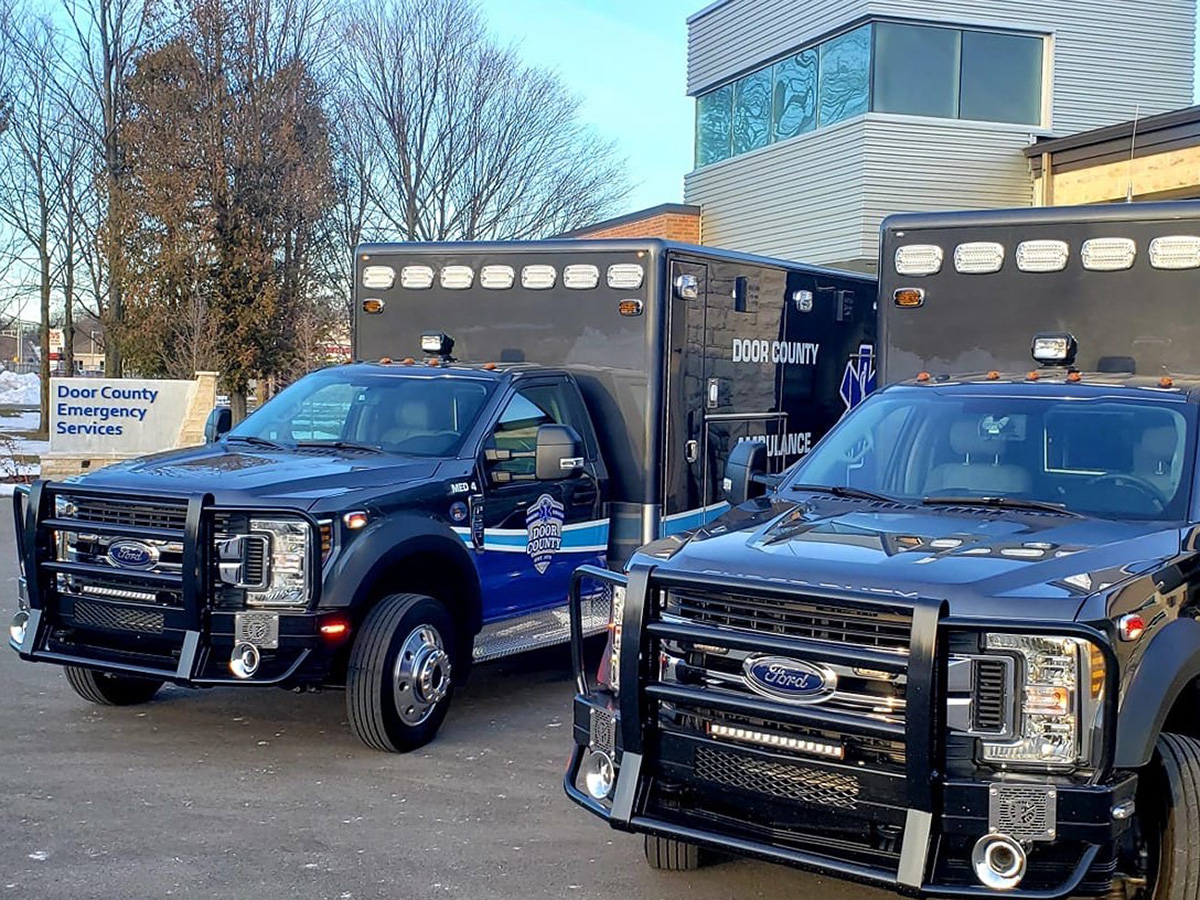
The Door County Board of Supervisors voted unanimously in favor of a resolution authorizing EMS staff to investigate and recommend an appropriate site for a fifth Door County Emergency Services station, at its regular meeting on Oct. 28.
Emergency services have grown significantly, County EMS Director Aaron LeClair said, including emergency call volumes that have doubled in the last decade.
There are already stations on Washington Island, in Sister Bay, Sturgeon Bay and Brussels. The station would be located somewhere in the Egg Harbor/Jacksonport area, according to a request from LeClair to the Public Safety and Judiciary Committee in June.
LeClair explained the need for a “middle station,” in his report to the county board on Oct. 28. An EMS ad hoc committee in 2015 recommended a new station be built in the central part of the county.
The station is estimated to cost $2.3 million to build, operate and maintain. There has already been $500,000 for the station set aside in 2024 in the county’s Capital Improvement Plan. The Judiciary and Public Safety Committee recommended splitting the remaining funding for the station between 2026 and 2027’s budgets, according to LeClair.
The time it takes for emergency personnel to respond is also a factor in the need for a middle station. For some parts of the county, including Egg Harbor and Jacksonport, call response times are about 20 minutes, LeClair reported. Other areas, nearer to an EMS station, have response times ranging from about four minutes to 14 minutes.
The National Fire Protection Association, a national nonprofit that develops and maintains safety standards for first responders, recommends optimal average response times, LeClair said.
The NFPA provides recommendations for urban and suburban areas and nine minutes is the recommended average. They also provide a recommended time of 14 minutes for volunteer fire departments.
Door County does not fit well into either of those categories, he said, as it is a rural area with a fully-staffed department, making it hard to determine what the optimal response times are here, he said.
“At the end of the day, this board, you folks, you dictate what we want as policy for response times here,” LeClair said. “We set our own and we strive for that.”
Response time is vital in cardiac events, strokes and trauma-related calls, he said, but non-emergency falls make up at least a quarter of the calls received. It is an ongoing issue the department is trying to address, he added.
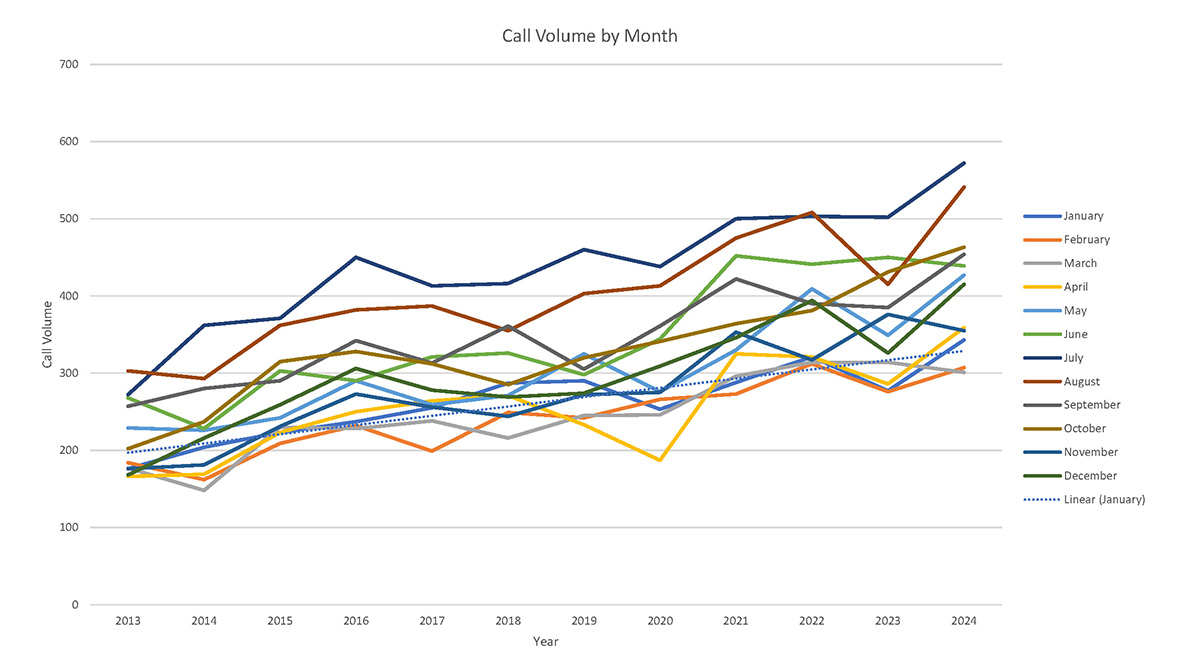
Most of the EMS calls are from people who live in Door County, according to LeClair. In 2024, 84 percent of calls were from residents. Residency is determined based on their mailing address, he said.
A midcounty EMS station would cost about $2.3 million to build and have a $15,000 annual utility and maintenance cost. LeClair said the department would try to use existing personnel, but there is the potential for the department to have to hire up to six more full-time staff for the station in the future, at an approximate annual cost of $700,000.
District 2 Supervisor Todd Thayse said he would like to see more than one option from the department come before the board. Thayse represents the Town of Brussels and the Town and Village of Forestville.
District 16 Supervisor David Enigl, representing the Towns of Egg Harbor and Jacksonport, indicated he supported EMS and saw the need for the station, but also was aware of the need to prioritize projects. Currently, a communications upgrade project is looming on the horizon, with a price tag estimated to be almost $23 million, to be funded by the county, municipalities, and grants.
Based on the approved resolution, LeClair and EMS Department Captain Robin Gordon and staff member Karen Doell will move forward on determining a specific location for the station. The board has yet to approve splitting remaining costs between the 2026 and 2027 budgets, which would put $900,000 in the CIP for each year.
New ordinance prohibits overnight parking on county property
A vehicle that has been parked in a county-owned lot for several months will have to move, according to an ordinance amendment to the county code unanimously approved by the County Board. The amendment bans parking on all county-owned property between the hours of 2:00 and 6:00 a.m.
The amendment was first discussed at the Oct. 6 county highway and facilities committee meeting and was prompted by this specific situation, according to County Administrator Ken Pabich in a phone call after the County Board meeting. He indicated there had been similar cases over the years involving county parking lots.
The vehicle has been parked in a county lot since June and belongs to a Door County resident who is experiencing homelessness. As of the date of publication, they do not have the means to move or repair the vehicle, according to the individual, whose name Knock is not publishing to protect their privacy.
“I have nowhere to go,” the resident said.
It is where they sleep and store their possessions.
“There was no way to address it,” Pabich said.
According to the amended ordinance, vehicles parked during prohibited times are subject to a fine of $50 per day and can be towed. The owner would be responsible for towing and storage fees. County-owned vehicles are allowed to park overnight, and exceptions can be made for temporary permission. It does not affect county parks or the Cherryland airport, as those already have overnight parking restrictions.
The ordinance change primarily affects the main county government facilities, including the Government Center, the Aging and Disability Resource and Community Center, Justice Center and Highway Department parking lots, according to Pabich.
Several Wisconsin communities have considered “camping ban” ordinances that prohibit overnight parking and sleeping in public spaces. The Village of Ashwaubenon recently voted against establishing such an ordinance. Village leaders and members of the public who opposed the ban said they felt it criminalized homelessness and did not solve the root of the issue.
With the amended parking ordinance in place, there is no county-owned public space where someone experiencing homelessness in Door County can legally sleep or park their vehicle overnight.
The City of Sturgeon Bay does not allow parking on city streets overnight from Dec. 1 through April 1 to allow snow removal. The police department does issue tickets for this, according to Michael Barker, municipal services director for Sturgeon Bay.
The city municipal code does not expressly prohibit vehicles overnight in city-owned parking lots, but stipulates that if a vehicle has been “parked or stored for more than 48 hours, the vehicle is deemed abandoned and constitutes a public nuisance,” and towing and fines may result. Additionally the city bans camping anywhere on city property without a permit.
“These have been used to avoid our parking lots and streets from becoming either a dumping ground, a storage location and campgrounds for people,” Barker said, and city and police department personnel try to remain flexible and reasonable while enforcing the ordinances.
The issue of homelessness in Door County is going to be discussed on a future meeting agenda, Pabich said. The county government will take a “leadership role,” he added, which may involve forming a task force or working with the Health and Human Services Department to find solutions.
County might lose $80,000 in funding for benefit administration
While Supplemental Nutrition Assistance Program, or SNAP, benefits and the federal government shutdown are making headlines, there are two ways to look at federal government activities and their impacts on county business, according to Pabich, the county administrator.
Direct program cuts are one thing, and changes to how programs are administered are another, he said. The federal budget reconciliation bill that passed into law in July—known as the “One Big Beautiful Bill”—made some SNAP benefit administration changes that potentially affect Door County’s pocketbook.
At the county board’s September meeting, Health and Human Services Director Joe Krebsbach outlined some of those changes and how they would affect Door County.
Right now, Door County HHS is part of a consortium of five counties that administer SNAP benefits. Administration tasks include determining eligibility, processing applications and following up on benefit recipients, Krebsbach said.
The consortium means all five counties work together to administer the funding no matter where the recipients reside, he explained. For example, Door County HHS staff might end up processing a benefits application for someone in Brown County.
Until Oct. 1, the federal government provided 50 percent of the funding to pay for administration costs, and the state or county paid the other 50 percent. In October, the cost sharing switched to 25 percent from the federal government, leaving 75 percent for the state or counties to pay for. This represents Door County losing about $80,000 in funding, Krebsbach said.
The board passed a resolution to be sent to the state Legislature, urging the state to provide funding to offset the financial impact of federal SNAP changes on county budgets, estimated to be around $68 million statewide.
This bill also means federal funding for SNAP administration now depends on an error rate of 6 percent or lower. The federal government determines the allowable error rate. Error rate refers to mistakes made in data input or calculations, Krebsbach said, and does not refer to benefit fraud, or people who do not qualify for benefits mistakenly receiving them.
“Fraud is handled in an entirely different area,” Krebsbach said.
If a state goes above a 6 percent error rate, the federal government will cut more funding accordingly. Until recently the statewide error rate has been under six percent, Krebsbach said, but it recently went over that mark at 6.8 percent.
When the error rate goes up, more funding is taken out of the program, Krebsbach said, and losing funding leads to cutting staff. Cutting staff, as well as tracking new employment requirements for SNAP recipients, means bigger workloads, he continued. Bigger workloads usually lead to more mistakes.
“It’s a vicious cycle,” Krebsbach said.
Even if Door County improves its error rate, it might not matter because the federal government is looking at the state’s overall rate, Pabich said, and that is concerning.
“There are multiple ways the errors can be introduced,” he said. “It’s not something that is malicious. These are honest mistakes in recording or interpretation and a punitive impact is counterproductive.”
Enigl asked that an agenda item be placed on the next board agenda to discuss additional budgetary impacts of federal activities to the county.
“I just find it unique that we’re talking about budgeting (this time of year) but we haven’t had that topic come up,” Enigl said.
“There was communication with Ken (Pabich) and I that we needed to get our arms around how it affects our county government,” County Board Chairman David Englebert said. “That target is moving.”
Other news
Cana Island repairs to be paid for by county funds
Cana Island Interpretive Center needs repairs from Aug. 9 storm damage. The county’s insurance will pay for the repairs, but there is a $10,000 deductible. Cana Island County Park also has debris from the storm needing cleanup. Together the repairs and cleanup will cost the county $33,000.
The board approved the funds to be transferred from the Cana Island Reserve Account to pay for the deductible and debris cleanup.
Door County, along with six other Wisconsin counties, applied for Federal Emergency Management Agency for damages from the Aug. 9 storm. Funds were denied because the damage to public infrastructure was deemed not severe enough to warrant public assistance, according to FEMA.
County adopts AI policy
Supervisors approved a policy regarding the use of generative artificial intelligence by county personnel for county business.
The policy is necessary to regulate what employees can and cannot do with AI technology, and several county departments have requested the policy, Corporation Counsel Sean Donohue said.
The potential for sharing confidential information with generative AI is the primary concern from a legal standpoint, he added, and one of the policy’s goals is to protect employees from “doing something inadvertently.”
The policy dictates “use of generative AI should be based on the premise that it does not take the place of a human being and the expectation is that the user must review, evaluate, amend, and supplement AI generated content.”
Additionally, the policy states AI must not be used for decision-making, such as determining employment eligibility, or obtaining legal or professional advice, and it should not be used for work that requires professional licensure or certification, such as surveying, legal advice, etc.
County makes crash responder proclamation
The board approved a proclamation declaring Nov. 17-21 as Crash Responder Safety Week. During discussion, District 9 Supervisor Ryan Shaw, representing parts of Sturgeon Bay, said he was in favor of the proclamation but asked why this particular proclamation was put on the agenda when others have not.
Last April, the board approved a revision of its Rules of Order and added specific criteria for proclamations to be considered by the board. The rule now states that in order for a proclamation to be placed on the agenda for board discussion and potential action, it “must be sponsored by the County Board Chairperson and directly impact the County’s programs, services, or budget.”
“I’m curious why this proclamation is allowed to see the floor and to see a vote whereas other proclamations, specifically the one this past June regarding Pride month, were not,” Shaw said.
“I felt it was pertinent to the highway department and emergency services, how they interact with accidents on the roadway and so that was the reason it was placed on the agenda,” Chairman Englebert responded.
Law enforcement expenditure approved
The county renewed a five year contract with Axon, a law enforcement technology and security company. Axon provides Tasers, body cameras and software used by the Door County Sheriff’s Office. The county will spend about $120,000 every year for five years for a total of about $600,000.