


Locked Out: Door County’s affordable housing shortage
Door County Knock is reporting an in-depth series on Door County’s affordable housing shortage, addressing questions such as why the county lacks affordable housing, how market trends have contributed to its decreased availability and what roadblocks exist to building more. Click here to read more.
If there are questions you’d like answers to or people you would recommend we talk with as part of our reporting, please email us at [email protected].
The newly formed Interfaith Coalition for Housing, in partnership with Door County Medical Center and Habitat for Humanity began remodeling work on a single family home in Sturgeon Bay on Nov. 4. Celebrated with a ribbon-cutting ceremony, the home will serve as transitional housing for one local family at a time who is experiencing housing insecurity related to a crisis or life-altering circumstance.
The hospital owns a building on 16th Avenue in Sturgeon Bay that used to be a clinic, and has been used for storage in recent years. CEO Brian Stephens offered to rent the building to the coalition for a nominal fee.
In order to renovate the former clinic into a three-bedroom, two-bathroom single family home, ICH reached out to Lori Allen, Door County Habitat for Humanity’s executive director. An $80,000 budgetary goal was agreed upon for remodelling costs and a team of Habitat volunteers and employees committed to starting work once the goal was reached.
The funds were raised by August. DCMC provided some money, and ICH member churches took up collections to raise the rest.
ICH is planning to apply for grants to fund the ongoing operations of the transitional home, according to Vice President Meleen, and is still in the process of securing their nonprofit 501(c)3 status.
House origins
About a year and a half ago, Rev. Matt Knapp, a handful of other faith leaders, DCMC representatives and community members began meeting to talk about helping local people experiencing homelessness.
Over 30 people showed up at that first meeting, Knapp said, and clergy and churches throughout the county reported regularly hearing from people experiencing homelessness. They were all frustrated by the lack of solutions.
From a faith perspective he said, “we all follow a dude who said we need to take care of this.”
Knapp has been pastor at the Sturgeon Bay Moravian Church for about the last 30 years, and he described the issue as “extremely frustrating” and “heartbreaking,” during an interview last spring.
“We’ll get phone calls from people all the time,” Knapp said. “It’s like, ‘I’ve got nowhere to stay tonight.’ … There’s just no resources there. There is nothing.”
Today, the fledgling ICH is working with DCMC and Habitat for Humanity to change that narrative. The coalition is made up of the Moravian Church, Hope Church, Bay View Lutheran, Christ the King Holy Nativity, and Hainesville Lutheran.
The coalition is tackling what Knapp considers the most extreme level of need that faith leaders see in the community, he said – families with children who are experiencing housing insecurity because of a catastrophic life event or change in circumstances. It is usually a situation that requires long-term support, according to Knapp.
“They need time to get everything pulled back together again,” he said.
Knapp also described other kinds of housing needs that are more temporary.
“I can’t tell you how often this happens,” he said. “I’ll get a phone call at 8:00 Friday night in January, and it’s 20 below, and a guy will say, I just got out of jail. It’s going to take two days for my family to drive up from Tennessee to get me. Do you know anywhere I can go?’ “
For these situations, one or two days of safe housing is all that is needed.
Falling somewhere in the middle are people who need a downpayment on an apartment or a few month’s rent, he said, just some help until “they pull in a few paychecks.”
No matter how the situation or level of need differs, one thing remains the same–the scarcity of options. For the most temporary of housing needs, local clergy used to have a pool of money and an arrangement with Clarence Cumber, Knapp said. Cumber was the owner of the former Butch’s Bar in Sturgeon Bay.
“One of the most grievous things that happened in this town was when Butch’s Bar burned down. (Clarence) would let guys stay for five bucks a night,” he said.
Many churches will pay for nights in a hotel, Knapp said, or they contact the local chapters of St. Vincent DePaul or the Salvation Army. St. Vincent gives hotel vouchers for varying stay lengths and helps pay people’s rent and security deposits, Mark Wilding said, and assistance is based on individual circumstances. Wilding is the president of the St. Joseph Parish conference of St. Vincent DePaul in Sturgeon Bay.
The local St. Vincent DePaul branch spent $6,229.93 on rent or security deposit assistance for people experiencing homelessness in Door County from November 2024 through October 2025. The organization spent $6,965.29 on motel stays in the same time period.
It is hard to break down the total into individual nights spent in a motel, Wilding said, because rates fluctuate depending on season and day of the week.
The average rate for a discount motel in Sturgeon Bay is $85 per night, based on comparisons of similarly priced motels in the area. Using this average, it can be estimated that St. Vincent paid for about 82 nights in a motel for an unhoused person last year.
The Salvation Army of Door County also provides shelter and lodging to people experiencing homelessness and their data collection system counts nights of lodging.
In the last 12 months, they provided 112 nights in a motel or other temporary shelter for 38 women, 16 children and 37 men at a cost of $9,943.77, according to Jeane Sager, service extension field representative for the organization.
The Salvation Army also paid $31,673.10 towards rent for housing insecure people in Door County and over $4,000 toward utility bills.
The most frequent response Knapp said he has for local people experiencing homelessness is, “can you get to Green Bay?” because Brown County has resources Door County does not.
“Going to Green Bay” is exactly what the coalition did to look for a transitional housing blueprint. They are modeling their project on the Ecumenical Partnership for Housing in Green Bay’s transitional housing program, according to Greta Meleen, vice-president of ICH.
The EPH in Green Bay is made up of over 20 churches that own and manage several single family homes. Families are screened, placed in housing, given a case manager and provided with services and guidelines related to self-sufficiency. The goal is for families to transition into stable long-term housing after 9-12 months.
Similarly, ICH will provide a home for a family, as well as weekly check-in meetings with a case manager, financial counseling and other services to support employment, savings and long-term stability.
Providing a home is imperative to a family’s success, according to Knapp.
“The first thing you do is you’ve got to get a person in a safe home,” he said.
Housing first
Both the Green Bay and Door County transitional housing programs overlap with the “Housing First” philosophy, which has steered the national conversation about homelessness since the 1990s, when it was adopted by the first Bush administration as federal policy.
Housing First means precisely what it says, putting unhoused people in homes before addressing any other issues they may have. It was a simple but radical idea at the time, according to Sam Tsemberis.
Tsemberis founded Pathways to Housing in New York City, a nonprofit dedicated to helping the homeless and supporting recovery for people with mental health and substance use issues. He is credited with originating the Housing First model, is a faculty member at UCLA’s Department of Psychiatry and Biobehavioral Sciences, and he was one of TIME Magazine’s 100 Most Influential People of 2024.
Prior to this model, people had to get into treatment and services first in order to “earn” housing, Tsemberis explained. Housing First was a radical idea at the time because it challenged the entrenched notion that the severity of someone’s mental illness is related to their ability to function, he said.
“People with severe diagnoses are considered incapable, but if it’s treated well, they can be running corporations, driving taxis, working in factories, leading congregations. The functionality of a person is not related to their mental health diagnosis, just like it’s not related to their heart disease. They have to treat their illness. Housing First demonstrated that people with severe mental illness can function very well, when they get support and their illness is well-cared for. People can function in an apartment or home in the community as opposed to putting them in an institution.”
Homelessness is not always caused by substance use disorder or mental illness, but can be caused by high rents and low wages, according to Tsemberis. Often those conditions exacerbate housing insecurity and vice versa, he added.
Housing First’s effectiveness is supported by evidence. Compared with other programs, Housing First programs decreased homelessness by 88 percent, according to studies. However, when the federal government adopted Housing First as a national policy, it started to get diluted, Tsemberis said.
“Everything began calling itself ‘housing first,’ and lots of them were not achieving the high percentage of long term stability,” he said.
He referred to supportive housing programs that do not have enough caseworkers, where residents are not given quality services, where home visitations are lacking. In these places, law enforcement is regularly called, overdose rates are high and the programs are viewed as failures.
“All sorts of disasters are attributed to the model rather than the policy,” Tsemberis said. Putting people with mental illness and substance use needs in housing and providing inadequate support is “neglectful,” he added.
In contrast to the transitional model being used by ICH, true Housing First programs provide long-term housing, typically for a single adult who needs mental health or substance use disorder treatment. That might not be the case for a family, where the adults usually need help getting back on their feet financially as opposed to long-term treatment, Tsemberis said.
He added that transitional housing with supportive services does work well, but there must be an “off-ramp.” “Where will they go afterwards? Even in the best of circumstances, if they are able to get a job and their goal is to stay in the community, is there affordable housing available to them?”
As Door County looks at the issue of homelessness within its borders, Tsemberis offered advice in the form of self-examination:
“What is required to solve homelessness is that, as a community, we want to make that happen. It’s a question of values. What kind of community do we want to live in? This question must be answered by all of the members of the community: the public, members of the city council, business leaders, social service and health care providers, police, faith community and others.”
Tsemberis acknowledged Door County has its own specific concerns when it comes to people being unhoused or housing insecure. A seasonal, tourism-driven economy means some people cannot make ends meet over the winter months to stay in the community.
“Are we going to be an inclusive and supportive community or are we going to be an exclusive community and banish people who are homeless until we have use for them again?,” he asked.
More than a home
Olivia Potter knows firsthand how a safe home can make a difference to a family. When she was a child, her single mom was struggling to make ends meet when the family’s furnace broke in the middle of winter.
A local company donated and installed a new furnace, and “for that moment it felt like we were sent a prayer to have a chance. (It) made a big impact for me, that these people were helping us,” Potter said. “I believed that folks will help you when you’re down.”
Potter turned that belief into a business. She is the “Door County Paint Lady” and works as a contractor doing inside and outside finish work. She saw a gap where other area contractors pass over small painting jobs, or jobs for low-income housing in favor of big projects that net more profit, she said.
She started her own painting business in August and has done some projects for landlords of low-income housing, and a mobile home in Sturgeon Bay. Potter began researching grants to support her desire to take on customers that might not have the means to pay for her services otherwise.
That search led her to Habitat for Humanity. Many grants require affiliation with a nonprofit, she said, and she began volunteering at the organization’s ReStore in Sturgeon Bay. There she met local mural artists Erin LaBonte and Don Krumpos, who are working with Habitat to design a mural at the store.
The three are also pooling their talents to paint a mural in the entryway of ICH’s transitional home on 16th Avenue.
To those who might say paint colors and wall decor is frivolous, Potter said basic necessities are not enough to make a house a home, or a person healthy.
“A well-fed kid isn’t a healthy kid,” she said. “A healthy kid feels like a kid, feels safe to be a kid.”
A family entering the ICH house for the first time will probably be feeling a lot of things, according to Potter. “People in that space might feel scared. They might feel like it’s not really their home.”
The mural in the entryway is going to be designed as a “welcome wall,” she added, with the goal of making people feel upbeat, and that the home is a place they can let their guard down. Potter called the work “psychological outreach.”
“Art really makes people open up and take a moment to look at it and think about what it means. It gets people out of their heads,” she said.
Housekeeping list; what still needs to be done
The coalition still has a lot of work to do with the project after the ribbon was cut on Nov. 4. Remodelling work began immediately after the ribbon-cutting ceremony on Nov. 4, and that is one step, according to ICH Vice President Meleen.
“There are a lot of baby steps, filing for this, recruiting for that, onboarding processes, getting policies and procedures in line,” she said.
The coalition still needs to determine guidelines for choosing a family and how case management will work. Door County Health and Human Services has expressed interest in providing a caseworker to ICH, and DCMC may also provide social work services, but nothing has been decided yet, Meleen said.
Operational needs and costs of the home and program are also yet to be determined, she said, but ICH member churches will play a large role by collecting money and providing volunteers for things like snow removal and property maintenance.
ICH will also need to stay in touch with the neighbors, Meleen said. Stephens and coalition President Lauren Daoust went door-to-door last spring, introducing themselves and the project to everyone in the neighborhood. They provided neighbors with a phone number to call with concerns and questions, she said.
Having conversations and answering people’s questions is the way to deal with potential concerns and the stigma that often applies to transitional and other types of alternative housing, according to Knapp.
“That is how that gets dealt with. People need to be in relationship with one another, and if we take time to do that you can tamp down that reaction,” he said. “You have to be willing to put the work in to have those conversations with folks.”
Another goal of the coalition is to grow, according to Meleen and Knapp. More churches and more people involved, are necessary to make the program sustainable and to move beyond the “drop in the bucket” it is now, Knapp said.
Communicate, educate, have conversations with people, get them all together in a room, he said.
Or a driveway.
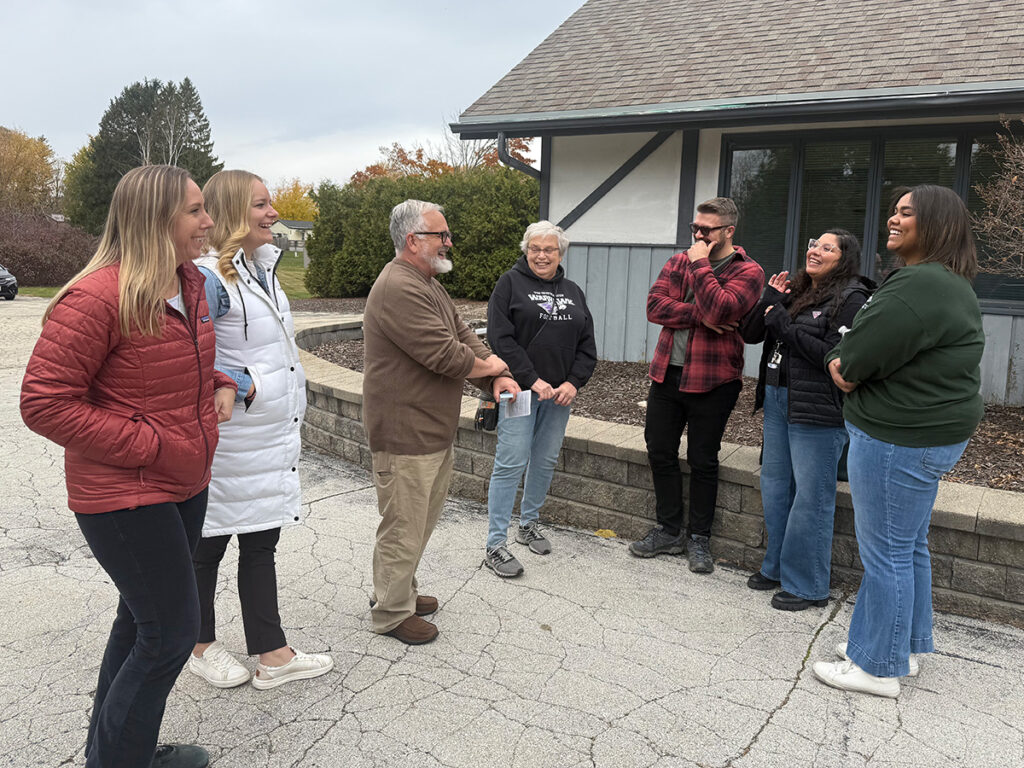
After the ribbon-cutting ceremony for the transitional home, a handful of coalition members and Lakeshore CAP’s housing team were standing in the driveway just outside the entrance. They shook hands and introduced themselves, and shared excitement about the house beside them and how they could share resources and ideas to grow the program. They commiserated about funding and data and bureaucracy, the hoops they must jump through to help people. A few expressed shock they had not met sooner.
And then they made a plan to meet again.
For more information about the Interfaith Coalition for Housing, contact ICH President Lauren Daoust at (920) 746-3714.