


Every summer dozens of friends, old and new, gather on a 1930s-era clay tennis court on the grounds of an old summer cottage in Door County to play croquet. The court is filled in with grass and surrounded by towering cedar hedges, making it feel secret and protected. After the games, long-time couples and friend groups share a delicious meal on a large flagstone patio, as fireworks burst over the bay side of the peninsula.
This is the Big Gay Croquet tournament. The private event, hosted by a gay couple now in their 80s, is at least 30 years old, according to Phil Berndt, who resides in Door County with his husband and has been attending the tournament for many years. After he came out, events like this felt like a rare privilege to him, he said.
It was meaningful “to spend time with some of the true elders of our community – people who had lived through the AIDS epidemic and had fought so valiantly for marriage equality, not just for themselves, but for all of us,” Berndt wrote in an email.
“I am profoundly grateful to have known them, and to have had the chance to surround ourselves with so many living examples of loving, healthy, enduring relationships,” he said. “Those gatherings quietly taught us what was possible, simply by showing us what was real.”
Before Pride events, before marriage equality, and often before people felt safe being out, members of the Door County LGBTQ+ community found one another in private homes and gatherings, and by word of mouth. In cities, people often gathered in bars, restaurants or clubs that catered either secretly or openly to a gay clientele.
Gay bars played a significant role in LGBTQ+ history as spaces to build community and foment movements.The closest ones to Door County were in Green Bay, Appleton and Milwaukee. This remains true to the present day.
The pattern of gay people meeting in private spaces in rural communities is one author Will Fellows is familiar with. Fellows, a gay man, grew up on a Wisconsin dairy farm and wrote two books centered on the oral histories of gay men. For his book “Farm Boys: Lives of Gay Men from the Rural Midwest,” published in 1996, he interviewed 75 men who grew up on farms. Interview subjects ranged in age from 24 to 84 years old.
Even in cities, many places the LGBTQ+ community historically gathered were somewhat hidden or private, according to Fellows.
“There were bars where gays and lesbians knew that they would find others like themselves, but they weren’t necessarily decidedly and devotedly queer bars,” he said. “For many individuals in that time, that was just too hazardous a way to try to have social engagement. Private gatherings were really a major focus of how people socialized.”
The croquet tournament was not the only example of private gatherings for the Door County LGBTQ+ community before organizations like PFLAG were established here. Berndt recalled a weekly dinner hosted by Kurtz Corral owners Jimmy Kurtz and Paul Connor that began in the 1990s.
What started as getting together to watch the television show “Queer as Folk” on Sunday evenings evolved into a weekly dinner and cocktail party, according to Kurtz. (Disclosure: Kurtz is a relative of Knock creative director Taylor Schultz.)
“Phil (Berndt) brought apple pies,” Kurtz recalled. “People would bring something of their personality. It became a kitchen thing.” It was not just for queer folks, he added, though the majority were gay men of all ages.
For Berndt, the gathering was another one that made “all the difference in the world” for him as a newly out gay man. It was a safe space, not a bar environment, and it made him feel like family.
Kurtz credited his rural Door County upbringing for the feelings evoked by his and Connor’s parties. Community was a strong part of his childhood, he said. He remembered his grandparents hosting square dances in their kitchen, where all were welcome and “all kinds of crazy stuff” happened.
Hard-to-find history
Finding Door County establishments and hosts where the LGBTQ+ community gathered in earlier times is not as straightforward as searching archives. Information about these places lives in fading memories and informal networks, and archive collections that do exist center mostly on bigger cities and urban circles.
Rural stories from the LGBTQ+ community are more rare, according to Fellows, and urban neighborhoods and establishments dominate the historical record.
A long-standing cultural bias that the lives of urban people are more significant or noteworthy pervaded his research, Fellows said, and many of the book’s subjects were dismissive of their own, often very interesting, stories for that reason.
“There were quite a number of individuals who felt like their life didn’t really begin until they left the rural community or left the farm and got to a city,” he said. “But of course, it did begin because they grew up, they were gay kids.”
The close-knit nature of small towns, where everyone knows everyone else’s business, is another layer to issues of privacy, safety and vulnerability, and that persists to the current day. The hosts of the annual croquet tournament asked that their names not be used and did not want to provide much detail about the event to protect the privacy of their guests.
Coming out the way it is known now was “out of the question” in the mid-20th century, especially in small communities, Fellows said. Homosexuality was still criminalized in many places and “gay purges” were taking place in academia and some other circles.
Many people who identified as LGBTQ+ “wore the mask” of a straight partner relationship and monitored their way of dressing and their mannerisms in order to blend into mainstream society, Fellows said.
Some individuals stopped masking their identities, however, but even that did not mean announcing to everyone they knew that they were queer, in the same way one does today, he said.
“They were nowhere near coming out, but trying to figure out a way to have some element of their lives true to themselves,” he said. “While wearing a mask in public to prevent losing a job or ending up in court or jail because of it.”
It would be even more important for those people to have safe, private spaces where they could drop their mask, he said.
Textbook rural pattern with a seasonal twist
A network of safe places and thriving gay-owned businesses existed in Door County from at least the 1960s on. Maxine Bennett and Martha Peterson, both prominent academics, built a home in Door County in 1963 and ran an antiques store called “The Port Shop.” McKeefry and Yeoman’s garden center, named for the same-sex couple who owns it, opened in the early 1980s and is in business to this day.
The Chanticleer Guest House opened in the mid-1990s and its former owners were once called “Door County’s gay poster boys” by the Wisconsin Gazette in 2011. The Gay Bicyclist Network hosted a camping event in Door County in 1988.
Private places like Kurtz’s farmhouse, a croquet tournament on old tennis courts, and a longstanding “Summer of Love” campout at another farm brought the community together. Coded invitations indicated LGBTQ-friendly places as well.
In the 1970s and 80s, Kurtz recalled, the Nautical Inn in Sturgeon Bay had a gay bartender who used coded language to let queer patrons know they were welcome. This is a typical example of how most establishments that were friendly to the LGBTQ+ population operated decades ago, according to Fellows.
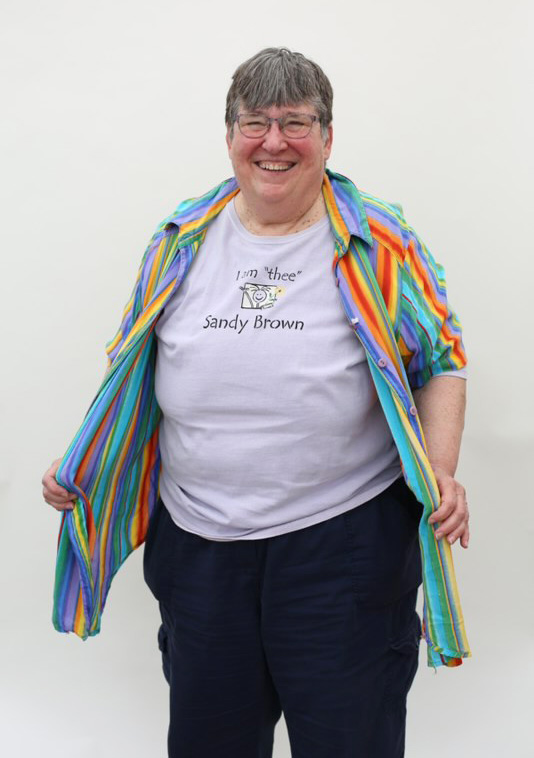
Sandy Brown, a leader in the community and the founder of the Door County chapter of PFLAG, remembered when people asked one another if they were a “friend of Dorothy” to find out their sexual identity. If you were a friend of Dorothy, you identified as a member of the LGBTQ+ community, she said, and it was a term mainstream culture was unlikely to recognize.
In Door County, people would ask if one was a friend of Sandy Brown instead, she said.
Brown also recalled a bar in Egg Harbor in the 1990s that was a popular spot for members of the Peninsula Players theater company to gather and was known to be gay-friendly. The theater was always a safe space for gay people, according to Brown, who, along with her partner, worked as an usher for the Players.
While code words and private invitations dominated the social scene for LGBTQ+ people in past decades, Door County probably had a larger queer influence than most rural Wisconsin areas, at least in the summer months, Fellows speculated. Much of that would have to do with it becoming an artists’ colony in the early part of the 20th century.
Fellows compared Door County to places like Mineral Point, Wis. and Provincetown, Mass., seasonal resort communities that attracted artists and creatives and eventually became havens for the LGBTQ+ community.
Artists are often “unconventional people with unconventional views on life,” Fellows said, and many of those who came to Door County were from Milwaukee, Chicago and other big cities. That seasonal influx of artists likely influenced the culture of the place year-round, he added.
Some people doing business are going to cater to the LGBTQ+ demographic, and some of those people are likely to be of that demographic themselves, he said.
The seasonality of the area can work both ways. Not only did it lead to an influx of artists and alternative lifestyles, but for Jimmy Kurtz, leaving the region during winter led to a broader sensibility that he, in turn, brought back with him.
In the off-season Kurtz went to college, he said, and he also spent part of his winters traveling to places like Miami, San Francisco, Los Angeles and Phoenix.
“I had a license to see the world beyond the limitations of Door County,” he remembered. “Then you come back to Door County and choose people who are interested, and you can tell them a good story.”
Going farther afield
If members of the Door County LGBTQ+ community wanted to experience a gay bar scene, they had to go to Green Bay and Appleton, or even as far as Milwaukee or Madison. That is still true today.
In Green Bay, the Astor Hotel bar and the Mayfair were open in the 1960s and catered discreetly to a gay clientele. The Two Women Cafe was a lesbian-owned establishment open from 1979 to 1993. Northern Womyn, Inc., a lesbian and feminist non-profit, held its meetings there for many years. Former owners of the cafe have ties to Door County.
Green Bay has the distinction of being home to the second-oldest gay bar in the state. The oldest – This Is It! in Milwaukee – closed a few years ago. The Napalese Lounge and Grill in Green Bay is now the oldest gay bar still in business in the state. The bar opened in 1982 and survived two location moves. For years, the most recent location had a discreet side entrance for safety concerns, after an armed robbery occurred in 1999. In 2021, the Naps, as patrons fondly refer to it, reopened its front entrance and marked the occasion with a colorful mural on the side of the building.
The painting of the mural turned into a three-day celebration and “Weekend of Pride,” according to an Aug. 29, 2021 article in the Green Bay Press-Gazette.
But going to openly gay bars and clubs had a major downside, PFLAG’s Brown said. “People were risking their jobs, livelihoods and physical safety.”
There are accounts of patrons harassed outside the Manhole nightclub in Green Bay, which was open in the 1980s. The bar manager at the Napalese Lounge was stabbed in 1991 by a patron. The victim, Paul Jacob, told authorities he believed the attack happened because he is gay.
The comfort and relative safety of private homes and gatherings appealed to many in the LGBTQ+ community, according to Brown and others.
Privacy turned into hospitality
The community began gaining more rights, visibility and acceptance in wider society between the 1970s and marriage equality in 2015, despite ongoing threats of violence and harassment.
Many subjects of Fellows’ book “Farm Boys” did not even have the vocabulary to identify or understand themselves. No one talked openly about being gay in the agricultural Midwest during the first half of the 20th century, Fellows said.
Changes in entertainment and pop culture contributed to LGBTQ+ visibility, but the most profound impact was from the internet and its expanded access to information and other people’s experiences, Fellows said. As visibility and acceptance grew, things began to change.
Two United Church of Christ congregations in northeastern Wisconsin voted to become “open and affirming” of members of the LGBTQ+ community in 1999. Hope UCC in Sturgeon Bay was one of them, according to the September 15-21, 1999, issue of Wisconsin Light.
In 2010, the Door County Visitors Bureau asked the former Chanticleer owners, Darrin Day and Bryon Groeschl, to be the models for an advertising campaign in Midwestern publications targeting LGBTQ+ tourists.
Going from tolerating queer folks to marketing to them was a big shift, according to Fellows, and likely indicative of the Door County arts community’s influence.
Public advocacy begins
Brown started the Door County PFLAG chapter in 1997. As the first LGBTQ+ advocacy organization here, the chapter made the community more visible and accessible to one another, she said. PFLAG offered the first public listing for resources, monthly meetings, and a newsletter, among other things.
“It was a way to find out what was going on for anyone coming into the community,” Brown said.
It was not as if everything suddenly became open and easy for members of the Door County LGBTQ+ community, she added. There were people who would not attend PFLAG meetings because they did not want their car seen at that time of day at the church where they were held, according to Brown.
PFLAG’s formation brought something besides connection with it: activism. In 2005 a constitutional amendment against gay marriage was making its way through the Wisconsin Legislature. Local PFLAG members started setting up a booth at the Sturgeon Bay farmer’s market to educate people and campaign against the bill.
While the bill eventually passed – essentially banning marriage between same-sex couples in Wisconsin until the 2015 Supreme Court decision overturned it – the market became a gathering place.
“We’d go out to lunch, or go geocaching or hiking afterwards,” Brown remembered.
The farmer’s market group also was responsible for making T-shirts emblazoned with the phrase, “I am a friend of Sandy Brown’s.”
Preserving the historical record
The most urgent reason to document places and spaces where the LGBTQ+ community gathered historically is to avoid erasure, according to both Brown and Fellows.
“When you have a whole category of people, whether lesbian women, gay men, trans people, intersex people, etcetera, when they have not been in the picture for a long time, they are viewed as lives not worthy of recording,” Fellows said.
Another reason to document these stories is that it makes the historical record richer, he added. Much of LGBTQ+ history centers around cities and urban queer life. Making sure rural perspectives are represented acknowledges that there is a “powerful, primal influence of geography” on history and identity, according to Fellows.
Then of course, there is the youth.
So much has changed, culturally and legally, over the past 50 years, Fellows said, and young people in the LGBTQ+ community are sometimes unaware of what history for that community has been like.
A lot of young people in the community are not involved in advocacy groups, Brown said, because they already have a group of accepting friends.
“It’s not as much (about) survival as it was,” she said. “Those were hard times.”
Younger generations may take their rights for granted, even though there is no guarantee they won’t be taken away, she added.
Learning more about queer history is important “so they know a little about what it could be like again,” Brown said.