

Locked Out: Door County’s affordable housing shortage
Door County Knock is reporting an in-depth series on Door County’s affordable housing shortage, addressing questions such as why the county lacks affordable housing, how market trends have contributed to its decreased availability and what roadblocks exist to building more. Click here to read more.
If there are questions you’d like the answers to or people you’d recommend we talk with as part of our reporting, please email us at [email protected].
A new bill aimed at increasing and improving manufactured home park regulation awaits the next session of the Wisconsin Legislature. In one of Door County’s MHPs, residents report rising rents and maintenance concerns that illustrate some of the issues driving the legislation.
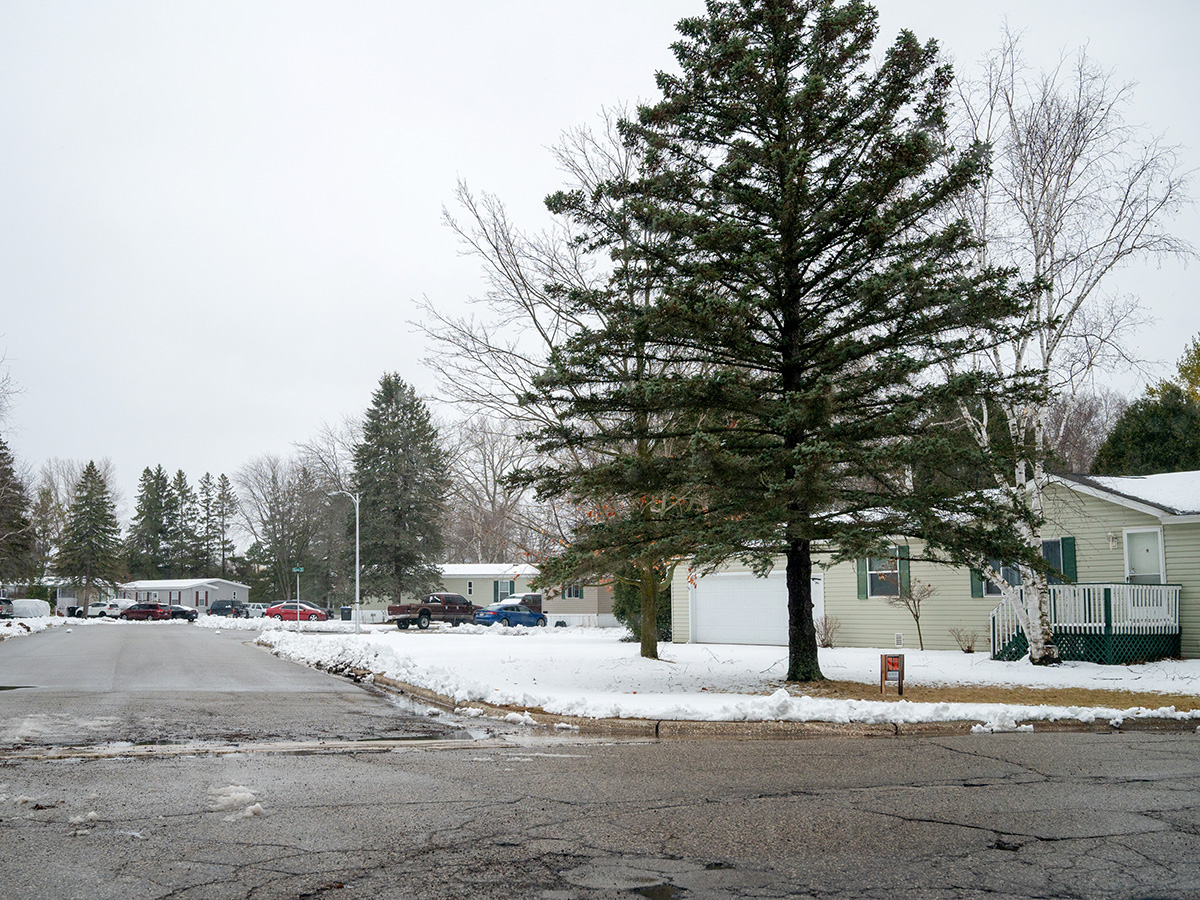
Carlton Heights mobile home park in the Town of Egg Harbor has been experiencing infrastructure problems again, months after the county and state got involved last year over sewage and other issues.
Residents said the current owner, Abraham Anderson of Tennessee, is almost impossible to get a hold of and is unresponsive to messages.The park has had a series of corporate owners over the last decade.
Christina Valdivia and her family have owned a home in Carlton Heights for many years. They also own Sunrise Food and Drinks, a restaurant in Sturgeon Bay.
For a while the problems at the park seemed to be resolved, she said, but recently, septic alarms are sounding on the park’s holding tanks, and the red lights are on, indicating the septic tanks are full.
There have been no service vehicles or any other indication of the tanks being serviced to her knowledge, she added.
Validivia also reported the park’s gravel roads had deteriorated again, with large potholes pockmarking the only way in and out of the park.
Residents are paying about $565 per month in lot rent, but many are questioning what they receive in return, Valdivia said. She has left messages for the park manager in recent weeks, and so have other park homeowners, she said, but has not received a reply.
Wisconsin Assembly Bill 1049
Assembly Bill 1049 proposes a handful of changes that will protect manufactured homeowners from predatory park owners and preserve a critical affordable housing option, legislators who sponsored the bill said.
The bill calls for annual MHP inspections–right now inspections are triggered by complaints, and many parks go years without a state inspector on site. The bill would cap rent increases according to inflation and require park owners to notify residents when the park is to be sold or redeveloped, including offering residents the right to purchase the park.
Manufactured home residents own their homes, and rent the land it sits on. The homes are difficult and costly to move. Resident advocates have said this leaves homeowners vulnerable to being trapped when rents are raised.
Opponents of the bill include the Wisconsin Housing Alliance, which argues that rent control, right-of-first-refusal for home owners, and cooperative ownership models may have unintended consequences for parks.
Industry representatives say rent caps could discourage investment and make it harder for owners to fund infrastructure repairs and upgrades. They also contend that requiring owners to negotiate with resident groups before selling a park could complicate transactions and deter lenders or buyers.
Certain resident-ownership models may also expose homeowners to financial risk if residents take on community debt without gaining substantial equity in the property, according to WHA Executive Director Amy Bliss.
The bill was introduced at the end of the Legislature’s floor session in early 2026; because of the late introduction, there was no chance it would pass this session, according to Rep. Joel Kitchens, a Republican from Sturgeon Bay who represents Door County in the state Assembly. The goal of introducing a bill like this at the end of the session was to get the issue necessary attention, according to state assembly Democrats who sponsored it.
This topic has “flown under the radar” in Door County, according to Kitchens. He said his office has not received any complaints or communication from constituents about manufactured home parks in Door County.
“Most of the legislation I’ve written has come from people pointing out problems,” he added. “They are probably not getting the support they need and it sounds like there’s a lot to be looked at. A hodgepodge of regulation makes it easier for people to be taken advantage of and knowing they are vulnerable, and to an extent, ‘trapped’.”
AB 1049 as it is written needs to be studied to strike a balance between consumers and owners, Kitchens said.
“Ideally the free market would bear this out, but that doesn’t seem to be working completely well right now,” he said.
The issue deserves further study, Kitchens said, and he is willing to look into it during the next legislation process. He also said he encourages his constituents to contact his office with issues and concerns.
Several municipal and state governments around the country have enacted, or are looking at enacting, similar policies to protect MHP residents.
Why manufactured home parks matter for affordable housing
Manufactured homes are one of the last sources of unsubsidized affordable housing, but it can be confusing to understand what exactly a manufactured home is versus a mobile home or trailer.
In 1976 the Department of Housing and Urban Development, or HUD, introduced mandatory and more stringent building and safety codes to the manufactured home industry. A mobile home built after June 15, 1976 is officially considered a manufactured home, and anything from before that date is a mobile home or trailer home.
In Wisconsin, three or more manufactured homes placed on the same property are required to be licensed as an MHP.
With Door County’s tight housing market, high rents and a lack of truly affordable housing, MHPs offer a path to home ownership. Local lot rents for an MHP in Door County range from $265 a month to $765 on the higher end. Thunderhill Estates in Sturgeon Bay is on that higher end, and park management listed lighting, paved roadways, green space and other resident amenities in the park as part of the reason for higher rent.
The park owner of Willems Court in Little Sturgeon Bay, Lisa Baxter, charges $300 a month to the 17 residents who have homes there. Almost all of the residents of Willems Court are seasonal, she said. She recently raised lot rents to help with electricity upgrades in the park and said it was the first time rents increased in 25 years.
Regulatory patchwork
MHP oversight is managed by a patchwork of state and local agencies, and record-keeping is spotty, as Wisconsin Watch reported in a 2025 series about manufactured homes.
Simply finding out how many licensed parks exist in Door County is difficult. The county does not keep a list, because it is not responsible for licensing parks, according to Karyn Behling, the county’s Land Use Services director.
The state Department of Safety and Professional Services oversees licensing, except in the dozen or so counties that have delegated authority. In addition, some municipalities have their own ordinances regulating MHPs.
In Door County, the City of Sturgeon Bay, Villages of Egg Harbor, Sister Bay, and Forestville, and the Towns of Gardner and Nasewaupee all have local ordinances governing MHPs in their communities.
A comprehensive list of MHPs in Door County can be found in the county’s 2022-2026 Hazard Mitigation Plan. The list shows 23 parks, with a total of 732 units. Parks in Door County include a mix of seasonal and year-round residents, and many of them are made up entirely of seasonal homes.
However, a 2023 list obtained from DSPS and the department’s online license search tool shows there are just six MHPs in Door County with active state licenses. The parks located in municipalities with their own ordinances have active local licenses
Baxter shares ownership of Willems Court in Little Sturgeon with her sister, and she has lived there her entire life. The siblings inherited the park from their parents 25 years ago, according to Baxter, and the state has not been to the park for an assessment or inspection in that time period. The park’s license is not currently active.
The state also has the incorrect number of homes listed for the park, Baxter said, and they have made attempts to update the park license. She described being on hold with DSPS “for hours” to no avail.
DSPS is responsible for licensing and inspecting MHPs, but performs no regular inspections. According to state law, park inspections are required upon completion of construction of a park or when a park is modified, and they are also triggered when the department receives a complaint.
The state has two Uniform Dwelling Code inspectors that are tasked with inspections of MHPs, according to John Beard, communications director for DSPS. The agency does not have an annual record of inspections, he said, and would be dependent on complaints received.
If AB 1049 were to pass as written, the state does not currently have enough staff to perform annual inspections of Wisconsin’s roughly 1,000 MHPs, he added. In a fiscal estimate of the bill’s impacts, funding would be needed for additional staff or contractors, according to DSPS analysis, and one way to do that would be to increase manufactured home park licensing fees.
Resources for manufactured home park residents and owners
For manufactured home park residents and owners, it may be confusing knowing what agency to contact when issues arise. Click here for a list of responsible entities.
The bill also eliminates delegating park inspections to counties, putting more workload back on the state, according to Beard.
County authorities are responsible for enforcing sanitation laws, as Door County did when Carlton Heights residents had sewage surfacing in their yards last year. The county’s involvement was triggered by a complaint made to the public health department.
Local zoning authorities regulate where MHPs can be created, and disputes between manufactured home owners and park owners are under the oversight of the Wisconsin Department of Agriculture, Trade and Consumer Protection, as they are considered landlord/tenant issues.
Between DSPS, county governments, municipalities, and DATCP, there are four separate potential authorities responsible for different regulatory issues, leaving some MHP residents unsure of where to turn when problems arise.
Local jurisdiction, inspections and record-keeping
While DSPS is responsible for inspection of MHPs and enforcing the related Wisconsin administrative code, there are 18 counties that have delegated authority for the MHPs in their area. Door County is not one of them, but there are several municipalities within Door County that require local licenses for MHPs.
Wisconsin counties with local oversight and the Door County municipalities with their own ordinances were better able to answer the question Door County officials could not: how many MHPs do you have?
In the case of Adams and Juneau counties, they have a contract with neighboring Wood County for environmental health services, including the permitting and inspection of MHPs, according to Mariah Heiman. She is an environmental health specialist in Wood County.
There are roughly 60 MHPs in the three counties, and all of them receive an annual inspection, she said. Inspections look for maintained streets, adequate parking, how garbage is dealt with, park management and an approved water supply. Common violations have to do with road maintenance, garbage and rubbish disposal and missing lot numbers, Heiman said.
If a violation is found three times in a row, as long as it is not an imminent danger, such as exposed sewage or contaminated water supply, there will be a re-inspection with extra fees charged to the park owner. If there is imminent danger, proper authorities are alerted and further enforcement action is taken, she said.
If an owner is unresponsive, additional enforcement steps are discussed with the county corporation counsel, Heiman added.
St. Croix County also has delegated authority to license and inspect its 18 MHPs. The county public health department performs routine inspections every fiscal year, and when the park is modified or a complaint is filed, according to Adam Kastonek, St. Croix’s public information officer.
Over the last five years, site maintenance and sanitary conditions were the most common reasons for citations, he added.
The City of Sturgeon Bay, Villages of Egg Harbor, Sister Bay, Forestville, and Gardner, and Towns of Nasewaupee also maintain lists of the MHPs in their jurisdictions. Most of the local ordinances do not require an annual inspection and follow the state’s requirements for inspections. The municipalities do require an annual renewal of an MHP license and a fee.
Manufactured home park oversight in Wisconsin can be difficult to track and enforce, as responsibility is divided between different agencies and state inspections triggered only by complaint. Supporters of Assembly Bill 1049 say the legislation will address that regulatory uncertainty.