

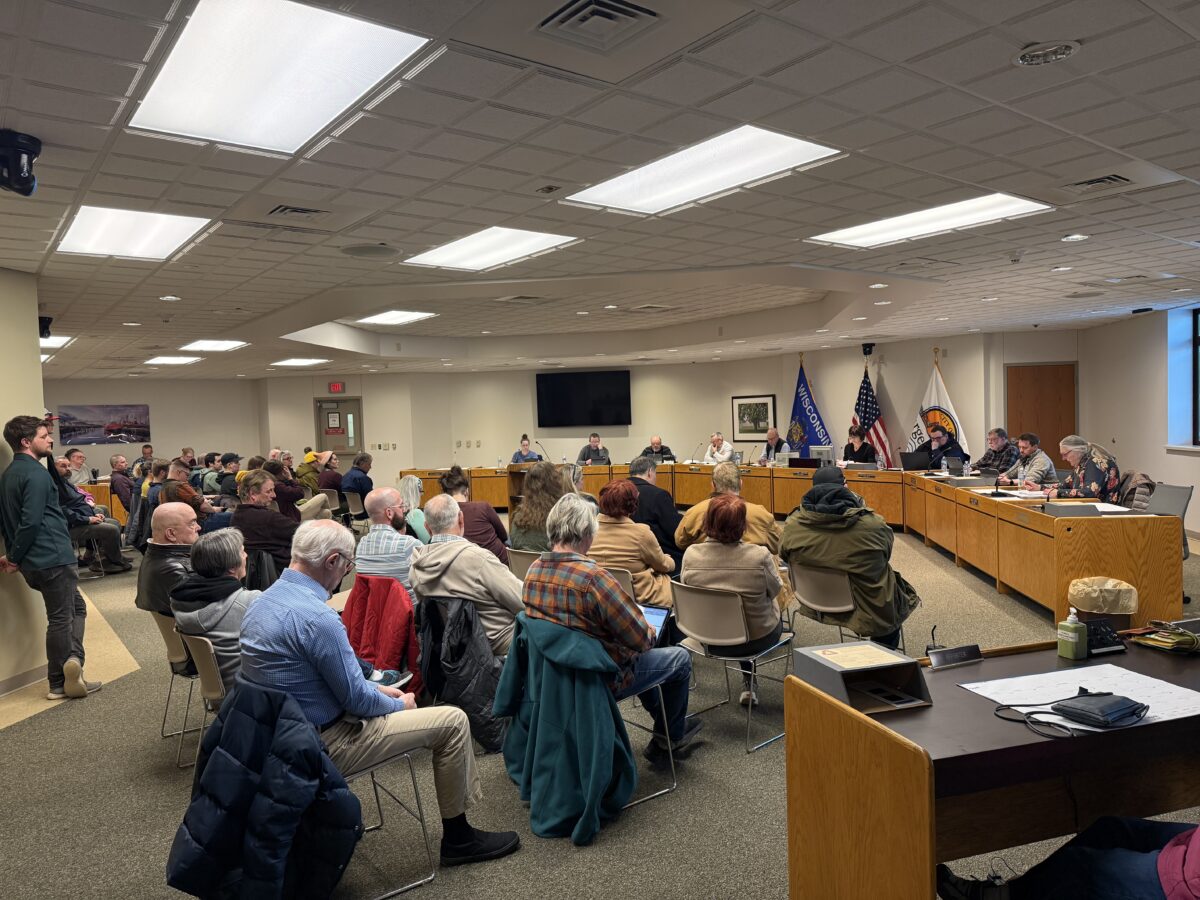
When Sturgeon Bay Mayor David Ward asked if anyone would like to make a motion to renew the city’s roughly $52,000, 21-month contract with Flock Safety, no one said a word.
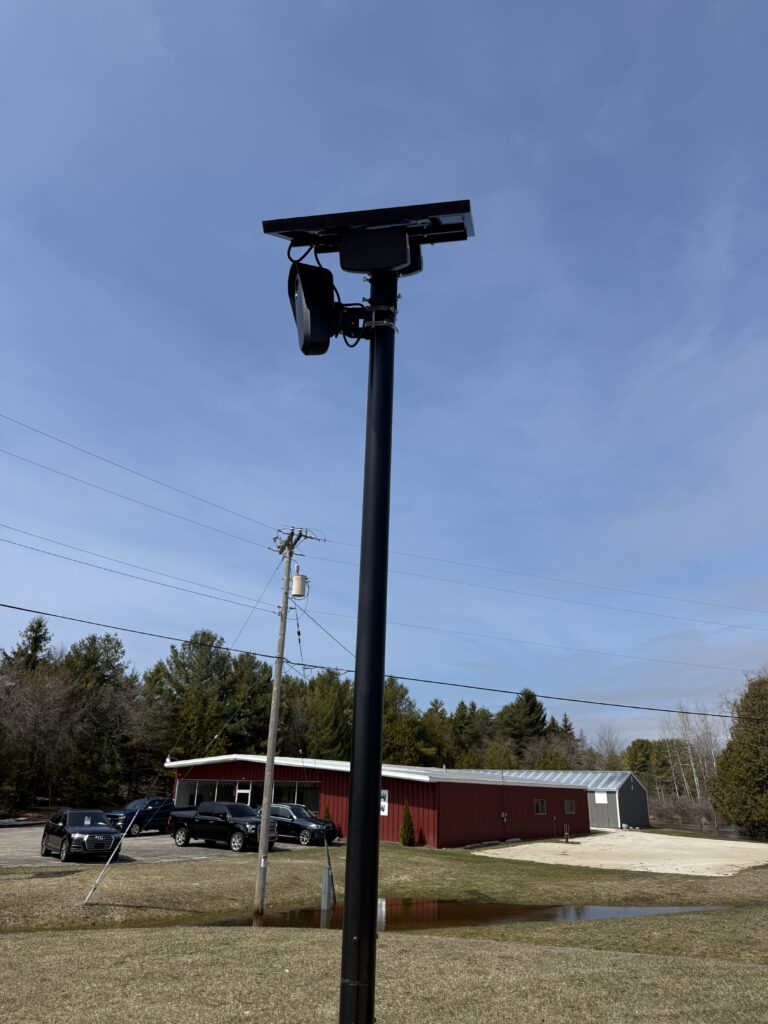
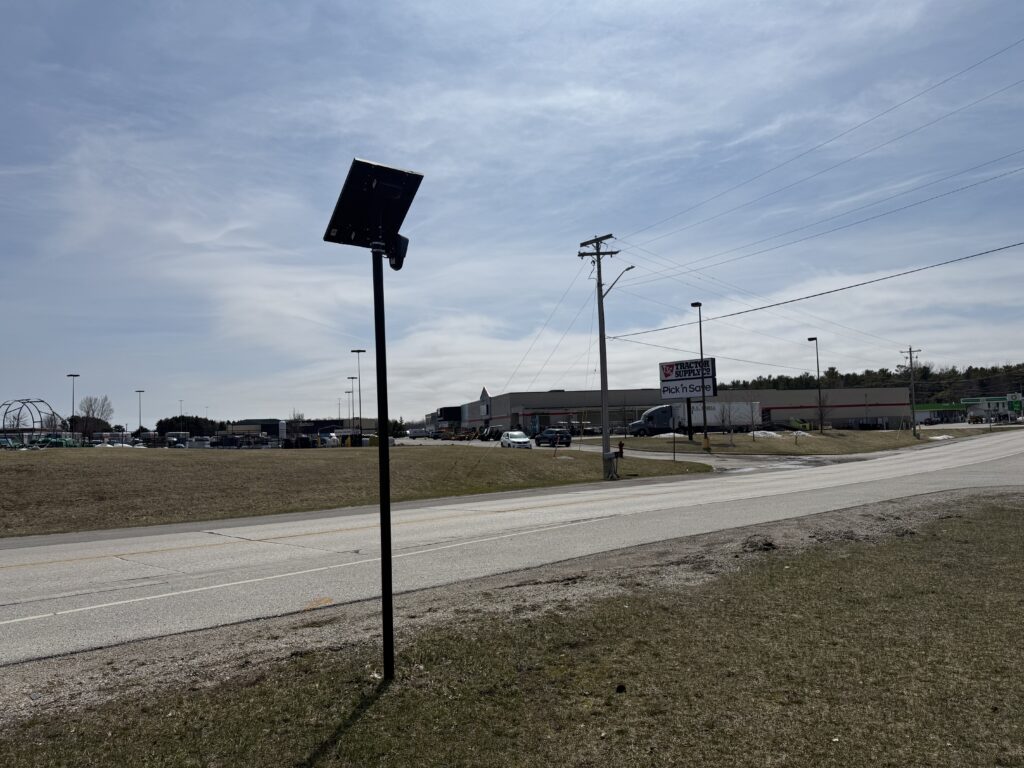
As a result, the pending renewal died on the floor, and the 10 Flock cameras around Sturgeon Bay will be removed. The cameras are automated license plate readers, or ALPRs. They take a point-in-time image and description of every vehicle that passes the camera, as well as the date, time and geographic coordinates, and are used in law enforcement investigations. The cameras were installed in February 2024.
Even if local law enforcement is no longer using the cameras, Door County drivers will encounter them in neighboring Brown County and other Wisconsin communities. According to deflock.org, a website that is critical of Flock and ALPRs and tracks where the cameras are located, there are 1,462 cameras spread across over 20 municipalities in the state.
Chamber seating was filled at the April 7 regular Sturgeon Bay Common Council meeting. During public comment, 12 Door County residents spoke against the contract’s renewal, and the city also received one email in opposition. Former Alderperson Kirsten Reeths was the only person who spoke in support of the cameras at the council meeting.
“No one motioning means no one is going to support the item,” explained District 7 Alderperson Nicole Matson, and the renewal dying on the floor indicates that the entire council was unwilling to renew the contract. Robert’s Rules of Order, the guide to parliamentary procedure that dictates how official meetings should be run, discourages bringing forward a motion in the negative–for example, making a motion not to renew the contract.
“Each alder has their own reason (for not supporting renewal),” Ward said after the meeting. “But 12 people spoke against it in public comments, and that’s a lot. Usually if two or three speak on an item, that’s a lot.”
In March, the city’s finance committee referred the matter to the common council for a decision, after hearing public concerns and information from law enforcement about the cameras.
Other communities across Wisconsin and the nation are grappling with the use of Flock cameras by law enforcement. By the company’s own estimation, it has cameras in over 5,000 communities in 49 states and connects over 4,800 law enforcement agencies.
The controversy that surrounds these cameras includes issues of privacy, data ownership, misuse, the scale of these networks and who can access, search and act on the information they provide.
“It’s simply not safe. The data and information security that Flock is beholden to is not sufficient for its role in this community,” Sturgeon Bay resident Nick Torsky said during public comment. Torsky added he is employed in the tech industry, working with data, AI and image processing.
“I feel safer to have them,” Reeths, a supporter of the cameras, said during public comment. “We have security cameras all over to protect us…there is only a small fraction of those that abuse it.”
The Sturgeon Bay Police Department is the agency that uses the cameras, and they share data with several other agencies in Wisconsin and some neighboring states, according to Capt. Chad Hougaard, who administers the system for the department. He said the department has strong safeguards and oversight on who has access to the data and for what purpose.
Several opponents of Flock’s renewal said while they trust their local police, they do not trust federal law enforcement or the security company itself.
“My opposition to Flock is not due to the integrity of local law enforcement,” Michelle Hroma, a Sturgeon Bay resident, said. (Disclosure: Hroma also is a volunteer with Knock.)
Council members expressed a similar sentiment, in conversations after the meeting.
The Sturgeon Bay police department “went above and beyond” in handling and keeping people’s data safe, according to District 4 Alderperson Spencer Gustafson.
Though he has seen firsthand how ALPRs can help solve crimes, especially in missing children cases, Flock’s data security is not strong enough, he said. Nor is there any federal or state regulation of these kinds of systems’ data security, he added.
“Unfortunately once that data goes beyond Sturgeon Bay, we can’t guarantee how it’s used,” Gustafson said. “And we have no guidance from the top.”
Professor Alan Rubel is the current director of the University of Wisconsin-Madison’s Information School and former director of the Center for Law, Society and Justice. He specializes in information ethics, law and policy, privacy and surveillance, and bioethics. He said Flock cameras were not on his radar until September of last year, but they have become a hot topic amongst his students.
Students enrolled in Rubel’s “Surveillance, Privacy, and Police Powers” class this year are “animated by it…it’s touching a chord,” he said.
What Flock is, and is not
Law enforcement can use the data captured by Flock cameras as part of a searchable, nationwide database, and the system can be searched by license plate number, time frame and location, according to the company’s website.
Captured data can also be used in connection to “hot lists.” These are lists generated by various law enforcement agencies, including the National Crime Information Center, Crime Information Bureau, and the Wisconsin Department of Transportation. Flock cameras send an alert when there is a hit, or a match to a vehicle on such a list.
Flock Safety was established in 2017 and started out as a security tool for homeowner associations and private businesses. The company expanded into law enforcement a few years ago.
The cameras are not video systems, they do not detect human beings and they do not have facial recognition software, according to information provided by Capt. Hougaard to the city finance committee.
SBPD shared access to their system with around 200 law enforcement organizations in Wisconsin and about 200 outside the state, most of them in the Chicago area, according to Hougaard. The department only shares access with organizations that allow them access in return, and SBPD does not share data with any federal agencies.
Data sharing
Flock uses a “social network” model of data sharing, allowing law enforcement, businesses and private entities to opt in to sharing data–similar to accepting or sending friend requests on Facebook.
The model is what keeps the data under local control, according to both SBPD officers and company representatives. If police do not consent to sharing data, its data cannot be accessed by retail stores or HOAs, limiting concerns about businesses having access to law enforcement data, they said.
However, law enforcement often gets agreement from private sector entities to use data for investigations. This is effectively expanding law enforcement’s surveillance footprint without public approval or oversight, Hamid said.
Local context and perspective
SBPD is not the only local law enforcement agency that has used Flock cameras.
Washington Island had one camera installed at the ferry dock in 2025 after an anonymous donor paid the first annual subscription fee of $3,650. There was some community opposition to the camera, and the town ultimately decided not to renew its subscription when the donated funds ran out. The camera was removed in January.
The cameras in Sturgeon Bay were adopted after a string of vehicle thefts in 2023, according to Police Chief Clint Henry. During that investigation, the department was given access to the database by Flock and got hits in Green Bay, Milwaukee and Sheboygan, he said. That information helped in solving those cases, and SBPD began looking into adopting the system itself.
The cameras have been used in stolen vehicle and missing persons cases locally, as well as in an arson case on Washington Island, Henry said.
The law enforcement agency using the cameras has control over who accesses that data, according to both local officers and Flock Safety itself. SBPD’s data is inaccessible to federal agencies, because that particular setting has been explicitly turned off, according to Hougaard.
Additional safeguards in place also include 30-day data retention limits, audit logs, and officers must use a case number to search the system, he said. Hougaard stressed that outside agencies must get clearance from Sturgeon Bay to access any of their data.
“If it meets our policy, we will search for them,” he said. “Our officer will pull a case number called an ‘agency assist’ and they must document the narrative–for example, ‘on this date, we were contacted by Door County Sheriff’s to search for this plate, checked our Flock system and got reads or not’.”
Though police cannot always say successful case outcomes are directly attributable to Flock, the loss of the system “definitely takes a tool out of our toolbox to use….it’s going to hamper us for sure,” Henry said. “The bottom line is, if you’re not doing anything wrong, you have no reason to worry about that system.”
Regarding public opposition to the cameras, Henry thought there was some misinformation about how the system works, but he understands that residents have fears.
“If you trust us, let us use the system to help protect you,” he said. “I do understand why people feel that way. It seems like the distrust in the feds is bleeding into our local government.”
Ultimately, it is the taxpayers’ decision, he added.
“If they don’t want it, we don’t have it.”
Civil liberties and privacy concerns
Some public concerns stemmed from a civil liberty perspective—including from organizations like the American Civil Liberties Union and Electronic Frontier Foundation, a nonprofit organization that advocates and lobbies for online privacy measures and against government surveillance.
There are general surveillance-related civil liberty concerns with Flock, EFF Director of Strategic Campaigns Sarah Hamid said during a phone interview, particularly in regards to immigrants and persons seeking reproductive healthcare.
Hamid cited a case in Johnson County, Texas where an officer searched the nationwide Flock database–-around 83,000 cameras–to locate a woman who had self-administered an abortion, which is illegal in that state. Though authorities contended they were searching for the woman for her own safety after family contacted law enforcement, court records showed the case was actually being considered a “death investigation” of a “nonviable fetus,” and the sheriff’s department considered criminal charges against the woman.
There are also concerns about federal immigration authorities and agencies using the system to target and track people.
Flock is a “pervasive surveillance system” that captures all drivers’ information, not just those related to law enforcement investigations, according to EFF.
“It has become possible to have massive amounts of privacy violations happening at a large scale because the data is sprawling and largely accessible,” Hamid said. Mass data collection captures everyone, not just crime suspects, she added.
“99.99 percent of that data has no law enforcement relevance,” she said.
That matters from a Fourth Amendment perspective, according to Rubel at UWM.
The Fourth Amendment states: “The right of the people to be secure in their persons, houses, papers, and effects, against unreasonable searches and seizures, shall not be violated, and no Warrants shall issue, but upon probable cause, supported by Oath or affirmation, and particularly describing the place to be searched, and the persons or things to be seized.”
But the amendment doesn’t just protect privacy, according to Rubel, it protects arbitrary exercises of power by police or other government actors.
“Once the cameras are trained and that data is there, there’s no Fourth Amendment protection against agencies using it,” he said. “They don’t have to get a warrant and they don’t have to have a reason. They can just search whoever they want.”
The Flock system increases the public’s exposure to arbitrary action by police, Rubel said.
“We hope that police don’t exercise this arbitrarily, but sometimes they do,” he said.”We don’t want to just rely on them not doing it when there’s a legal pathway to do it. That’s where my concern starts, my spidey sense tingles.”
A lot of the privacy and civil liberties concerns hinge on trusting law enforcement. The way the system is used depends entirely upon how each agency administers it and the policies they have in place, according to Flock Public Relations Manager Paris Lewbel.
“We don’t own the data, the customer does,” he said in a phone interview.
Occasions of misuse of the system by police have also been documented. Over the last year, officers in Milwaukee and Menasha have been accused of using the system to stalk ex-partners.
Flock is a private company holding massive amounts of data and is not accountable to voters or public records laws, Hamid pointed out. That’s a civil liberties issue because “it cinches back down to a single point of failure. One vendor has the servers that all of the data is being captured on, one single point of vulnerability.”
Safeguards and their limits
Data retention limits, audit logs and required justification fields are safeguards against misuse, according to Henry and Hougaard. SBPD also has a strict policy for use of the Flock system.
During a demonstration of how SBPD can search its Flock data, Hougaard showed how officers must enter three search fields before accessing the information. An offense type from a pre-selected list needs to be entered, as well as the related case number and reason for the search.
The latter two are not “hard-coded” fields, meaning someone could enter a fake case number or invalid reason, but Hougaard performs regular audits of the system and gives a monthly report on how many times it is used, he said.
“I think our officers are very cautious with it,” Hougaard said, and he would be able to identify if the system had been misused.
Critics say safeguards can fall short. Retention policies can be bypassed via screenshots, exporting data and emails, according to EFF’s Hamid.
Any downloads of ALPR data by SBPD is stored in a case file, Hougaard explained and is subject to the same safeguards fingerprints or crime scene photographs are.
“At that point it becomes evidence,” he said.
“We did everything possible to minimize issues,” Henry added.
In the end, members of the public speaking up to their elected officials resulted in the city no longer using Flock cameras for law enforcement.
Ideally, that’s the way the system should work, Alderperson Gustafson said. “It’s pleasant to have an overwhelming majority of public comments and the council follows suit. It’s a prime example of where voice matters.”
Even though Sturgeon Bay opted out of its Flock contract, data still flows from nearby jurisdictions and public surveillance will remain an issue for communities to contend with.