

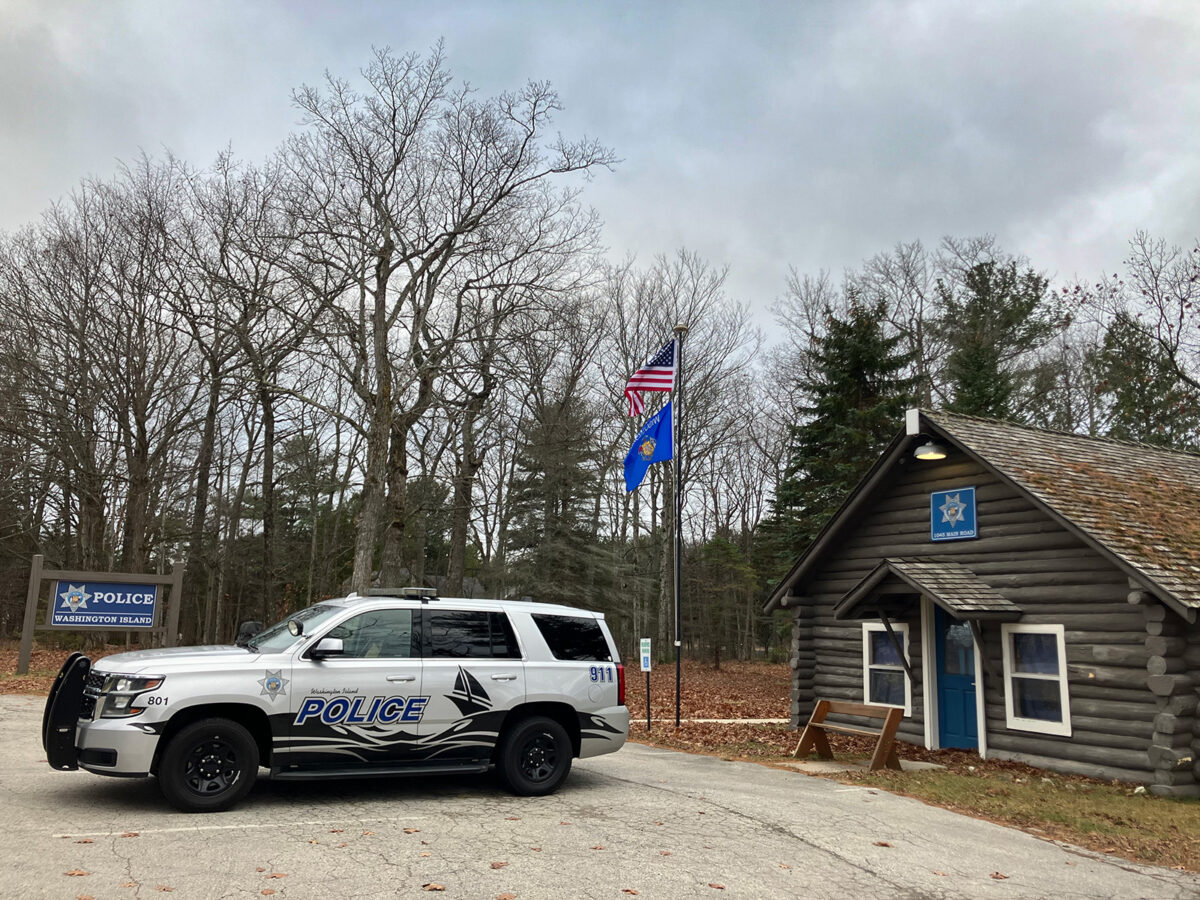
Just shy of one year on the job, April 24 was Ulises Ponce’s final day as one of two officers with the Washington Island Police Department. Besides being unable to find long-term affordable housing, Ponce resigned after what he described as mounting backlash from residents and frustration with how complaints about his methods were handled by the town.
The town publicized six resident complaints before any investigation, and later dismissed them without disciplinary action. The outcome left both the officer and complainants dissatisfied, raising bigger questions about how town-run police departments handle complaints.
The complaints
Six complaints from island residents about Ponce’s policing methods were published in a Feb. 19 town board meeting agenda packet, prior to any investigation into them by the board or Police Chief Gary Schultz. Three of the complaints were submitted anonymously.
Most of the complaints centered around what residents felt was aggressive, preemptive traffic enforcement, viewed as intimidating, excessive and out of line with community expectations. Concerns about speeding and reckless driving by the officer were also raised.
One anonymous complainant stated, “following drivers aggressively in hopes of manufacturing a violation crosses a line when enforcement shifts from responding to the actual wrongdoing to ‘fishing’ for stops. It begins to resemble intimidation and predatory policing. In a close knit community like Washington Island, those practices are unacceptable.”
Washington Island Town Clerk/Treasurer Alex McDonald said she often helps Chairman Peter Sownie put together agenda packets, but the board chair is ultimately responsible for what is included.
McDonald said complainants specifically requested the documents be part of the public comment and record of the board meeting, and she errs on the side of being as transparent as possible with packet information.
“These are serious issues people have,” she said. The town office has also received several queries in the last few months regarding the correct way to complain about an officer, she added.
“People don’t know,” she said.
Schultz declined to comment when asked if he thought the town made the right decision publishing the complaints in a packet.
There is a complaint form available at the island police department, according to Sownie, and he encouraged residents he spoke with to use it. None of the complaints in the packet were filed using that form.
“If you really expect something to be done that’s the best way to do it,” he said.
Using the department’s official form is best, agreed Washington Island Police Chief Gary Schultz, but he investigates complaints received by the town as well.
The board acknowledged the complaints and its responsibility to review them and take action at the February meeting, according to Sownie. The board held two closed sessions with Schultz and directed him to review and validate the complaints and determine appropriate disciplinary action, if any.
During the town board’s March 26 meeting, Supervisor Richard Ellefson made the following statement:
“Police Chief Gary Schultz reviewed the complaints brought forward in the Feb. 19, 2026, Town Board Meeting and concluded that no disciplinary action will be taken.”
Complainants’ perspective: lack of follow-through
Some residents said they did not receive satisfactory responses to their complaints.
Aaron Bresnahan and Hannes Johnson both wrote letters to the board, citing specific incidents where they felt Ponce’s behavior was unwarranted and unsafe.
Bresnahan felt Ponce was unwarranted in pulling over a vehicle he was a passenger in, and indicative of a greater pattern of “lousy excuses to pull people over just because they have had their vehicle at a tavern,” according to his complaint.
Johnson and his wife said they witnessed Ponce driving recklessly fast.
“We feel that the officer driving the squad disregarded our safety, along with our daughter’s safety, and ultimately put all of our lives in jeopardy,” the complaint stated.
Neither Bresnahan nor Johnson received follow-up from the town or from Schultz about the results of investigation into the incidents, they said.
Stephanie Reiter said she had a problematic interaction with Ponce earlier this year. Her mother, Caroline Reiter, made a verbal complaint about Ponce during public comment at the February meeting. The Reiters did not receive follow-up from the town either, according to Stephanie. The family did request and receive body cam of the incident from the police department however, she said.
“The board decided their statement was enough (follow-up),” Schultz said, and according to department policy, anyone who fills out the department’s complaint form will receive a written response from Schultz after the matter is investigated.
“That doesn’t apply to complaints made to the town,” he said.
Ponce’s perspective: backlash
The Washington Island Police Department was Ponce’s first job after graduating from the police academy, and he said he came into the position with the goal of consistent law enforcement.
“Be yourself, be a police officer, enforce the law and do your job to the best of your ability, and you know, that’s what I feel like I’ve been doing,” he said.
However, he did not feel that some residents wanted consistent enforcement of things like OWIs and traffic violations, he said.
“I think they want us to be seen but not heard. They want you to respond to calls for service…but to a certain extent know who you’re not supposed to pull over,” Ponce said.
Ponce also said he experienced harassment in his off-duty hours that he felt may have been a result of what he perceived as an overall lack of support from the town, he said.
Island residents drove by his home and revved vehicle engines late at night, gave him the middle finger when he was with his family–he has a wife and two young children–knocked on his door when he was off-duty and called him racial slurs, he said. Ponce is Hispanic.
He felt there should have at least been a review or investigation of the complaints before publicizing them, he said.
“I think the way that the town handled things was not the right way,” he said, and that he felt unsupported by the board.
Ponce said he wishes it had been handled differently because it made his job more difficult. He stands by his policing methods despite the backlash, and said he has felt fully supported by Schultz as his immediate supervisor.
Law enforcement complaint process across the Door
It’s not mandatory for law enforcement oversight to follow-up with residents regarding the status of their complaint, but it’s good practice, according to Travis Thyssen, Town of Gibraltar administrator.
Gibraltar has a one-officer police department and a police and fire commission made up of three residents. The commission and Thyssen himself serve as the oversight body for public safety. Complaints go to Thyssen and the commission, he said. After review, the commission makes a recommendation if the complaint is valid or not and disciplinary action is taken from there. Thyssen then contacts individuals involved to let them know the status of their complaint, he said.
The City of Sturgeon Bay police department has a complaint form residents can fill out when they have concerns, according to Police Chief Clint Henry, but they can also be made verbally or in writing to the police department.
Depending on the nature of the complaint, a sergeant or the assistant police chief will look into it, he said. The assistant chief also serves as the department’s internal affairs coordinator. If the complaint is found to be justified and an officer broke departmental policy or the law, then as chief, he will recommend discipline, Henry said.
If an officer decides to fight disciplinary action, or if the officer receives criminal charges, the matter is then referred to the city’s police and fire commission, he said, but “most complaints don’t get that far.”
The Door County Sheriff’s Office has an online complaint form on their website, Professional Standards Captain Carl Waterstreet said, and while the office does receive email, written and verbal complaints, he said he tries to encourage people to use the form, as it discourages “frivolous” complaints.
Wasterstreet investigates complaints using body and vehicle camera footage and other documentation, he said. If the complaint is justified and an officer has violated internal policy, Waterstreet handles discipline. If an officer has broken the law, an outside agency will be brought in to investigate, he said.
The oversight body for the Sheriff’s Office is the county Judicial and Public Safety committee, made up of supervisors and community members. If any complaints are going to be published anywhere, it might be in the packet for that committee’s meetings, Waterstreet said, but the common practice is to forward them to him for investigation first.
“I don’t blame them on Washington Island for being as transparent as possible and open with the community,” he said, when asked about complaints included in a board packet. “But airing dirty laundry that much is probably not right.”
Providing clarity
Other Door County departments have a more formalized system to document, investigate and respond to complaints, something Washington Island is now trying to clarify.
In Wisconsin, in lieu of a police and fire commission, the town board is the oversight body if a municipality has its own law enforcement agency, as is the case on Washington Island.
“The town board is the ones who have to hire and fire, bottom line,” Schultz said.
At its April 16 meeting, the town board approved a policy clarifying the following:
- Complaints about town employees can be made in town meetings or in written communication to the town.
- All written complaints are to be forwarded to board members and discussed in closed sessions and that written complaints should not be included in meeting packets.
- Law enforcement complaints can also be made by filling out the official form at the police station.
This move to formalize its complaint policy suggests town officials recognized the need for clearer procedure. Emails obtained between Supervisor Margaret Foss, Chairman Sownie and Clerk/Treasurer McDonald in early April reflected that as well.
McDonald wrote the board, requesting a clear policy regarding town employee complaints and criteria for what should be included in board meeting packets. The public can make complaints and “accusations” during public comment in town meetings, according to Sownie’s response, but the town should refrain from “publicizing” such things in the packet.
“I can also share my opinion. In matters where Town employees are the subject of a complaint and individuals are named, I believe such letters should remain private and not be published in the monthly packet,” Foss agreed.
Policing in a small community
To some degree, the taxpayers determine the police’s level of law enforcement, according to Waterstreet.
“Public safety is paid for by taxpayers, and there’s a level of propriety we have to follow,” he said. “The public has a right to know what’s going on with us.”
More of a “community policing” method is necessary in small towns, Waterstreet said. Having conversations with community members and knowing the dynamics can be difficult for someone brand new to the community like Ponce, he added.
Schultz also talked about what community policing looked like in a small town like the island.
“It’s what we do every day, stopping by WICHP (Washington Island Community Health Program), the grocery store, teaching CPR and first aid at the school, having a cup of coffee and learning what’s going on around town,” he said. “You gotta get out of the squad car without the lights on.”
There is no difference between enforcing laws on the island and anywhere else however, Schultz added, and expecting leniency because someone is “local” is unrealistic.
Ponce said that he intends to specialize in OWI enforcement and training as his career continues. While he understands using discretion, and he likes small town policing, entrenched practices do not trump public safety, he said.
“There’s a lot of people that walk here on this island. There’s a lot of kids that ride their bikes. There’s also a lot of people that drink here,” Ponce said. “And I don’t want to ever feel like, if something happens…I don’t ever want to feel like, where was I at that time?”
Washington Island is currently recruiting for another officer and determining whether the island will need law enforcement coverage from the Sheriff’s Office in the meantime.
Correction: A previous version of this story misspelled the name of Ulises Ponce. The story has been corrected.
Update: This story has been updated to include a chart. The data in the chart was received after publication.
Correction: A previous version of this story stated the Reiter family submitted a letter of complaint to the town that was not published. That is not the case. The Reiters sent a letter to the police department requesting body cam footage of their daughter’s interaction with Ponce, which they received. The story has been corrected.