

In their first regular county board meeting on April 28, seven new supervisors joined the rest of the board to take action on two local environmental issues.
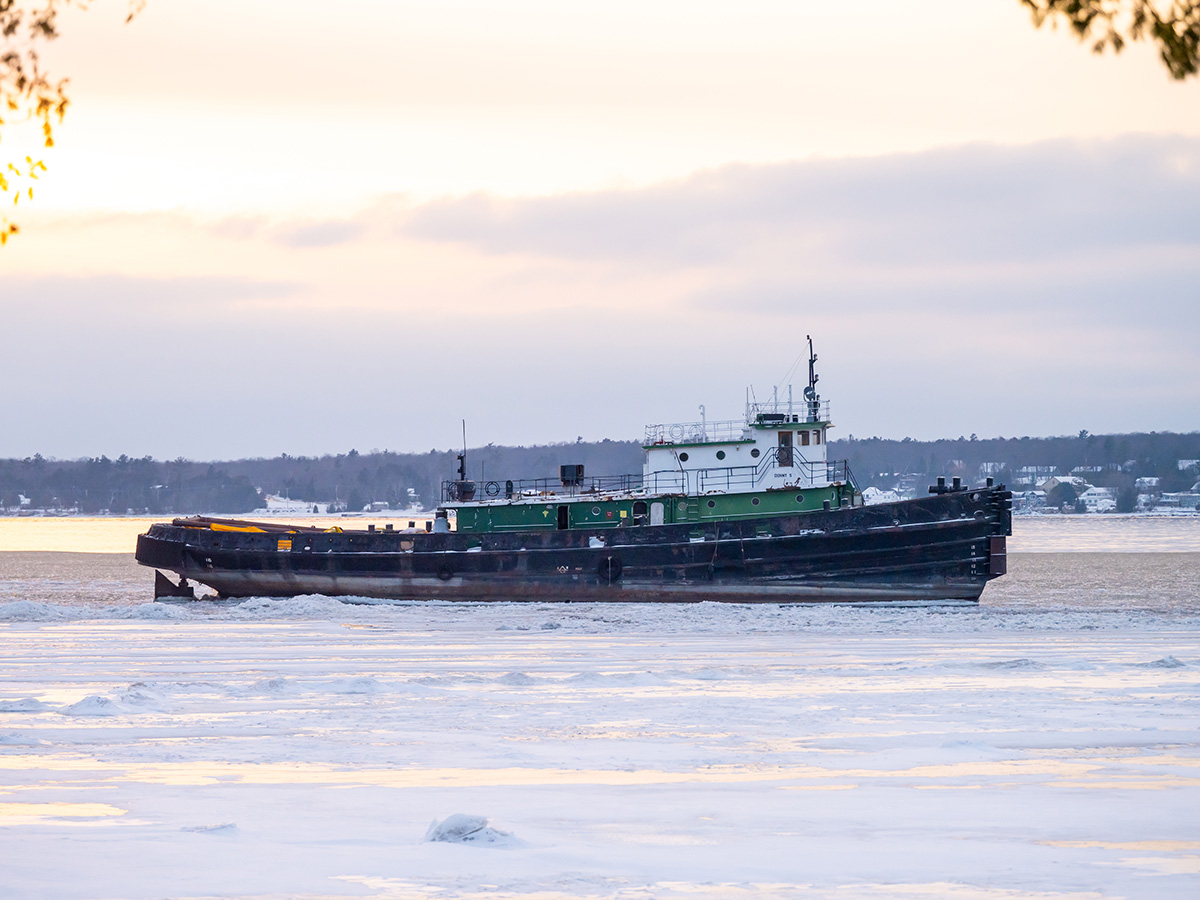
The board approved a resolution requesting the state legislature and Department of Natural Resources investigate and possibly remove an abandoned tugboat in Baileys Harbor.
The board also voted to join other Wisconsin counties in a national lawsuit against PFAS manufacturers.
Abandoned vessel
The Donny S. tugboat has been stuck in Baileys Harbor since 2021, when it was brought there by owner Jeremy Schultz. After attempts to move the tug were unsuccessful, interested parties organized an informal work group to address the problem.
The group has met several times since 2022 and has included representatives from Andre Jacques’ office, DNR staff, county and town representatives, Coast Guard members, neighbors and environmental advocates.
Door County Corporation Counsel Sean Donohue said he discussed the county’s capacity to request state action on the tug at a recent work group meeting.
The Town of Baileys Harbor drafted and passed a similar resolution in February, urging the state legislature and the Wisconsin Department of Natural Resources to “take immediate action towards abating the hazard of the Donny S.”
The county resolution goes a step further and requests the DNR conduct an official inspection of the tug to determine if there are hazardous materials on board and to evaluate any environmental and structural risks, and take action to “secure, stabilize and remove” the Donny S. from Baileys Harbor.
The county, town and Coast Guard have all stated in the past they are not responsible for the abandoned vessel, and Wisconsin law is murky on the topic of jurisdiction.
“It became apparent that the state wasn’t providing funding to take care of this issue even though it seems to be a DNR responsibility,” Donohue said during discussion of the county resolution, and the county is asking the state to “provide funding at the state level to the allow the DNR to do its job.”
The DNR has fined Schultz over $20,000 and the amount was paid last July. No other fines have been issued since.
New District 19 Supervisor Preston Pluff expressed concern that if the DNR inspected the boat and found hazardous materials on board, the county would be responsible for costly removal. Pluff represents parts of the Towns of Baileys Harbor and Liberty Grove and Villages of Ephraim and Sister Bay.
“The county is not responsible, in my opinion, to remove this,” Donohue responded.
Pluff cast the sole dissenting vote against the resolution.
The DNR has not responded to requests for comment on the resolution and the tugboat’s fate in time for publication. Waterways Program Director Benjamin Callan said the situation “affects a number of DNR programs, so they need time to coordinate.”
PFAS contamination
PFAS, per- and polyfluoroalkyl substances, refers to thousands of human-made chemicals used commercially to repel water, grease and stains. They are used in several products, from nonstick cookware to firefighting foam.
Concerns about PFAS effects on the environment and human health have increased in the last decade. Called “forever chemicals,” they do not break down and can build up in soil, water, and living things. Most notably, several human health issues are tied to PFAS, leading federal, state and local governments to study and address their impacts.
National litigation
The county board voted unanimously to retain legal counsel and a contingent basis, and enter into multi-district litigation against PFAS manufacturers. If there is no money recovered by the county through this lawsuit, Donohue explained, the county will not need to pay out any money. Any expenses incurred by the litigation will be shared amongst all municipalities represented in the suit, he said.
Multi-district litigation is similar to a class action lawsuit, Donohue explained to the board, and he compared it to the opioid settlement lawsuits from several years ago. The lawsuit is attempting to hold manufacturers like 3M and Dupont responsible for “knowing the product was harmful, not pulling it off the shelves and continuing to market it,” he said.
The litigation is happening in three phases, he said. The first phase targeted drinking water, resulting in companies paying billions of dollars to remediate water contaminated with PFAS. The second phase focuses on personal injury claims, or people who were directly harmed by the chemicals.
The third phase relates to soil contamination and is where the county government fits in, according to Donohue. Litigation would include testing soil at airports and other county facilities to see what contamination may look like and seeking reimbursement from the manufacturers if harm has been incurred, he said.
Airports are hotspots for PFAS contamination because airport firefighting crews use foam to put out high-intensity jet fuel fires, and the Federal Aviation Administration requires regular training drills using the foam.
District 12 Supervisor Nissa Norton, representing parts of Sturgeon Bay, asked how many other Wisconsin counties have advanced the resolution. When the proposal was brought to his attention several months ago, there were at least seven others involved, according to Donohue.
“I imagine it’s really going to be ramping up. We won’t be a minority, we’ll be part of the majority,” he added.
“This is holding the manufacturers responsible, not relying on taxpayer dollars to fund remediation,” Donohue said, and the national litigation is independent of recent legislation passed by the state and signed by Gov. Tony Evers.
State legislation
Gov. Tony Evers signed two bills into law on April 6 that will provide millions of state dollars to mitigate and remediate PFAS contamination. The money will be in the form of community grants and programs.
It remains to be seen whether Door County will receive any of the funds provided by the state, according to County Administrator Ken Pabich.
“It is not clear how the funds would be made available,” he wrote in an email. “So at this time, we have not determined if we would be seeking funds.”
Once the county knows the focus of the programs, it can determine which departments might apply for funding, he added.
The DNR will be responsible for a lot of the testing, remediation and response indicated by one of the bills. The state agency will gain ten new staff positions to focus on PFAS as well. Many of those positions and funds will focus on drinking and groundwater, according to Sean Strom, an environmental toxicologist with the DNR, but fish and wildlife-focused programs like his will be able to sample more fish for PFAS.
County advisories and concerns
Sampling fish is important to understand PFAS safety because the chemicals build up in fish, and when consumed, can pass into humans. In 2024 the EPA finalized strict drinking water limits for two major PFAS chemicals after much consideration and public comment.
While federal PFAS limits are stricter now, the impact on Door County anglers and consumers depends on local testing and data. PFAS advisories in northeast Wisconsin have been limited in the past due to lack of data.
The DNR has a “very robust” monitoring program for fish from Green Bay, according to Strom, particularly fish collected from what he called the “southern bay,” Marinette to Sturgeon Bay and southwards. Monitoring of fish collected from the Lake Michigan side of Door County is more sporadic.
The DNR collects fish in even-numbered years from Lake Michigan and sometimes that includes fish off of Door County, and sometimes it doesn’t, he said. The DNR does not issue separate advisories for southern and northern Lake Michigan. Recommendations are usually shared jointly with neighboring states like Indiana, Illinois and Michigan, he said.
There are “do not eat” advisories for some inland water bodies in Wisconsin but none are currently issued for Door County. However, there are other fish consumption advisories for Door County, including fish caught in the Ahnapee River and some parts of the bay of Green Bay.
The DNR is currently reviewing updated advisories for waters in and around Door County, Strom said, and will release updates in late spring or early summer.
Door County’s Soil and Water Department is also closely monitoring PFAS levels in groundwater, according to Greg Coulthurst, department director. The county has two well-testing programs designed to create a database of local groundwater quality and changes over time.
The University of Wisconsin-Oshkosh steers one of the testing programs. The other is overseen through a contract with GZA GeoEnvironmental. Both programs target E. coli, nitrates, lead and arsenic, Coulthurst said, but they also measure emerging contaminants like PFAS.
“This emerging contaminant study was developed to figure out what’s going on there and see these trends developing and say, ’hey, wait a minute. We might want to limit this,’” he said.