

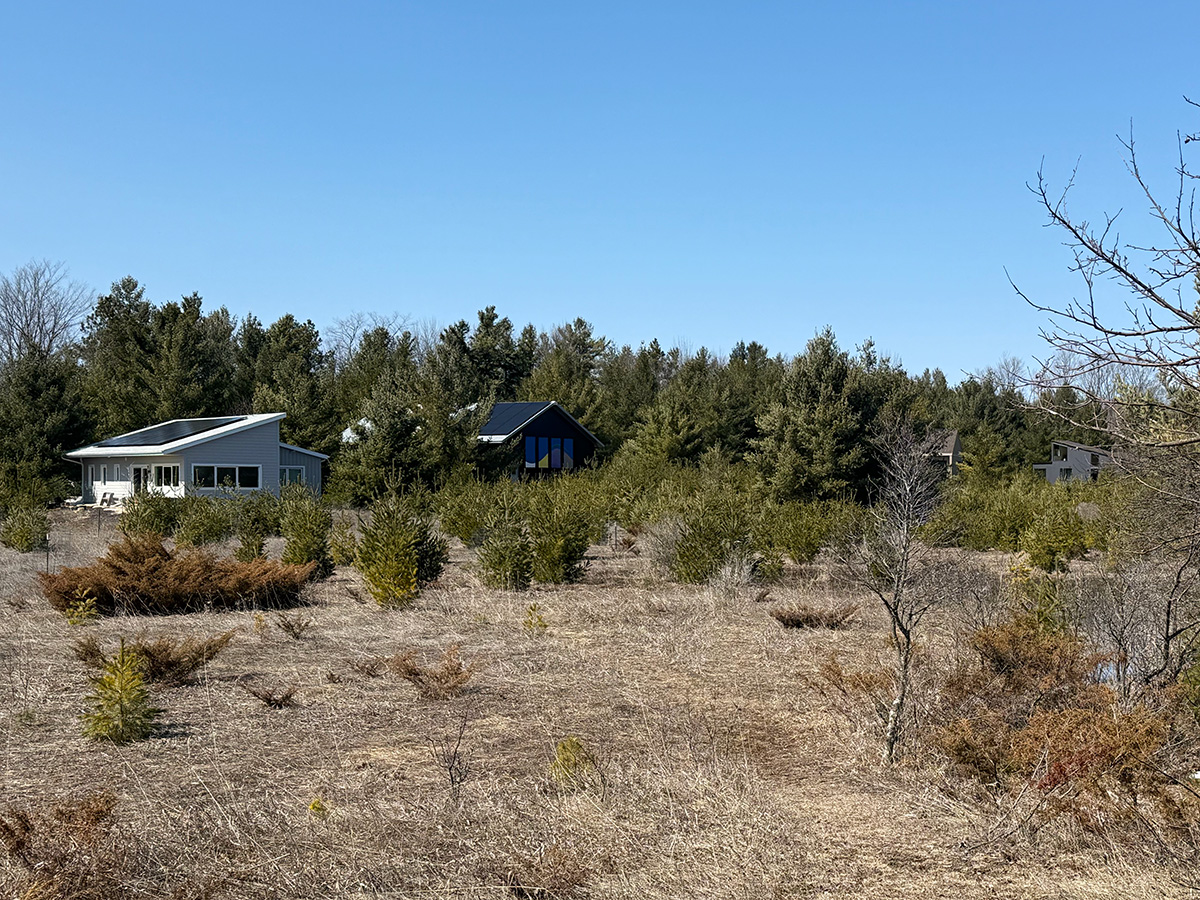
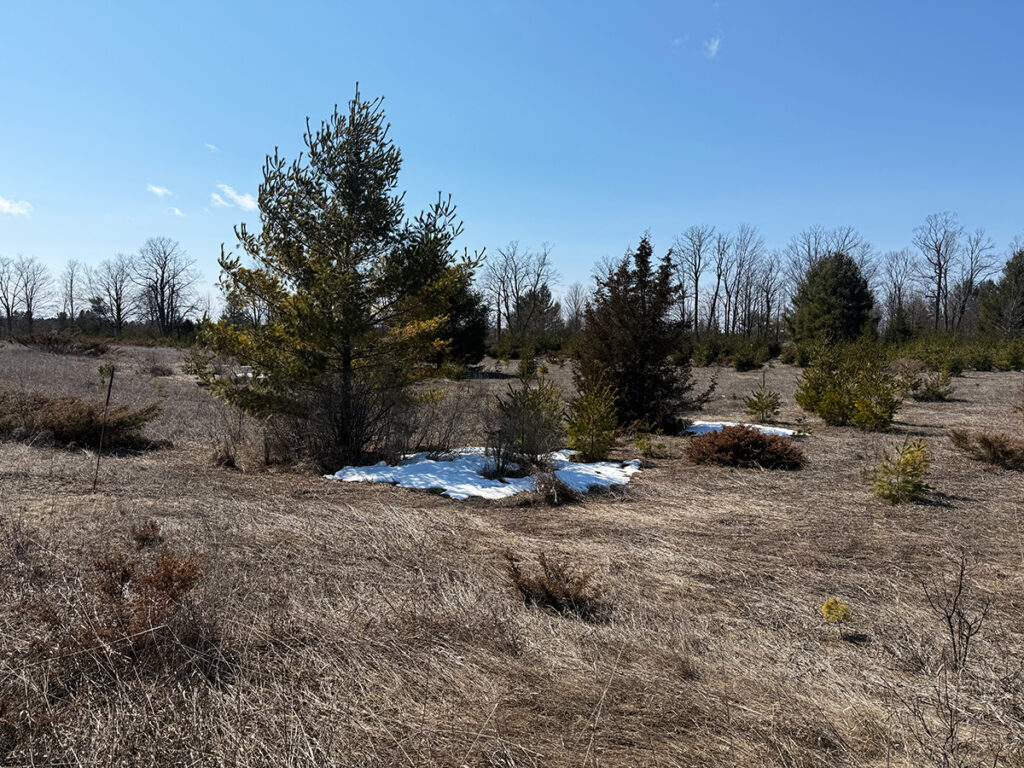
A driveway through a cathedral of 150-year-old maples and white pines leads to a cluster of homes. The old growth trees form a central axis, surrounded by former farm fields slowly being taken over by juniper and young white pine. A walking path winds up and over gentle hills, and rain water and snowmelt sit in low patches. Birdsong and wind wash over the area. The buildings appear to be neatly tucked into the landscape beneath the towering trees.
This is Boreal Preserve, a conservation subdivision in Baileys Harbor, and the brainchild of Jeff Lutsey.
“I definitely didn’t want anything to do with any suburban cookie cutter houses with lawns,” he said, explaining his project vision. (Disclosure: Lutsey is a donor to Knock.)
Lutsey is a mechanical engineer who moved to Door County several years ago. After living here a while and meeting other transplants who love the land and water, he said he began thinking about a way to “live and play” with other nature-minded folks. Developing a conservation subdivision was his answer.
Conservation subdivisions cluster houses on smaller lots than conventional subdivisions and permanently preserve large portions of land as open space.
In places like Door County, where land is at a premium, and significant and rare ecological systems abound, conservation subdivisions make a lot of sense, according to Maine’s Randall Arendt, landscape planner, site designer and author who has written books on conservation subdivisions. He has also helped communities facilitate their own plans, including Walworth County, one of the earliest adopters of conservation development ordinances in Wisconsin.
In fact, Arendt was in Door County more than twenty years ago, he said, giving county officials a presentation on this kind of development. About 15 years ago, the county’s Land Use Services Department was in the process of amending its zoning policy to make conservation subdivisions easier to develop, according to Mariah Goode, who was LUSD director at the time.
Most conservation subdivisions, including Boreal Preserve, are market rate or high-end properties. For example, in Waukesha County, there are 54 conservation subdivisions, and almost all of them are made up of premium or luxury homes.
However, these types of developments have the potential for being sources of both affordable housing and land conservation, especially in rural areas, according to Arendt and other experts.
A different kind of development
Conventional subdivisions spread homes evenly across land. For municipalities that operate under Door County’s comprehensive zoning code, there are minimum lot sizes required depending on the zoning district. Conservation subdivisions trade smaller minimum lot sizes for more shared open space.
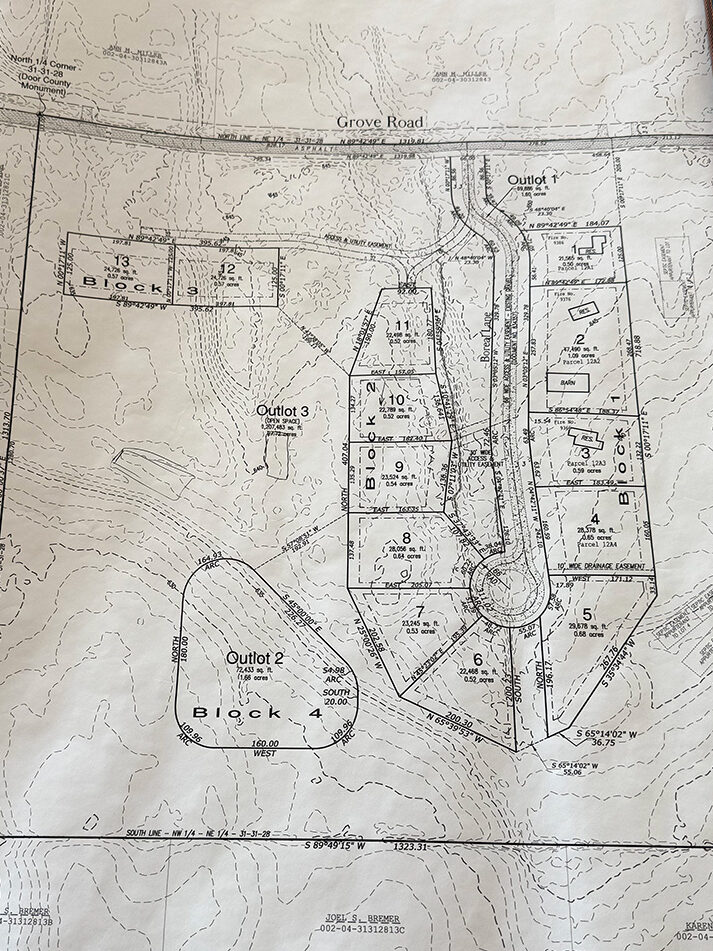
Boreal Preserve currently has three 1,200-square foot homes, each on a half-acre of land. There is room for a total of 13 homes. Thirty of the total forty acres in the preserve are part of a conservation easement with the county and cannot be developed, meaning no roads and no buildings. That open space is to be shared by Boreal’s homeowners, under a homeowners’ association agreement, according to Lutsey.
The land was under estate zoning when Lutsey bought it, meaning it was open to traditional development, with land split up into 5-acre minimum parcels. The conservation easement allowed that minimum to drop to a half acre.
According to a Door County ordinance, the purpose of conservation subdivisions is to preserve natural resources, agricultural land and open spaces, in exchange for greater density.
Smaller lots are possible within a conservation subdivision framework and homes are clustered more closely together. Reduced road lengths and shared infrastructure like septic systems and wells contribute to potential savings for developers and homeowners.
Lutsey is not a developer, but he said he had to be “enough of one” at first to get his vision off the ground. He worked with county planning officials extensively to help him understand regulations and formulas governing things like setback and easement sizes.
“There’s a bunch of things in there that the developers know immediately, but for someone that’s not a developer, you have to ask a million questions,” he said
Lutsey designed and built the three houses that are currently in Boreal Preserve. He lives in one and rents the other two homes to year-round residents. He experimented with design features to increase affordability and efficiency, but he said he does not want to be a builder or a developer in the long term.
Ideally he would sell the half-acre parcels with their one-thirteenth share of open space to individuals and they would build their home. Understanding the process and having some solid experience with building means he can share that information with future residents of Boreal Preserve, and other people who are interested in the conservation subdivision model, he added.
How conservation subdivisions can protect groundwater
When development cannot rely on public sewer and water infrastructure–as is the case for most Door County municipalities–installation costs for septic systems and wells are a hefty part of building a home.
In a conservation subdivision development, small, shared septic tanks with drain fields located in the open space area are ideal, Arendt said. Homeowners can share maintenance and service costs and this model ends up with better groundwater protection, he said.
In a conventional subdivision, land is sliced up into evenly-sized 5-acre lots and if a soil test for septic placement “passes even by a whisker,” it will be approved, he said.
“It’s beyond stupid to approve a subdivision where any lot is on really borderline soil,” Arendt said. “That happens all the time.”
With conservation subdivisions, the best spot for septic infrastructure can be chosen out of the entire acreage of open land, rather than 5-acre chunks. If you put systems on the deepest soil, rather than soils that just meet the minimum depth, “you’re going to have a much better functioning system, and your groundwater is going to be better protected,” Arendt added.
Safer drinking water is just one reason communities should make conservation subdivisions the norm, he said. Zoning and planning departments can do that by making these developments an option “by right,” he explained, meaning they would be the standard for subdivision developments.
In this case, “a conventional subdivision is going to be a special exception or a conditional use,” Arendt said. In most places, land use regulations are the opposite.
Door County has removed barriers
Door County zoning code already contains the tools conservation subdivision advocates like Arendt are asking for. The county adopted its conservation subdivision ordinance in 2011.
Unlike many communities, Door County does not require a conditional use permit or rezoning process for conservation subdivisions.
Minimum home sizes have been reduced to 500 square feet, shared wells and septic systems are allowed, and smaller lots–down to one-quarter of an acre–are possible.
The ordinance was not initially designed around affordability, according to former LUSD Director Mariah Goode, who helped create it, but limiting sprawl and preserving open space. However, there is potential for affordability to be built into a conservation subdivision design, she said.
Developers would save on roads and driveways because they are not as long as those in conventional subdivisions; shared wells and septic systems cost less and smaller lot sizes do not require as much earthmoving, tree-clearing and other costly development aspects, she said.
Door County has approved 14 zoning permits for conservation subdivisions, according to a report obtained from LUSD. Boreal Preserve has the most parcels at 13, with most of the other developments having only two or three. One has eight.
One of the permits that is still in the application process, is for a 38-parcel conservation subdivision in the Town of Gibraltar, called The Grove at Fish Creek. (Details were not available in time for publication, but Knock will follow this development for future coverage.)
Why many conservation subdivisions become luxury housing
Conservation subdivisions often market exclusivity by highlighting privacy and natural scenery, leading to higher-end homes on a protected landscape, according to Arendt, and he points to Waukesha County’s network of conservation subdivisions as an example.
Conservation subdivision design can lower development costs but it does not guarantee affordability, he said. Unless local governments require or incentivize affordability through density bonuses, he said, those savings turn to profit or luxury amenities instead of more affordable homes.
A density bonus means developers can build more homes than zoning would normally allow, in exchange for providing benefits like affordability or open space preservation.
In one of Waukesha’s dozens of conservation subdivisions, Lakeside Conservancy in Delafield, current homes listed for sale range from $1.8 to $5.9 million. In Racine, Woodland Waters is a conservation subdivision with a minimum square footage of 2,400 square feet, twice the maximum allowable at Boreal Preserve. Woodland Waters also requires a minimum three-car attached garage for every home.
Walworth County worked with Arendt in the early 2000s to draft a conservation subdivision plan, according to Corporation Counsel Michael Cotter. Affordability was not a part of those initial conversations, he said. The primary goal was land preservation.
None of the conservation subdivisions in Walworth County that he knows of have homes selling for less than market rate, he said. Most of them are high-end luxury homes like those in Waukesha County.
“I think our goals would be different now than they were in 2000 and if affordability is the driver, you could tie density bonuses to affordability. We tie density bonuses to preservation of land. Those are great goals. They’re just different goals,” Cotter said.
What experts say would make them affordable
Experts said affordability does not happen automatically in conservation subdivisions, but it can be built into the design and zoning structure.
Door County already lowered the minimum house size to 500 square feet, and smaller footprints equal lower costs, but affordability is only ensured when developers can build more units than normally allowed. A conventional subdivision plan that might allow 25 homes would get a density bonus for being a conservation design, Arendt explained.
If the developer can build 40-50 homes instead, on smaller lots, with a smaller footprint, the math makes sense, he said. It makes even more sense when mixed housing types are allowed–duplexes, cottage courts, multifamily units, senior housing and workforce rentals could all be worked into a conservation development.
Battle Road Farm in Lincoln, Mass., is a good example of this, Arendt said. When town officials in the late 1980s became aware that young families and municipal employees could not afford to buy homes in the community, they purchased a large tract of land for $3 million. The town designated 24 acres for mixed-income housing.
Market rate and affordable housing sit side-by-side and are architecturally indistinguishable from each other. Of its 120 units, forty percent are affordable and deed restricted so they remain affordable in perpetuity. With minimum home sizes as small as 500 square feet, Arendt said Door County is well-placed to explore using manufactured, modular or factory-built homes for conservation subdivisions as well.
The county ordinance does prohibit “new manufactured homes,” which LUSD staff said is aimed at mobile homes, not necessarily modular or prefabricated homes. The distinction is becoming blurrier however, according to Arendt, and prohibiting these types of homes is a form of exclusionary zoning. Allowing different types of homes and building methods is key to creating affordable models of conservation subdivisions, he said.
Another way to make conservation subdivisions affordable are funding and collaboration possibilities, according to Goode, who is a member of the Door County Housing Partnership, Door County Economic Development Corporation Attainable Housing Committee, and the Technical Advisory Committee to the Workforce Housing Lending Corporation.
“The permanently conserved open space could be owned by anyone–land trust, nature conservancy, town, county. Governments could ostensibly get money or funding to buy the open space. It opens the door to partnerships and collaborations,” she said.
Door County Land Trust Director Emily Wood agreed and said she was “curious” about the model. Though the Land Trust’s main focus is on preserving significant ecological areas, and would not spearhead housing development, she said it would not be opposed to being a collaborator.
The Land Trust may be poised to look at different ways of acquiring and preserving land soon, she added. The Knowles-Nelson Stewardship Program may be coming to an end in June, after state legislators did not reauthorize its funding.
“It’s devastating for us,” Wood said.
The Door County Land Trust uses the program’s funding more than any other land conservancy organization in the state, she said, and about half of all of its land deals–106 grants in 20 years–were made with Knowles-Nelson money.
On the surface, development is the opposite of what the Land Trust does, she said, but pairing land conservation with affordable development is interesting, she said.
“There’s a lot of big questions,” she said. “But ultimately this is the type of development that should be happening in Door County with so many ecologically sensitive areas. There’s ecological magic here.”