

In early March, the U.S. Department of Agriculture announced significant cuts to several food programs, including The Emergency Food Assistance Program, or TEFAP. Of the ten food pantries that make up the Food Pantry Coalition in Door County, two of them receive USDA food and funding – Lakeshore CAP in Sturgeon Bay, and the Washington Island Community Health Program Food Pantry.
As the amount of federal food going to pantries is decreasing, a 30-year-old nutrition education program is coming to an end due to loss of federal funding. FoodWISe, run through the University of Wisconsin-Madison Extension office, served several counties, including Door.
According to Lakeshore CAP pantry director Sandi Soik, they are feeling the cuts. Lakeshore CAP is the largest pantry in Door County, serving an average of 500 clients every month. Since May, the pantry has received about half of what it previously received from the USDA, she said, most of the cuts reflected in meat and dairy products.
The congressional budget bill that was signed on July 4 ended funding for the National Education and Obesity Prevention Grant Program, also known as SNAP-Ed, as of Sept. 30. FoodWIse is one of six programs in Wisconsin that received SNAP-Ed funding. At least 90 people were laid off from FoodWIse by the cuts.
Laura Apfelbeck, FoodWIse Nutrition Coordinator for Door, Kewaunee and Manitowoc counties, anticipated being one of them, she said. However, a last-minute grant from the West Foundation in Manitowoc allowed Apfelbeck and another staff member to remain employed. The grant covers programming for Manitowoc County through September 2026.
FoodWIse has always collaborated with area nonprofits, organizations and businesses, Apfelbeck said, and she hopes those connections will be maintained during a time of continued funding uncertainty.
The Door County Food Pantry Coalition also relies on collaboration with other groups to meet its needs, according to Adam Peronto. Peronto is the philanthropic services officer for the Door County Community Foundation and helps manage the pantry coalition. Most recently, a partnership with Gathering Ground on Washington Island brought 1,600 pounds of local produce to pantry shelves.
Another recent collaboration includes the Gleaning initiative at the Sturgeon Bay farmer’s market this summer. A UW student intern, Kendra Dantoin, started the program, which collected unsold produce from market vendors each week and delivered it to CAP.
Once Dantoin’s internship was completed, Destination Sturgeon Bay staff and United Way of Door County volunteers took over the project. At least 554 pounds of produce were collected over the course of this season’s market by the Gleaning project, Destination Sturgeon Bay Events Director Andrea Buboltz-Hanson said.
As federal funding is removed, competition for grant funds is increasing. On Nov 1, Wisconsin recipients will not receive their SNAP, or FoodShare, benefits, as a result of the government shutdown. Collaboration is more important now than ever, according to Peronto and other people involved in addressing local food insecurity.
“That’s one thing that we’ve really been trying to do a lot this last year, is look towards sustainable local resources that can infuse food assets into pantries,” Peronto said.
FoodWIse
FoodWIse has been part of the UW-Madison Extension for more than 30 years, providing local nutrition education to Wisconsin families with limited resources who receive SNAP benefits. Ninety percent of the program’s funding comes from the SNAP-Ed grant program that was cut this summer.
There are 2,031 county residents who receive SNAP benefits, according to Apfelbeck, which is about 6.6 percent of the Door County population. That number does not include the people that are eligible for benefits but do not receive them, she said.
The number of Door County students who are eligible for free or reduced meals provides a more realistic picture of food insecurity, she added. If a student qualifies for free or reduced meals, it means their families are likely eligible for benefits. That number is far higher than 6.6 percent.
Thirty-nine percent of county schoolchildren are eligible for free or reduced meals.
In Door County, FoodWIse has worked with several area organizations to teach practical, evidence-based skills in meal planning, food safety, and helping people stretch food dollars and make healthier choices, Apfelbeck said.
In past years, FoodWIse staff provided nutrition education during the YMCA’s summer meal program. Children and families received a free lunch and some information about healthy eating. JAK’s Place, a mental health resource organization, has held FoodWIse cooking classes and has a community garden.
Educators also provided classes and activities for the Boys and Girls Club summer and afterschool programming. Working in a Door County Master Gardeners’ community garden, children in the club harvested, sampled and learned how to cook with garden produce.
“A lot of the kids didn’t know how food grows, or (they) have never grown food before,” Apfelbeck said.
An afterschool program called “Teen Cuisine” for students 12 years and older taught basic culinary skills, like how to hold a knife or use a blender, follow a recipe, and read nutrition labels.
Working with older adults, who make up a large portion of SNAP benefit recipients, FoodWIse has provided extensive programming at the ADRC in Sturgeon Bay. FoodWIse has offered everything from crockpot cooking to fitness classes, Apfelbeck said.
The organization also helped the ADRC expand their outdoor gardening space. Raised bed gardens, vertical plant towers and fruit trees were added over the last five years. All of the beds are wheelchair accessible, Apfelbeck said, and there are things anyone can do in the garden regardless of mobility level. Garden produce is then used in the salad bar for the ADRC’s meal program.
Nutrition is important in aging to maintain health, she said, but for many older people, social isolation threatens health even more than poor nutrition. FoodWIse classes at the ADRC encouraged eating meals communally and cooking and sampling food together, she said.
“Food brings back wonderful memories for people,” Apfelback said.
Statewide, FoodWIse is attempting to find alternative funding sources and continue some programming, according to a statement. Apfelbeck applied for and received a grant from the West Foundation in Manitowoc in August. The grant is enough to cover programming in Manitowoc County. As of Sept. 30, there will be no more FoodWIse programs in Door County – except one.
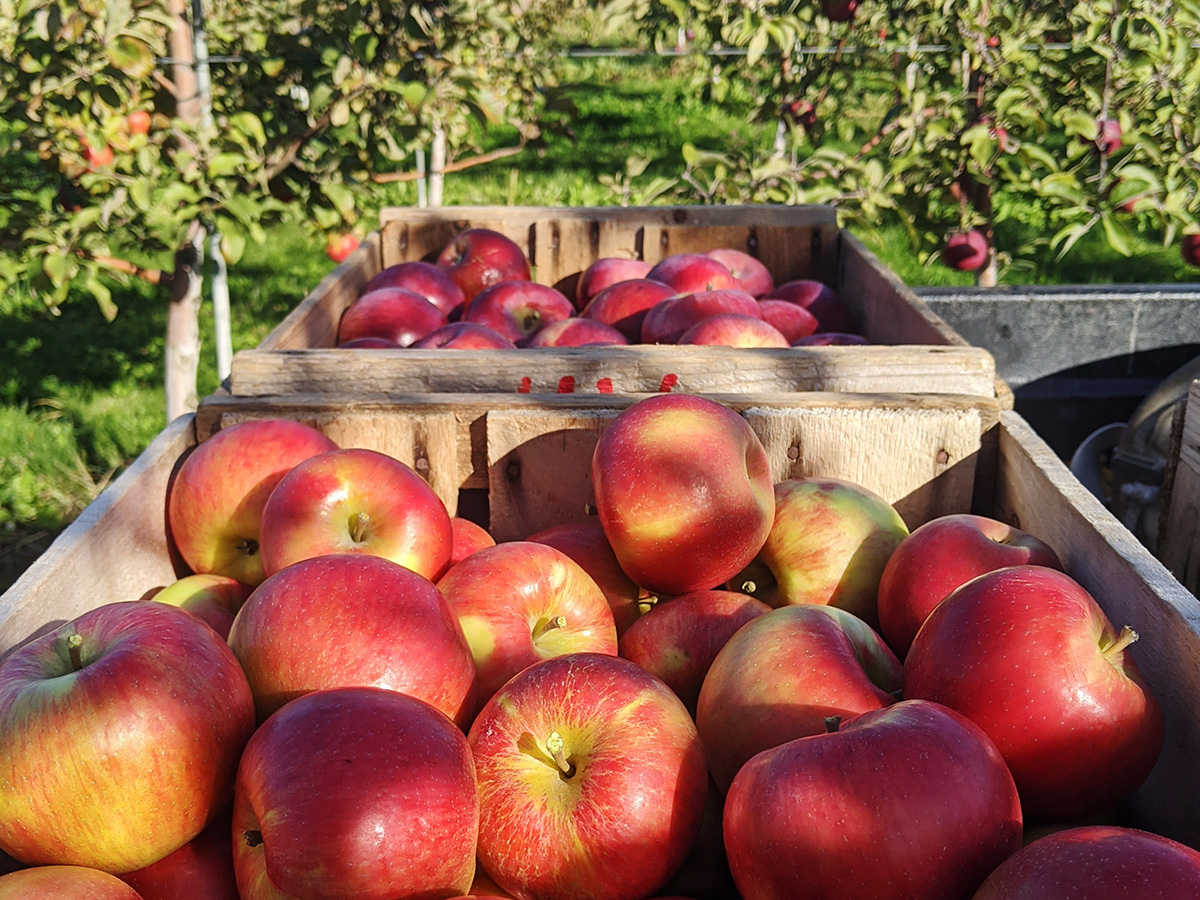
The Big Apple Project is harvesting and distributing apples to food pantries in Door, Kewaunee and Manitowoc counties throughout October, thanks to a collaboration between FoodWIse and the Door County Peninsular Agricultural Research Station.
The Big Apple
The Peninsular Agricultural Research Station sits on 120 acres off Highway 42 in Sturgeon Bay and is also part of the UW-Extension system. The station houses and maintains the NRSP-6 U.S. Potato Genebank, the world’s largest collection of wild and cultivated potato species. More than 150 species are represented.
It also acts as a field laboratory for developing pest control methods and conducting other research. Apples, cherries and grapes are a focus, and some small grain and vegetable research is also conducted there.
The station ends up with a substantial amount of apples every year, Apfelbeck said, and does not have the capacity to harvest, market or deliver them anywhere. Until this fall, the station would mostly try to sell the crop for deer bait, which was frustrating for staff, she said.
“There’s an emotional investment in growing food,” Apfelbeck added.
Part of the grant FoodWIse received from the West Foundation was $8,000 for harvest equipment, transportation and drivers to distribute the apples to Door, Kewaunee and Manitowoc food pantries. Pantries pay a nominal fee of $6 per bushel, or about 40 pounds of apples. Grow It Forward, a nonprofit, and Sullivan Family Farms (no affiliation with Sully’s Produce in Door County) provided the refrigerated transport to pantries. Both entities are in Manitowoc.
“Once we created the logistics, it took on a life of its own,” Apfelbeck said. “We were hoping for five pantries, now we have more than 17 organizations participating.” Two are school districts that will receive apples.
The Big Apple Project will continue delivering apples throughout October, and the initiative will happen again next year now that infrastructure is in place, she said.
Gathering Ground
Alessandra Rolffs talks a lot about local food webs and agricultural sustainability. Her husband, Russell will tell you everything you need to know about soil health, erosion and planting trees. Together with a handful of other Washington Island community members, they started Gathering Ground in 2017.
Alessandra is the executive director and Russell is the farm manager of the conservation and agricultural nonprofit. Its mission is to create “thriving communities connected to the environment and their food through work and play.”
Gathering Ground’s initiatives and programs are as varied as that mission implies. Sustainable agriculture, education and creating a healthy local food web all play a part, and according to Alessandra, there are countless ways to develop their mission.
The nonprofit sponsors a local farmers market, a community garden, a vineyard, a working farm, and conducts research on chestnut trees suitable for a Wisconsin climate in its orchard. Gathering Ground hosts workshops and classes for the community on how to enrich and maintain soil health, compost, plant vegetables, control pests, bake bread, make salsa, and many other topics.
Gathering Ground also works with the Island school, getting students involved in planting and harvesting. It maintains “Ground School,” a 10-week seasonal internship for young adults interested in conservation and sustainable agriculture, and hosts numerous community events throughout the year.
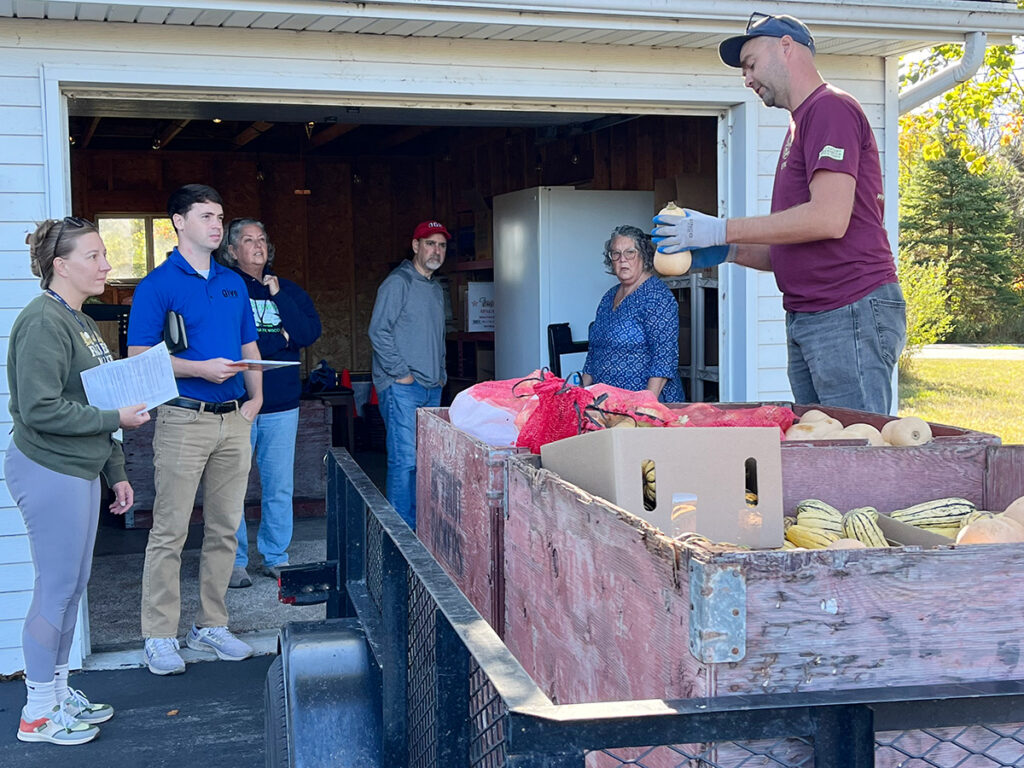
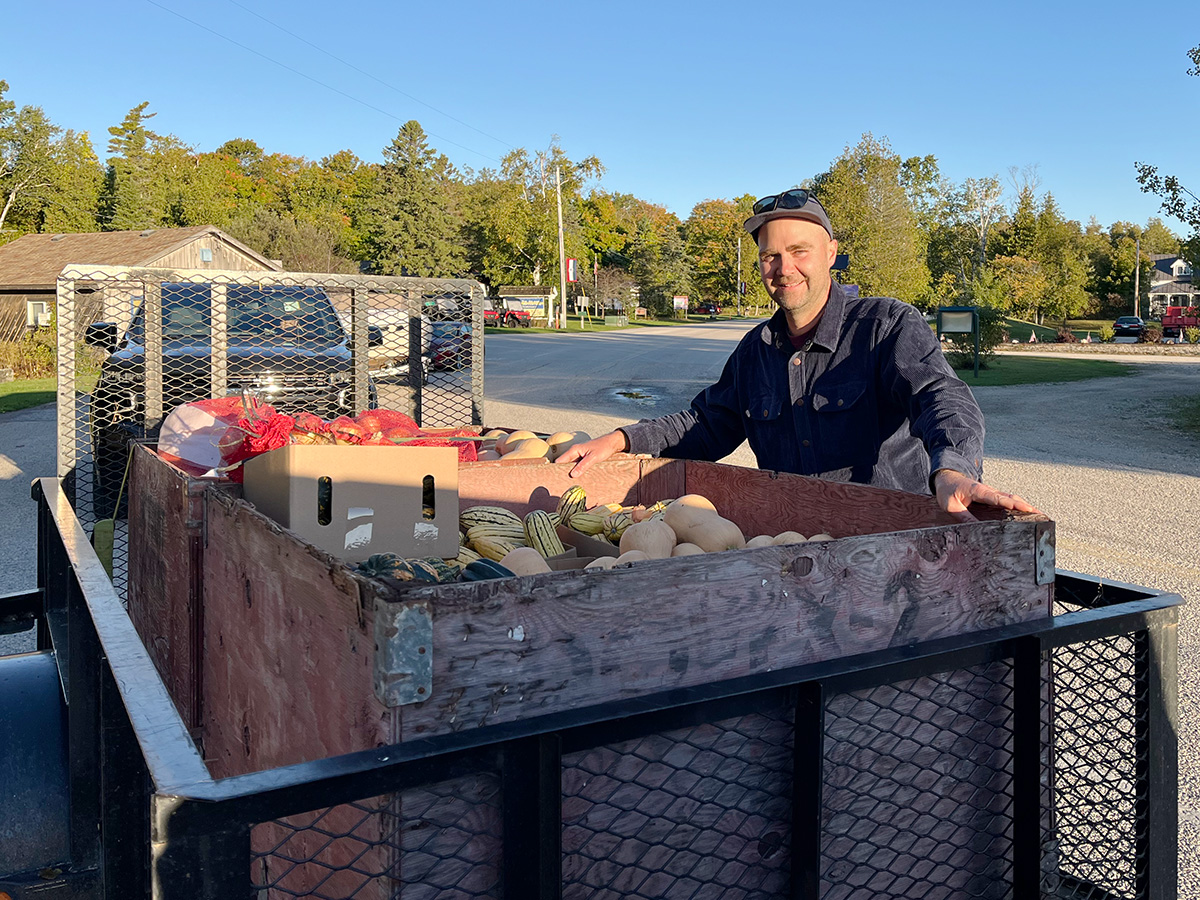
The nonprofit’s most recent initiative delivered almost 1,600 pounds of shelf-stable produce to Door County food pantries through a partnership with the Food Pantry Coalition. The crops were grown at Gathering Ground’s new site, the 40-acre Aznoe Farm on Washington Island, purchased earlier this year.
The new farm more than doubled Gathering Ground’s space. Only a few miles away is the nonprofit’s original 34-acre farm. That land was donated by the Lyons family who operated it as a vineyard for many years.
“We heard about funding being cut last spring,” Alessandra said, referring to USDA cuts to pantry food deliveries.
As a nonprofit farm, Gathering Ground did not want to compete with other Island farms by selling produce they grow while researching, educating and experimenting with sustainable agriculture practices, she said.
After talking to Dan Westbrook, the Washington Island pantry director, an idea was hatched to grow storage crops for donation that would be easy to share and move. Westbrook had already been working with Island growers to bring local produce to pantry customers.
Westbrook reached out to Peronto at the Community Foundation, and like the Big Apple Project, it took on a life of its own. In one season, on one acre, Gathering Ground grew enough shelf–stable produce to provide all ten pantries in the coalition with things like butternut and delicata squash, red, yellow and white onions, garlic and some potatoes.
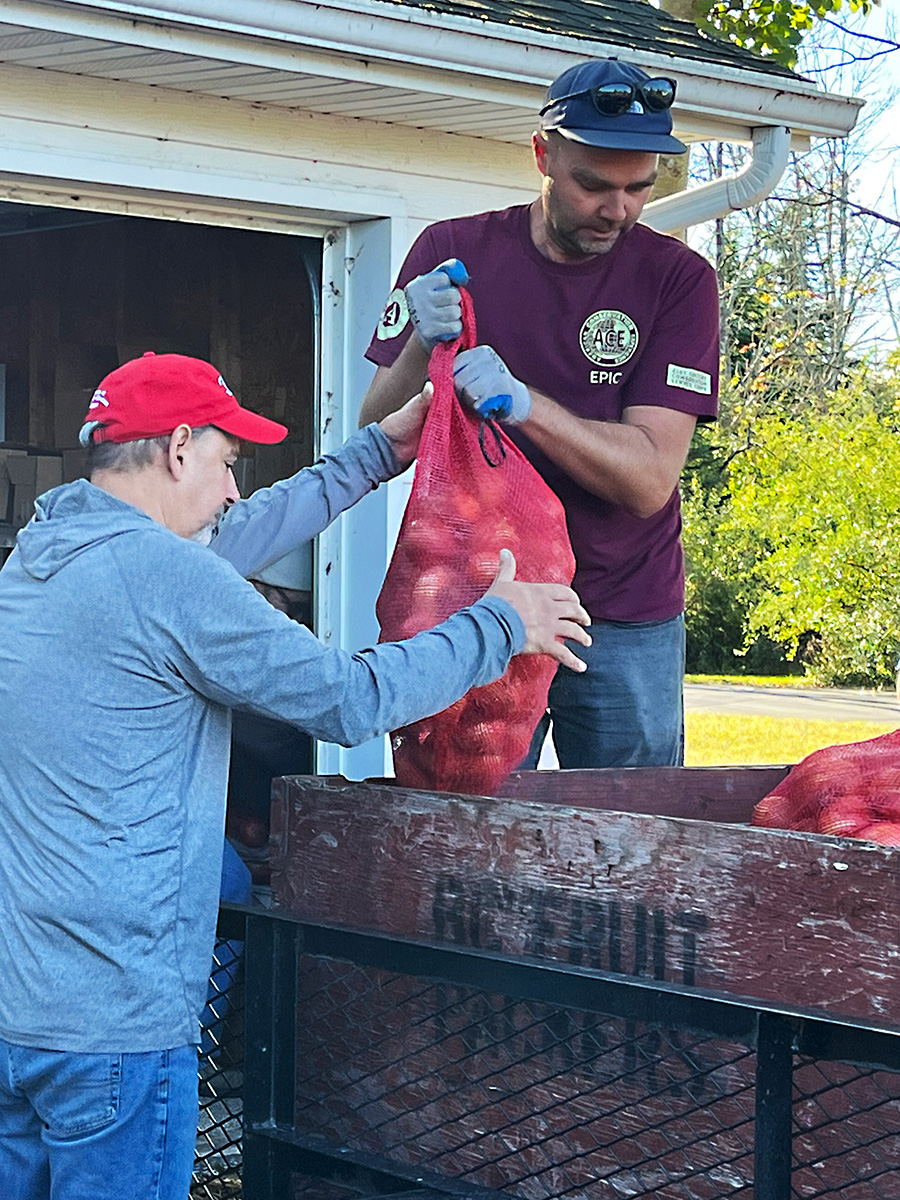
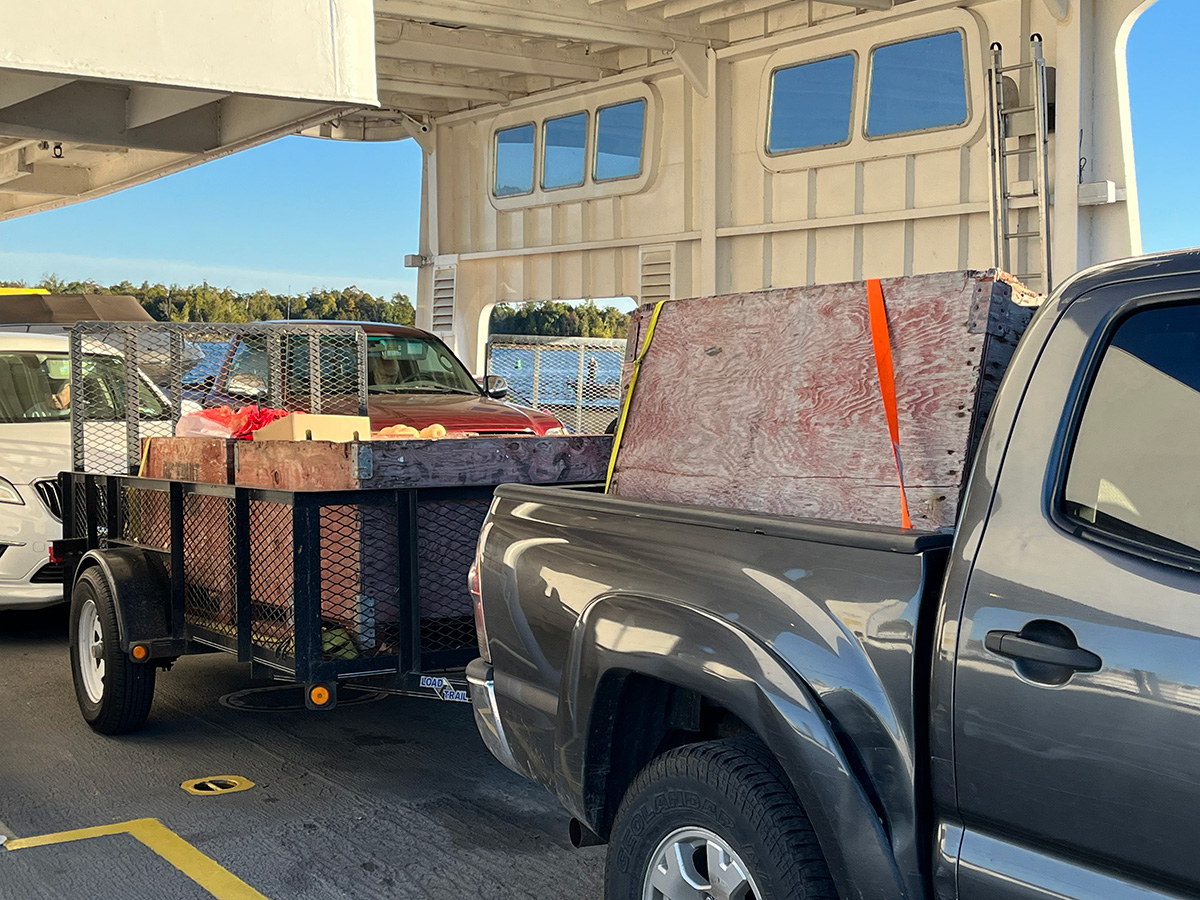
On Oct. 7, a truck and trailer full of food was ferried from Washington Island to the peninsula, and was taken to the Door of Life pantry in Sister Bay. Some of it will be stored there for monthly distribution to other pantries in the county. Coalition and pantry volunteers divided it up and delivered some to all the pantries in the coalition.
The Community Foundation and United Way also worked with the Gathering Ground initiative, providing volunteers and some of the funds necessary for transport. The Washington Island Ferry Line waived ferry charges for Russell and his truck and trailer to get the food to the mainland.
Gathering Ground provided recipe cards and education about the produce, which has been well-received by pantry clients, according to Peronto.
This kind of collaborative effort of pairing nutrition education with fresh produce to strengthen local food security illustrates Gathering Ground’s mission perfectly, Alessandra said. A local food web means “knowing where your food comes from, knowing the farmers who grew your food and having more choice and access to greater diversity of food.”
“One of the problems of the industrial food complex is that people don’t have a lot of choice. There’s so much processed food and if you don’t have access to land or a farmers market how do you get fresh vegetables full of nutrients? Industrially grown vegetables actually have less nutrition because soils are so depleted,” she explained.
Gathering Ground’s goals are more attainable than ever with the recent expansion, according to the Rolffs. The new property not only has acres of farm and woodland, but also has a five-bedroom farmhouse, an outdoor kitchen pavilion and a greenhouse. The farmhouse means lodging is available for interns, educators and workers. A kitchen for cooking classes and demonstrations, space for community gatherings–the sky is the limit, Russell said.
Future goals include growing more produce for pantries, holding food preservation classes, building a central location or food hub in Door County with cold storage, expanding the internship program to six months, starting agroforestry research, getting involved with more local schools and hosting more community engagement events like the recent “Farmtober Festival.”
The organization launched a fundraising effort this fall for these goals. “Planting for the Future” hopes to raise $1.1 million over the next five years. They have already raised $700,000 through the generosity of about 15 “lead donors,” Alessandra said.
Sustainable models and gratitude amidst increasing need
The pantry coalition has been the recipient of other local food initiatives, according to Peronto. This year, 11,000 pounds of salmon were harvested from Strawberry Creek, a DNR spawning facility. They were filleted, packaged and stored by Baileys Harbor Fish Company, and then distributed to pantries on a monthly basis.
The coalition recently worked with a pantry out of Green Bay, according to Peronto. They were also doing a salmon program, but instead of having filleted salmon, pantry clients were receiving a whole fish. This year the Green Bay pantry partnered with Blue Harbor Fish and Seafood to fillet and package the salmon to make it more accessible to clients.
“They modeled their effort after what we were doing,” Peronto said, which was gratifying to coalition staff and volunteers.
The coalition is also working on restarting a venison harvest program with the DNR, Peronto said. Local hunters who do not want the meat from their kills can donate it to the coalition instead.
Pantry client response to the Big Apple and Gathering Ground food has been overwhelmingly positive, according to Peronto and Lakeshore CAP Director Soik.
People are grateful to have healthy options, locally-sourced food and new produce that they are able to try and integrate into their families’ diets, Peronto said.
Soik concurred, and said that the apples and “gourmet” delicata squash have been especially popular.
Lakeshore CAP is the largest food pantry in Door County and one of the only coalition members that tracks pantry use, because they receive state and federal funding. Exact numbers of how many people use food pantries here in total is impossible to obtain, Peronto said, but staff and volunteers have a good sense of their pantries’ use.
Right now, all of them are reporting more use than ever and are going through food faster, he said.
CAP has had more than 500 visitors every month since April, except June and September, which saw only slightly fewer users, according to Pantry Director Soik. The pantry consistently sees new households using it every month. There were 17 new households at the highest point one month, and eight at the lowest month, she said.
For 2025, CAP is projected to have close to 8,000 visits, Peronto said. “That’s a lot.”
Overall, the coalition estimates pantries in Door County will have had about 15,000 visits this year, he added. This number is based on observation and amounts of food being used.
Those numbers are expected to increase in winter months, Soik said. Looming SNAP benefit cuts, healthcare cost increases, heating bills and seasonal job layoffs are all indicators that pantry use will go up even more over the next few months, she added.
Door County is a generous place, according to Soik, and private donors, other local growers, and partnerships with businesses like Walmart, Pick-N-Save and Kwik Trip help fill gaps, but pantries always need basics. They often need to purchase things like tuna, rice mixes, macaroni, and other dry goods, she said.
“Things that we don’t always get through food donations. We go through cases at a time,” Soik said.