



At a County Board meeting in August, Sturgeon Bay resident John Vincent made a request.
If the Wisconsin Department of Natural Resources were to hold an in-person public hearing to consider a local dairy farm’s expansion, he said, then “people impacted by this expansion will have the opportunity to look lawmakers in the eye, ask their questions, and be part of the process.”
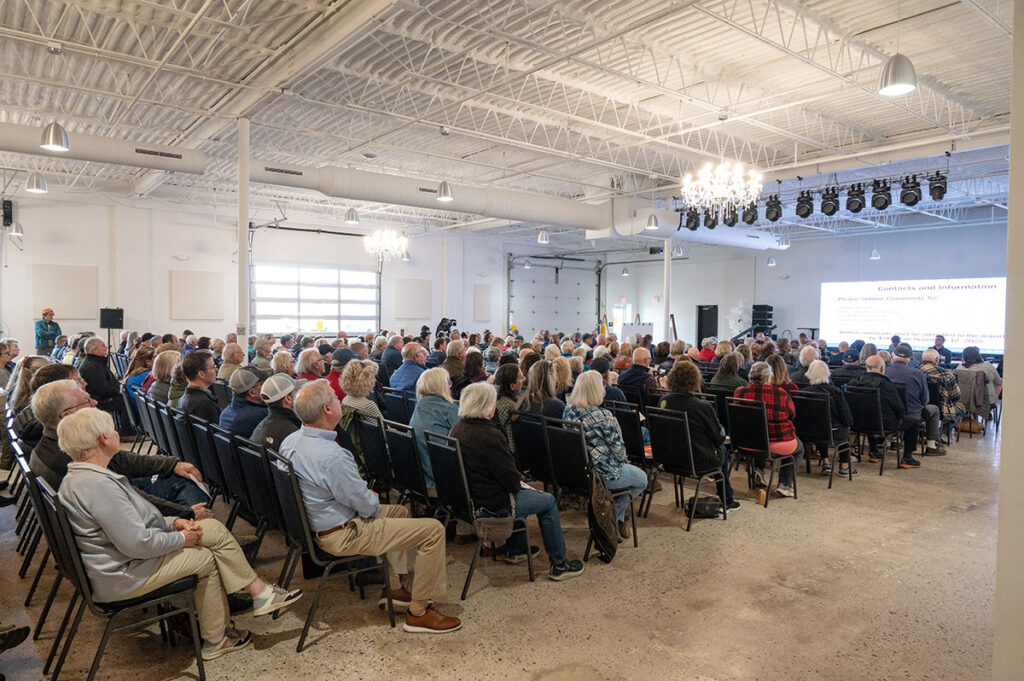
The DNR listened to Vincent and the more than 250 people who sent comments and requests for an in-person hearing. On Nov. 4, approximately 600 people, in person and virtually, attended the hearing regarding Gilbert Farms, Ltd.’s application for a Wisconsin Pollutant Discharge Elimination System permit, according to DNR representatives.
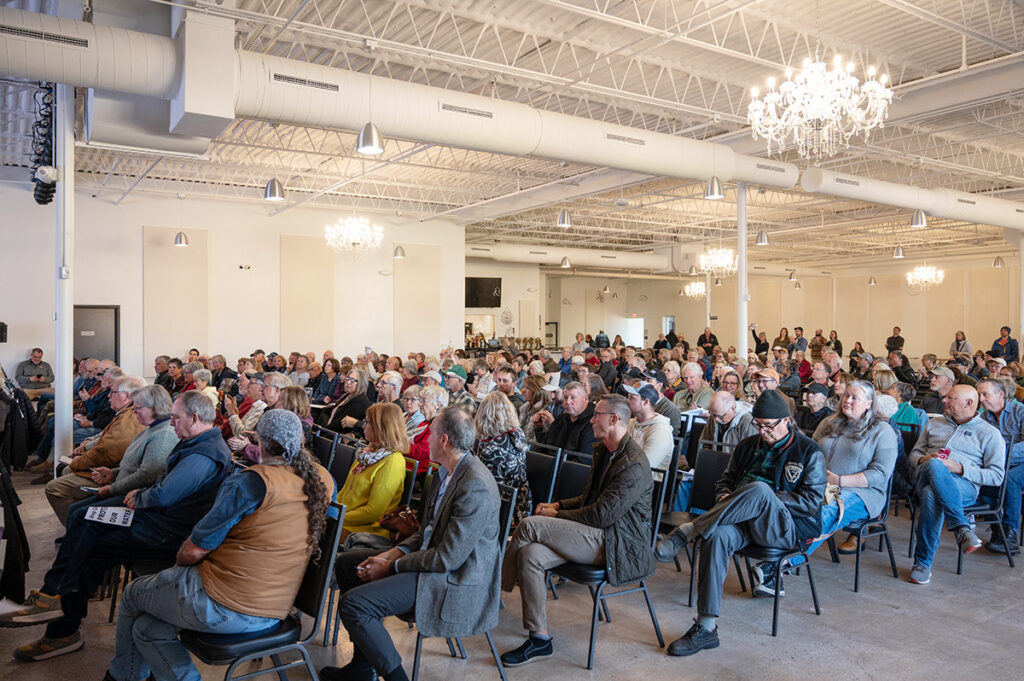
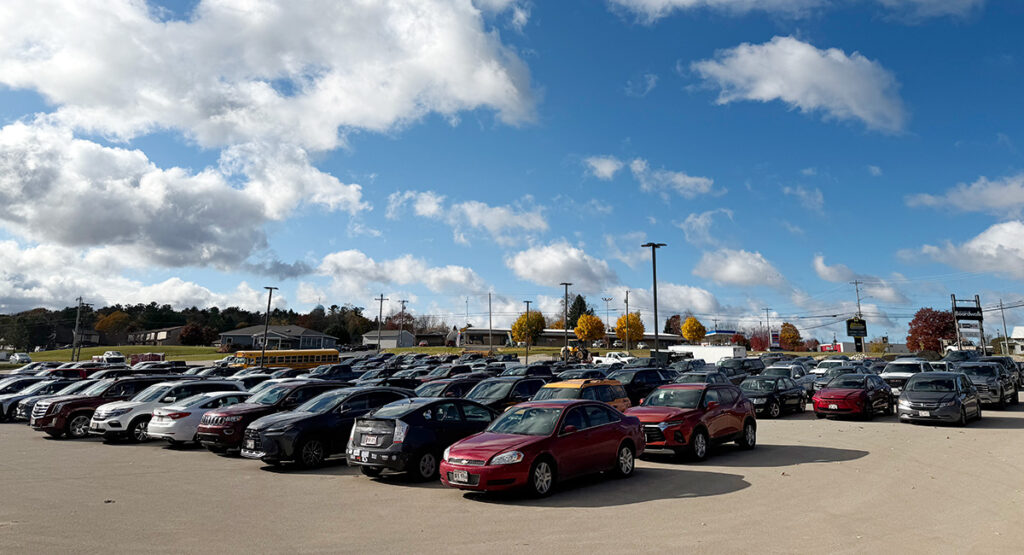
At least 63 of those in attendance provided comments during the hearing. The majority of them were opposed to the permit.
The three-and-a-half hour public hearing was the first to be held in person for a WPDES permit since before the Covid pandemic, and it received extensive coverage by local media.
The permit application itself drew widespread interest after it was posted on social media by members of Concerned Citizens for Responsible Agriculture, a group formed in response to the farm’s proposed expansion.
The application also drew criticism, as many people expressed concern about possible groundwater contamination from manure, and Door County’s fragile karst geology.
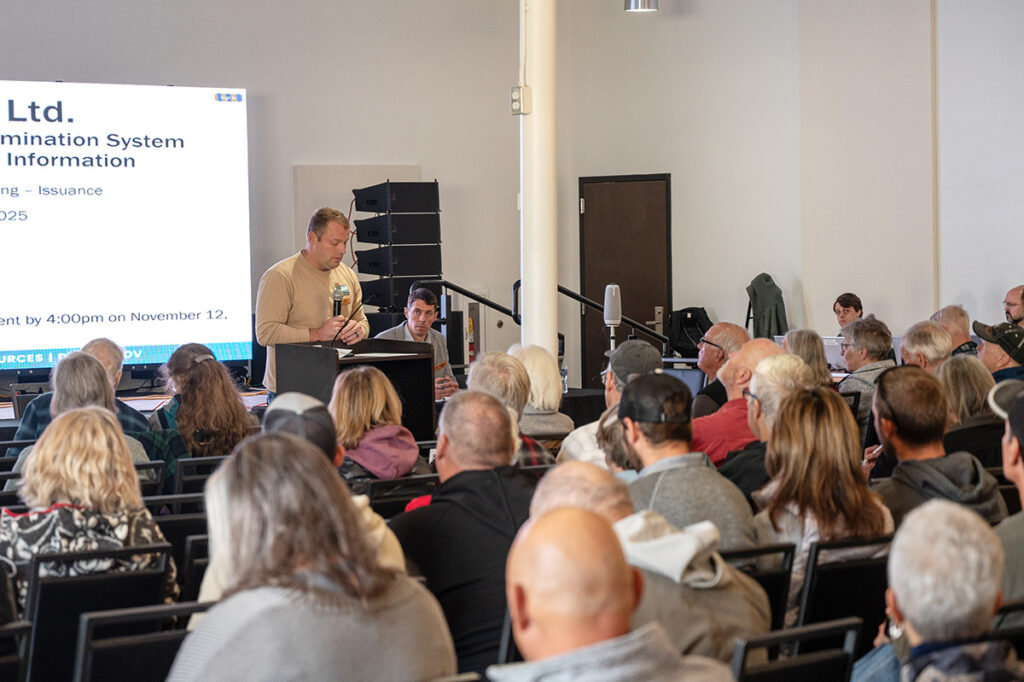
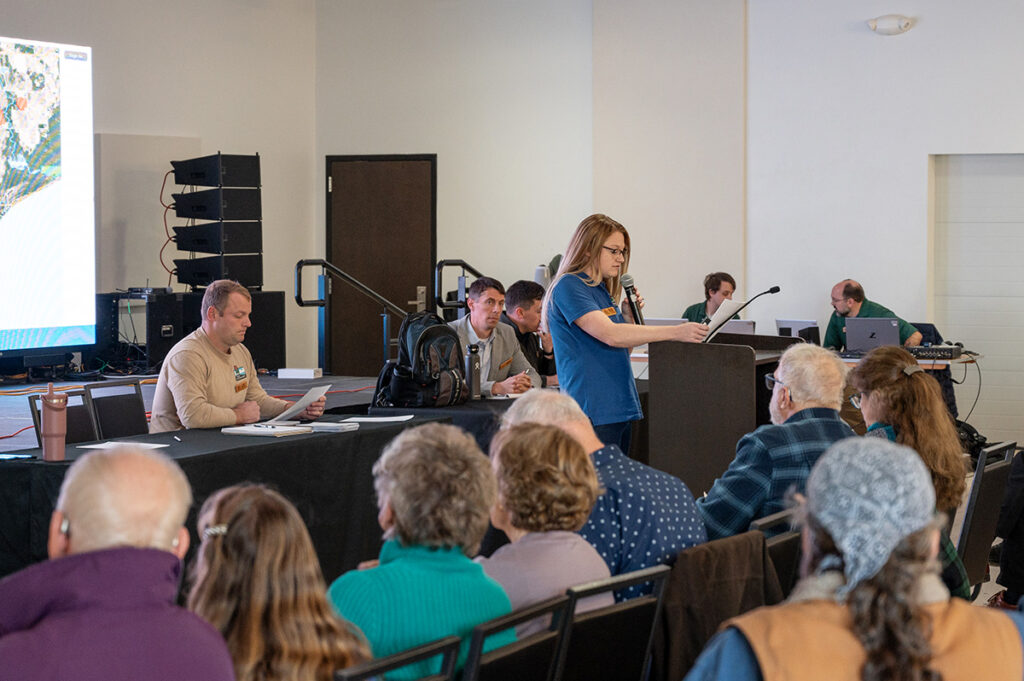
The event was held at Door County Gala in Sturgeon Bay. Brittiny Mueller, a DNR wastewater specialist responsible for overseeing the permit application, and Joe Baeten, a DNR natural resources basin supervisor, began the hearing with general information and an explanation of the permitting process. They then took five comments at a time from those attending virtually, followed by five in-person, until all comments were made.
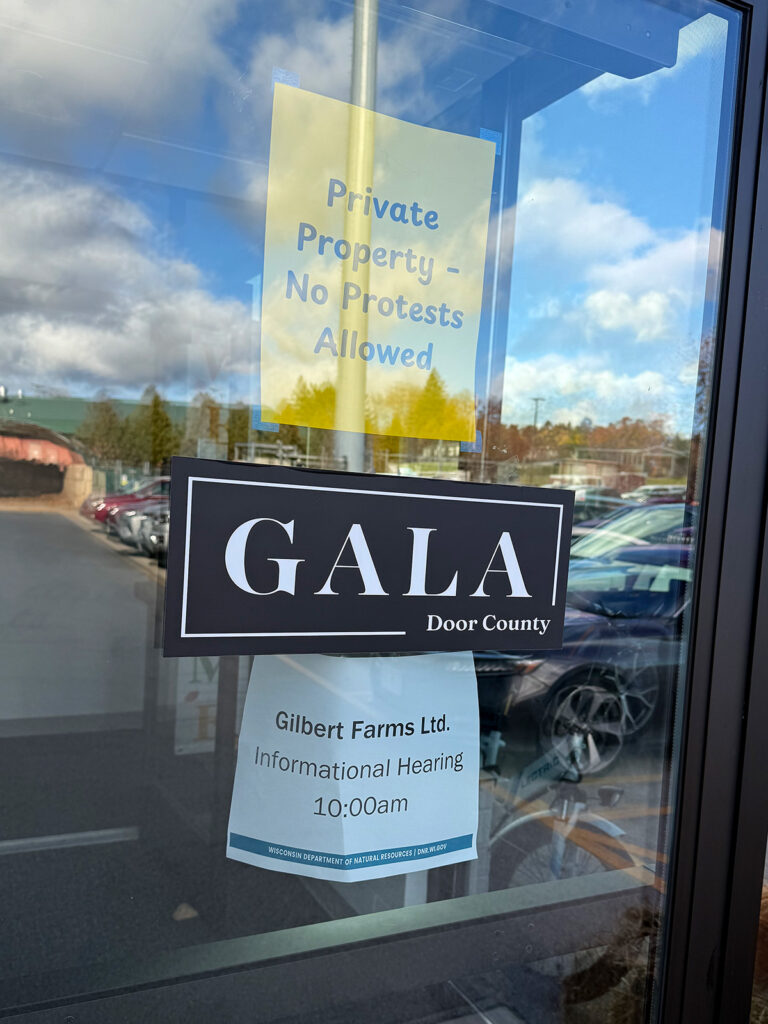
The DNR accepted written comments until Nov. 12 and will take a few months to organize and respond to comments and make its final decision, according to Baeten.
The owners of Gilbert Farms declined to comment on the hearing.
Public comment review process
The DNR received about 374 written comments, along with 63 at the hearing. Many of the people who spoke at the hearing also submitted written comments, and some people submitted more than one written comment, according to Mueller.
Mueller is responsible for oversight of all CAFOs in Brown, Door and Kewaunee counties, including WPDES permit applications like the Gilberts’.
All written comments are converted into a PDF, she explained, and are sorted by topic, and directed to the appropriate DNR specialist for response. For example, comments primarily concerned with groundwater monitoring will be sent to a hydrogeologist on staff, she said.
Anything that does not refer to a specialty area, like hydrogeology or engineering, goes to Mueller herself. Comments referring to anything the DNR does not have control over, such as air quality or traffic noise, are “set aside,” Mueller said.
Any oral comments from the public hearing that bring up concerns not reflected in written comments already are converted to text and sorted as well.
“We literally go through the comments one by one,” Mueller said.
Department staff respond to every comment individually, she said, before issuing a notice of final determination. The notice summarizes any changes made to the permit based on public input and describes the agency’s final decisions on permit requirements.
The DNR is focused on two things in the WPDES permitting process, Mueller said, and that is whether the applicant farm has sufficient storage and spreadable land for the wastewater they will produce as a CAFO. If the farm meets that criteria, their permit request cannot legally be denied, she added.
Mueller said she thinks it is important for people to understand that under its current status, Gilbert Farms does not receive oversight or inspection unless a complaint is made. If the WPDES permit is approved, the farm will be subject to regular inspection and monitoring, she said.
Public hearing comment breakdown
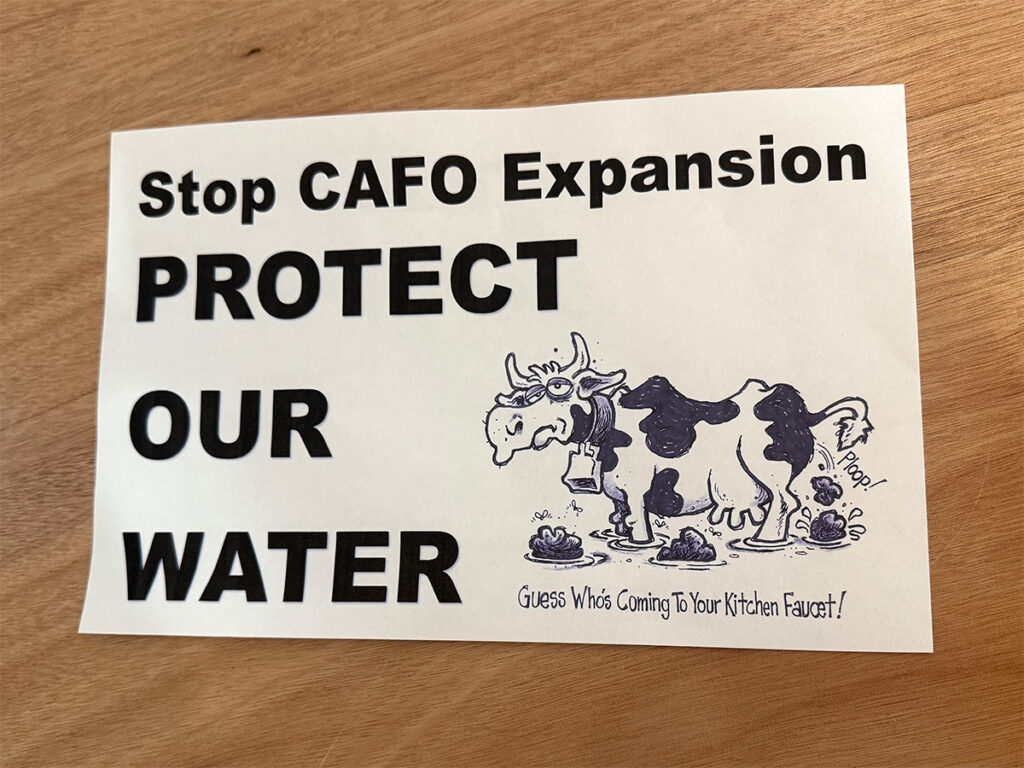
The majority of the attendees at the Nov. 4 hearing opposed the Gilberts’ bid to become a CAFO. Whenever anyone spoke against the permit, a large number of people cheered and held up signs that read “Stop CAFO expansion, protect our water.”
In order to qualify both public opposition and support for the permit, Knock combed through every comment from the hearing and analyzed them according to the speaker, specific concerns and issues raised. The results are as follows:
- 51 out of 63 comments expressed opposition to the permit.
- 15 of those 51 comments stated they were opposed to the permit “as written,” and indicated they would be more supportive if additional oversight and more requirements, such as an environmental impact study, were added to the permit.
- Seven people who were opposed identified themselves as members of environmental groups. The Clean Water Action Council and the Door County Environmental Council were represented, as well as Concerned Citizens for Responsible Agriculture, the group formed directly in response to the Gilberts Farm permit.
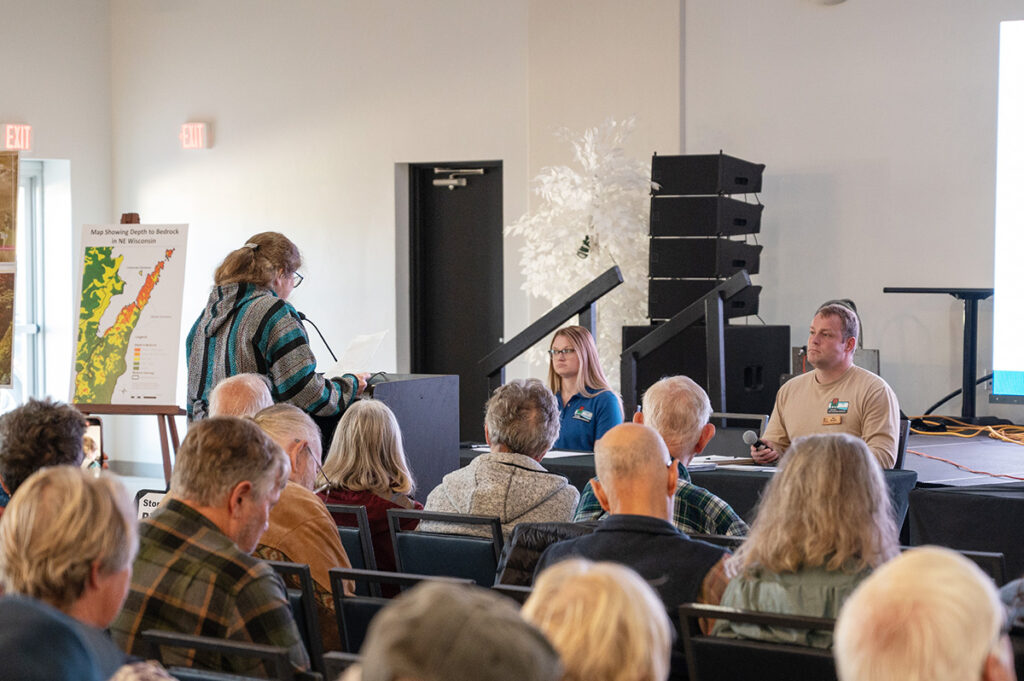
- Most comments in opposition cited a sinkhole located on the farm, Door County’s shallow bedrock and fragile karst geology, groundwater monitoring not being required until 2029, and the farm’s past noncompliance as the main reasons they were opposed to the permit.
- There were seven other reasons cited outside of the most common concerns. They included: lack of an emergency spill mitigation plan; other contaminants present in wastewater besides nitrates and phosphorous, such as antibiotics and agricultural chemicals; climate and other scientific data that shows current restrictions are not enough to protect groundwater; the presence of ecologically significant land like Crossroads at Big Creek and Kellner Fen nearby; surface water contamination leading to toxic algal blooms; and a decrease in property values near spreading fields and farm facilities.
- Two commenters against the permit issued calls to action, including a Kewaunee County resident who urged Door County residents to stop renting their land for manure-spreading. Another encouraged residents to call their county supervisor and demand the county develop a comprehensive environmental plan and change zoning laws to prohibit further agriculture expansion.
- 12 comments were in support of the permit, including one from Marge Gilbert, who commented virtually and is an owner of the farm.
- Nine of the comments in support were either from dairy farmers, or from people connected to the dairy industry. Three commenters in support of the permit were not affiliated with the industry.
- Six of the commenters in support of the permit cited the Gilberts’ track record of land stewardship and care for their animals as reasons the permit should be approved.
- Six comments in support of the permit also indicated the plan as written is more than sufficient to prevent groundwater contamination.
Voices from the hearing
Keith Bancroft, Kewaunee resident:
“For me, it’s frustrating looking back at the research and data, the science, that has been done over the years. Way back in 2007 there was the Northeast Wisconsin final taskforce report made up of over 30 DNR folks, scientists, county representatives from the surrounding counties, and their report identified spreading liquid manure on topsoils of less than five feet as being extremely dangerous. Even spreading on soils of less than 15 feet over this karst bedrock was dangerous to the groundwater. After that, we’ve had more studies from Dr. Muldoon at Oshkosh, the hydrologist, and Dr. Mark Borchardt, the USDA research scientist. Those studies have all identified that spreading liquid manure on soils of less than 20 feet is not good for public safety and protection of the groundwater. If you really want to protect the groundwater you need at least 50 feet of topsoil. The NR151 legislation that we got is totally inadequate, saying two feet. We need to follow the science.”
Marge Gilbert, one owner of Gilbert Farms Ltd.:
“Generational farming is a continuity of a legacy. We have learned from working with our family over the years that there is a wealth of practical knowledge and experience to be shared. Now we are all still learning and accepting technology that makes our day-to-day life on the farm easier and more efficient. As a family farm we work towards common goals and continue to build our legacy. Farms serve as both a business and a way of life. It gives us a sense of purpose, builds self reliance, creates a close knit community and provides deep fulfillment for all. We work with and support the other family farms in our community, and we see our neighbors as family too. If someone needs help we’re always there to lend a hand just like we have been for years. Our son Wade is that guy, all the other farmers call him, neighbors, if they need anything. And we are proud of his commitment and our commitment to our family and to our neighbors. It’s our wish that this sense of community go on for generations to come. We ask you approve the WPDES permit for our family farm. Thanks from Tim and Marge.”
Mike Grimm, conservation ecologist, Sturgeon Bay resident:
“The soils data is really about 50 years old, it’s 1976 mapping of these soils. I think that that is not adequate to get a good sense of what’s on the ground right now … I would oppose the approval of this permit application until we get some site specific current data as to soil types. And also that goes for the karst features information, that was mapped probably about 20 years ago by a UW-Green Bay professor and some students and staff from DCSWCD, and it was not a comprehensive inventory for the county. There are gaps. Those gaps need to be filled on a site specific basis on lands under consideration for this permit. The same can be said for the groundwater elevation maps … those are based on maps produced in the 1970s…those are really outdated. We need some good data so we can make good decisions …
We talked about groundwater monitoring wells, but there are three Great Lakes tributaries that serve as spawning habitats for northern pike, suckers and some salmonids, Lily Bay Creek, Big Creek and Shifting Sands Creek. I would urge some surface water monitoring of these systems be established as well as groundwater monitoring. I think we have to consider more adequately the constraints and limitations of this site for any kind of expansion at this scale.”
Mike Bruno, Gilbert Farms neighbor, Sevastopol resident:
“I’ve lived there for 32 years, and I’m a neighbor of the Gilberts. I also engage with them to manage my land and they also spread on my land. So I have direct experience I’d like to share with the audience and the DNR. I’m completely comfortable with the approval of an expansion. In fact I’m actually encouraged by that and there are several reasons why. Number one they have been excellent stewards of the land. I’ve raised my two children on this land, we drink the water. I pay attention to their compliance which has been one hundred percent completely in compliance with spreading. They also live here in the community, they drink the water, their grandchildren drink the water. I think there’s advantages that go beyond that. Our county wins when we protect the water, of course no one wants dirty water. I can understand some of the passion about that. ….
I know much has been said, there’s only 55 million dollars of farming contributions to the gross county product. That’s a call for me to support the farmers more. We do not have a diverse economy in Door County and I don’t think that’s a positive.
I’m also encouraged that with a CAFO designation the regulatory regime actually increases. I appreciate the efforts of the DNR overseeing and keeping our environment safe. I think that would give the DNR more tools to assess their compliance, and that’s excellent. It improves the resiliency of our county, and education opportunities. The Gilberts have always been really open and kind with local high school students visiting their farms, learning about agriculture. These people are good actors. We should support our community. We should support our neighbors. Of course we should protect our environment, but those things are not incompatible. So I stand in support.”
Kristin Mitchell, geologist, seasonal Door County resident:
“I was extremely disturbed when I heard the news of the CAFO coming, of this permit, and I am strongly opposed…I am aware of the very delicate groundwater situation with the karst topography. I became further disturbed when I heard there was a sinkhole nearby the facility that was going to be built in this expansion. I know as a geologist that’s a direct link into the water system.
It surprises me there hasn’t been an environmental impact study done, especially to understand the karst groundwater system underneath the Gilbert farm. I would request that, at a minimum, be done before this permit is approved, I would ask that the DNR would delay the approval until that study is completed … I did environmental studies for companies out in New York and it was crucial to have those monitoring wells in place before the permit is issued. That allows for when, not if, a spill does occur, you have a system already in place to deal with a spill.”